
Executive summary
The industry, regulator and other stakeholders have well-developed arrangements relating to the management of rolling stock risk. These include regulations, guidance and standards. With the introduction of new technologies, material developments and changes in operating practices, these arrangements will need to continue to develop and evolve.
Rolling stock encompasses self-propelled trains, traction units, multiple units, passenger carriages, freight wagons, and mobile railway infrastructure construction and maintenance equipment. The railway continues to operate a diverse range of vehicles across different operating environments, from conventional driver-operated railways through to increasingly automated systems. The safe operation of rolling stock depends upon effective design, risk assessment, maintenance and operational management throughout the vehicle lifecycle.
ORR views the following as the key current and future rolling stock challenges:
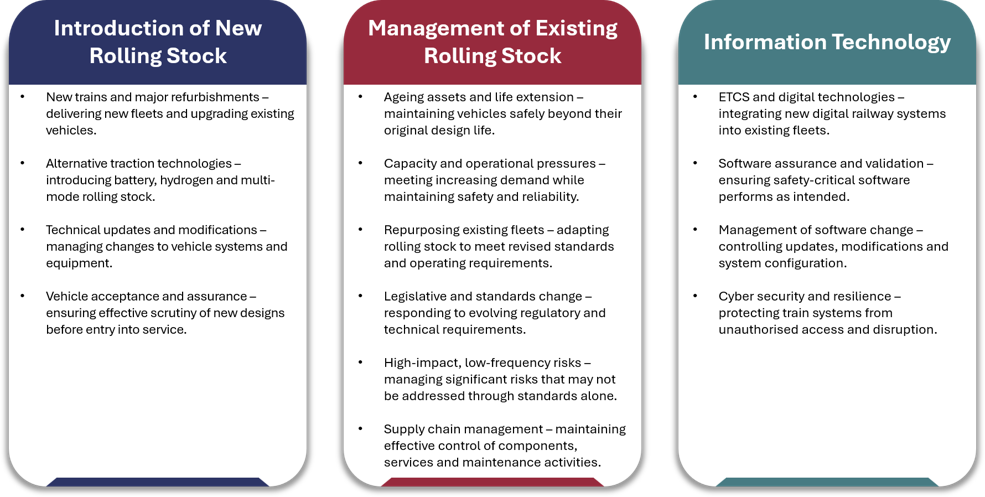
ORR will continue to use its range of inspection, enforcement and permissioning powers to influence industry to address these challenges. ORR will continue to work with industry to encourage consideration and implementation of health and safety by design from the earliest stages of project development, increased focus on engineering change, improved management of software and software-based systems, effective implementation of National Technical Specification Notices (NTSNs), and the adoption of emerging technologies where they can improve safety and performance.
ORR also encourages the development of new and novel rolling stock that manages risks throughout the operational life of vehicles, coherence between original design parameters and overhaul specifications, and continued improvement in Entity in Charge of Maintenance (ECM) arrangements and wagon maintenance management.
Dutyholders should ensure that risks associated with rolling stock are effectively identified, assessed and controlled throughout the vehicle lifecycle, including design, authorisation, operation, maintenance, modification and renewal.