
Maintenance and asset management
Most maintenance of rolling stock is governed by a vehicle maintenance plan specific to the type of rolling stock. These plans prescribe maintenance activities and frequencies, although variations may be required to reflect differences in operating conditions and service cycles. Any revision to Vehicle Maintenance Instructions (VMIs) should be subject to appropriate change control processes.
Some rolling stock operating on the mainline railway is nearing, or has exceeded, its original design life. Maintenance and life extension will therefore remain important challenges for the industry. Whilst appropriate maintenance can ensure continued compliance with original design requirements, older vehicles may not achieve the same safety performance as modern rolling stock, particularly in areas such as crashworthiness. When undertaking overhaul and life extension activities, duty holders should consider opportunities to improve safety and performance, particularly where concerns have been identified during operational service.
Maintenance improvement pathway
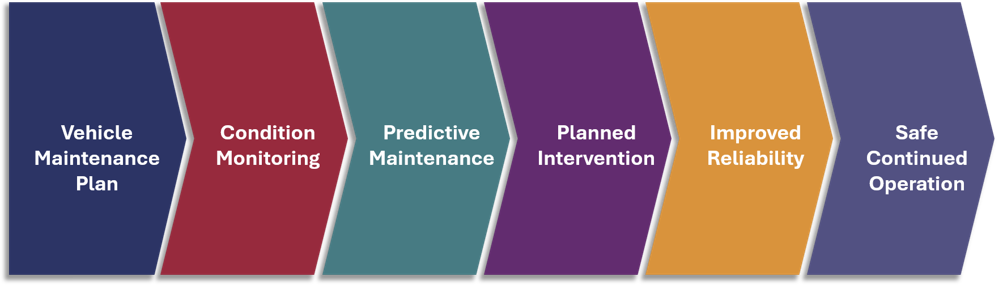
The adoption of modern technologies can support a more proactive approach to maintenance. Predictive and condition-monitoring technologies have the potential to identify degrading components well before failure occurs, allowing maintenance activities to be planned more effectively and reducing the likelihood of in-service failures. ORR encourages duty holders to consider opportunities to move beyond traditional maintenance approaches where these technologies can improve safety and reliability.
Despite established industry controls governing the supply of components and services, a significant proportion of rolling stock defects continue to be associated with supplied components, either when new or following overhaul. Effective collaboration with the supply chain remains important to improve reliability, understand recurring defects and develop longer-term improvement strategies.
The increasing use of automation and digital railway technologies may also influence maintenance requirements. Changes in vehicle operating characteristics, such as frequent transitions between traction and braking or repetitive operating cycles generated by automatic train operation, can alter wear patterns and affect component life.
Table 3: Future maintenance considerations
| Theme | Key Consideration |
|---|---|
| Ageing Assets | Managing vehicles operating beyond their original design life |
| Life | Considering safety improvements during overhaul and refurbishment |
| Predictive Maintenance | Using monitoring technologies to identify defects before failure |
| Supply | Improving reliability of supplied components and services |
| Automation | Understanding the impact of new operating patterns on component wear |
| Engineering Change | Ensuring modifications do not adversely affect maintenance requirements |
Particular attention should be given to modifications made to support automatic operation. The impact of these changes on vehicle dynamics, braking behaviour and component wear should be fully understood. For example, changes in braking profiles may alter wear rates and influence maintenance intervals. Maintenance regimes should therefore be reviewed whenever significant operational or technical changes are introduced to rolling stock.
Health and safety by design
The engineering design of rolling stock should address the majority of risks associated with its use, minimising the need for operational risk controls. Standards provide a starting point for a design that is broadly fit for use on the GB network, but they must be accompanied by a clear understanding of how the vehicle will be operated and the environment in which it will be used. An effective design process identifies and controls risks at the earliest opportunity.
Failure to consider the intended use of a vehicle can result in risks being identified late in the design process. This can lead to increased costs, delays to introduction into service, operational restrictions, and the need for additional operational controls to manage risks that could otherwise have been addressed through engineering solutions. In some circumstances, it can also lead to the withdrawal of rolling stock from service while solutions are identified and implemented.
For this reason, ORR promotes the application of health and safety by design principles, including effective planning, early risk identification, compliance with standards and adoption of good practice. Early consideration of lessons learned from previous projects and advice from operators can help reduce the need for costly late-stage modifications and improve overall project outcomes.
Further guidance is available in the health and safety by design strategic risk chapter.
Engineering change
Engineering change is the alteration of the function, performance or physical characteristics of a vehicle. It can introduce risk where the wider impacts of the change are not fully understood or effectively managed.
Engineering change may involve physical modifications to rolling stock, such as installing new signalling equipment, altering braking systems or replacing components. It may also include changes to maintenance methodologies, such as moving from time-based maintenance to condition-based or mileage-based maintenance regimes.
Duty holders should ensure robust change management arrangements are in place to assess the impact of proposed changes, identify associated risks and implement appropriate control measures. Effective engineering change processes are essential to prevent new risks being introduced into rolling stock systems and maintenance arrangements.