
Rolling stock systems and operations
In this chapter, the term rolling stock is used to cover self-propelled trains, traction units, multiple units, passenger carriages, wagons and mobile railway infrastructure construction and maintenance equipment.
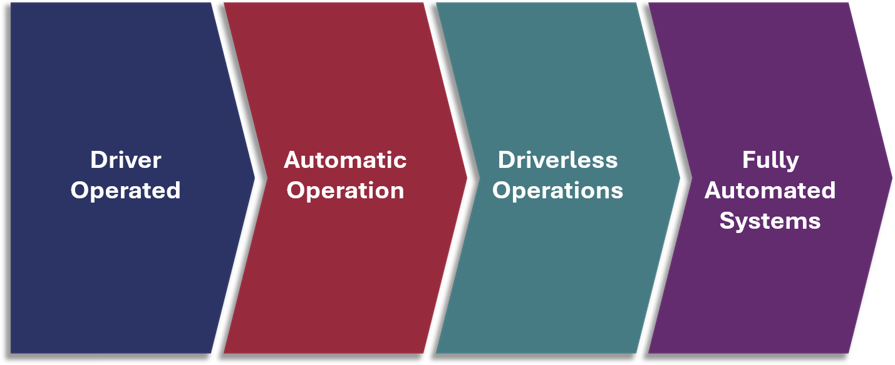
Different parts of the railway system often have different rolling stock challenges and issues to manage. These challenges are heavily dependent on the underlying railway operating systems, which broadly fall into four types depending on the extent of automation. These range from traditional rolling stock operated by a driver responding to signals, through to systems where automatic control is used for all or part of the journey, fully automatic trains operating under the control of central systems, and automated people movers where the entire operation is conducted without on-train staff.
Railway operating systems
Design, standards and safe operation
The safe operation of rolling stock is managed by a fit-for-purpose design supported by a robust risk assessment and, where required, the implementation of standards. For the mainline GB railway, compliance with some requirements is compulsory through obligations under the Railways (Interoperability) Regulations 2011 (RIR). The Regulations prescribe the use of National Technical Specification Notices (NTSNs) and National Technical Rules where applicable.
It is important to remember that conformity to NTSNs to meet obligations under RIR does not guarantee that safety obligations under ROGS or other safety legislation are met. Rail safety law requires entities making significant changes to the railway to apply the Common Safety Method for Risk Evaluation and Assessment (CSM REA), identify hazards and apply appropriate mitigations for the circumstances. This may identify that additional or alternative measures are needed to ensure the safety of rolling stock.
If the designer’s risk assessment processes are not sophisticated enough to identify gaps, a train that meets the NTSN may not meet the legal standard for safe operation under operational or geographically driven local constraints or freedoms. Risks identified should be assessed and managed through design so far as is reasonably practicable. The designer should identify and document residual risks that they are proposing to transfer and ensure that the operator or asset owner is fully aware of, and accepts, those risks. Similarly, the train operator needs to conduct a risk assessment at a sufficiently early stage, considering and, if necessary, challenging risks identified by the designer that are proposed for transfer.
Further guidance is provided in the health and safety by design strategic risk chapter.
Safe introduction of rolling stock

New or significantly upgraded rolling stock must be authorised before it is placed into service on the GB mainline railway. Rolling stock authorised in an EU member state requires additional authorisation before entering service in Great Britain. GB-specific requirements for safety and technical compatibility must be met regardless of whether an authorisation has been issued elsewhere.
ORR has a specialist team of professional engineers who support inspectors in the oversight of train operators and the rolling stock they operate. The team is responsible for authorising new, upgraded and renewed rolling stock and provides guidance on the authorisation process under RIR. ORR also carries out inspections to ensure operators apply the principles of the Risk Management Maturity Model (RM3) when managing the systems that underpin the safety assurance of rolling stock.
Freight wagon safety
Freight wagons play a critical role in the movement of goods across the railway network. Their safe operation depends on effective maintenance arrangements, appropriate loading practices and the management of the interface between vehicles and infrastructure. Failures in any of these areas can increase the risk of derailment, disruption and environmental damage.
In recent years, there has been an increase in the number of freight wagon derailments. Causal factors have included offset loads and locked wheelsets that increase the propensity to derail, particularly on twisted track or at crossings. While correct loading remains essential, the interaction between wagon condition, loading configuration, adhesion and track conditions can significantly influence derailment risk.
Investigations into freight derailments at Llangennech, Ferryside, Llanharan and Petteril identified locked wheelsets as a major contributory factor. The RAIB report into the Llangennech derailment found that a mechanical separation between the interfaces of the brake relay valve and the distributor resulted in a partial brake application, leading to a locked wheelset. Low adhesion is also considered a significant factor in the development of wheel flats and subsequent derailment risk.
The industry continues to develop technologies capable of identifying emerging defects before component failure occurs. This includes trackside equipment designed to identify unequal wheel loading across axles and other conditions that may indicate an increased risk of derailment. Such technologies have the potential to provide early warning of developing defects and support more effective maintenance interventions.
Software and digital safety
Software interacts with multiple subsystems within and beyond the train itself, interfacing with mechanical and electrical systems. Modern railway systems are increasingly dependent on software and there have been instances where software changes have introduced problems to wider train systems. Software changes could impact safety-related systems and therefore require effective management throughout the system lifecycle. The application of robust cyber security measures is important to prevent unauthorised access to train systems.
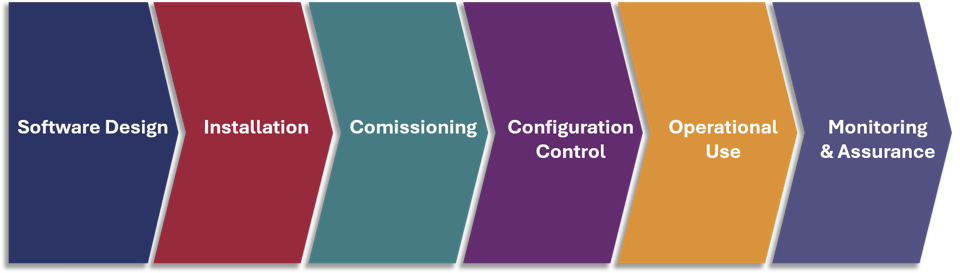
Increased use of Train Service Agreements, whereby the manufacturer undertakes maintenance of the fleet on behalf of the duty holder, could lead to the import of risks. The duty holder remains responsible for managing those risks and must ensure that suitably competent personnel maintain visibility of changes being made and their interaction with other train systems and subsystems.
Following a number of safety incidents involving software-based systems in operational use on the railway, where software faults were found to be a contributory factor, RSSB established the High Integrity Systems Group (HISG) to commission research into the use of high-integrity software. This work informed the development of GEGN 8650, which has since been replaced by RIS-0745-CCS Client Safety Assurance of High Integrity Software-Based Systems for Railway Applications.
ORR encourages duty holders to implement relevant industry standards and good practice when developing, modifying and maintaining software-based systems. As software, digital technologies and connected systems become increasingly important to railway operation, the industry will need to continue developing the skills, competence and assurance arrangements necessary to manage associated safety and cyber security risks.
Further information is available in the digital safety strategic risk chapter.
Adhesion and braking performance
The performance of rolling stock braking systems is critical to the safe operation of the railway. As rolling stock evolves, potential risks need to be identified, understood, and managed.
Whilst incidents due to brake equipment/component failure have become less common in recent years, there have been a number of precursor events which have mainly been caused by issues relating to safety critical brake systems and components.
Reliable braking performance has become more important since the introduction of the European Train Control System (ETCS). It is essential that there is predictable braking performance to enable the on-train computer to determine safe speeds and thus deliver full automatic train protection (ATP). There is further work to be done to optimise algorithms and ensure that the duty holders apply the system intelligently to maximise benefits.
ORR acknowledges the development of innovative wagon technologies, including systems designed to prevent wheel flats, which have the potential to enhance safety, reduce maintenance costs, and mitigate the risk of similar incidents in the future. Engineering controls such as these that prevent wheel slide should be considered by freight operators.
In response to the need to improve adhesion in both traction and braking, the GB rail industry has elected to install on-board sanding systems to mitigate the effects of low adhesion. The use of sanding controls, including Double Variable Rate Sanding (DVRS), should be considered, particularly on busy routes where there is a need to maintain high volume of trains. The need for automatic train operation brings challenges to achieve dependable braking.
To meet these challenges the industry will need to innovate and understand the impacts of new technologies and systems. Electro-magnetic track brakes and eddy current brakes are alternative braking technologies that are now in use in several European countries.
As these technologies develop and more information is gathered from successful implementation, the industry should continue to assess the suitability and viability of these and other approaches to address low adhesion conditions in line with the Rail Technical Strategy. The wider implications of low adhesion are discussed in detail in the strategic risk chapter on interface system safety.
Train door safety
Train door-related incidents remain a significant safety concern. The two principal risks are trap and drag incidents, where a door system fails to detect an obstruction, and passengers stepping or falling from incorrectly opened doors. Whilst door technology continues to improve, effective procedural controls remain essential to manage residual risk and to ensure safe train dispatch.
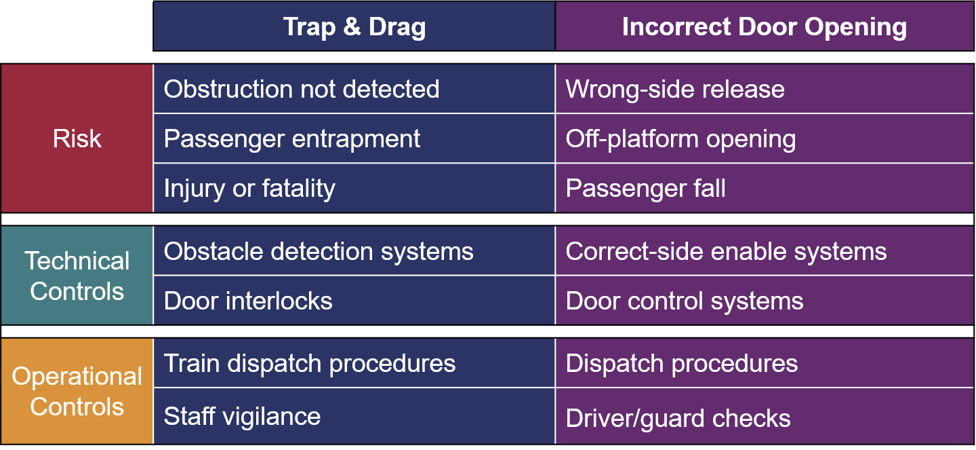
There have been issues with obstacle detection systems on some passenger fleets which have required modifications to door systems. For this reason, ORR continues to encourage the industry to improve door systems, including the adoption of new technology where reasonably practicable.
However, increasing reliability of door systems should not lead to reduced vigilance. Procedural controls remain an important safeguard where safety depends on train dispatch activities and human intervention.
Passengers may also be exposed to risk if doors are opened incorrectly, including opening on the wrong side at stations, outside platform limits or outside station areas. ORR continues to support the development of correct-side door enable systems to reduce these risks.
Particular risks remain on charter and heritage operations involving MK1 and MK2 coaches without central door locking. Hinged doors may open whilst a train is in motion, creating risks to passengers on board and people standing on platforms.
Historical rail vehicles
The heritage sector is diverse and includes heritage vehicles, historic rail vehicles and other older vehicle types operating on both standard and narrow gauge railways. It continues to grow and, by its nature, relies on rolling stock operating well beyond its original design life. Heritage organisations and operators of older vehicles therefore need a clear understanding of asset condition and effective safety management arrangements to identify and control risk so far as is reasonably practicable.
Many heritage railways operate former mainline vehicles which typically require more intensive inspection, maintenance and overhaul than modern rolling stock. The challenge is often compounded by difficulties obtaining replacement parts and retaining the specialist engineering skills needed to inspect, maintain and repair ageing equipment.
Table 1: Key challenges facing historic rail vehicles
| Challenge Area | Key Risks and Considerations |
|---|---|
| Ageing Assets | Corrosion, wear, fatigue and deterioration of structures and components |
| Skills & Competence | Retaining specialist knowledge to inspect and maintain ageing traction and carriage stock |
| Parts & Materials | Obtaining replacement parts and suitable substitute materials |
| Engineering Change | Managing risks arising from repairs, modifications and replacement components |
| Legacy Hazards | Asbestos, slam doors and droplight windows |
| Modern Equipment | Introduction of newer traction and rolling stock technologies into the heritage sector |
Maintaining expertise within the sector is an increasing challenge. Whilst arrangements for managing the risks associated with steam and diesel locomotives are generally well established, the capability to manage the risks associated with ageing carriage stock is less mature, particularly regarding inspection, structural integrity and long-term asset management. ORR continues to work with the Heritage Railway Association (HRA) to encourage the development of guidance and good practice in these areas.
Historic rail vehicles often contain hazards associated with older designs and construction methods. Many items of traction and rolling stock built before the 1980s contained asbestos. Although much of this has been removed, some vehicles may still contain asbestos-containing materials and operators must maintain suitable management arrangements to control the risks to workers and the public.
Table 2: Legacy safety risks
| Legacy Feature | Principal Risk | Typical Control Measures |
|---|---|---|
| Slam Doors | Passenger falls and accidental opening | Door locking systems, dispatch procedures and operational controls |
| Droplight Windows | Passengers leaning out of moving trains | Engineering controls and window restrictions |
| Asbestos | Exposure during operation, maintenance or restoration | Asbestos management plans and controlled removal programmes |
New build and reconstructed vehicles
There is a growing trend to build new heritage-style vehicles. These include new builds and the assembly of parts from existing vehicles to form another vehicle. Any new vehicle (whether a new build or assembled from parts from existing vehicles) must demonstrate it is safe to use before it enters service. Depending on the intended use of the vehicle, there are a number of approaches to determining the appropriate level of assessment. They include compliance with original standards, comparative assessment and evaluation from first principles.
Whilst ORR has no formal role in approving new build vehicles for operation on the heritage networks, we will maintain oversight of them and engage with heritage railways to encourage a level of assessment commensurate with the intended operation. We expect that projects can demonstrate use of approved designs and that change from the original designs are effectively considered and assessed.