

1.1 The Office of Rail and Road (ORR) is a non-ministerial government department, accountable to Parliament. One of our statutory roles, established in the Infrastructure Act 2015 (the Act), is to independently monitor National Highways (the company), the appointed strategic highways company for the strategic road network (SRN) – the motorways and major A-roads in England. The company has statutory duties to manage, operate and improve the SRN. Our role is to assess the company’s performance and efficiency, investigate and where necessary take enforcement action and ultimately hold it to account to fulfil its duties on behalf of road users, taxpayers and the wider public.
1.2 This document sets out our approach to undertaking this statutory role. It explains how we undertake routine monitoring and assessment, enhanced monitoring and, where needed, enforcement. It sets this within the context of our statutory duty to undertake our activities in a way that is transparent, accountable, proportionate, consistent, and targeted only at cases where action is needed
1.3 This document supersedes and replaces the policy issued in March 2020 and takes effect from 1 April 2026. It incorporates changes made as a result of the consultation we ran from 1 August to 26 September 2024.
1.4 A glossary of terms used in this document is provided on the webpage to aid clarity and transparency.
Strategic objective
1.5 We have a corporate strategic objective to secure better highways:
1.6 In defining our strategic objective, we are clear that our role is focused on benefiting all those who use, or are affected by, the SRN.
1.7 Our statutory monitoring powers extend to all National Highways’ functions. We hold the company to account for its delivery in a way most likely to promote efficiency and performance. Our priority is to secure its compliance with the road investment strategy (RIS) and statutory directions and guidance (SD&G), including its licence – delivering what government has asked for and taxpayers are funding.
1.8 We aim to provide robust, transparent and independent reporting that meets the needs of all stakeholders and empowers them to effectively check and challenge the company, complementing our own work. Our holding to account also informs our advice to the Secretary of State for Transport (‘the Secretary of State’) to support the setting of future RIS, along with our ongoing programme of benchmarking work. It further supports our accountability to Parliament, including by laying our annual assessment of the company’s performance.
Our statutory role
1.9 Our role originates in Roads Reform (see the chapter introduction above) as part of a new framework to improve the management of England’s SRN to drive economic growth, boost innovation, and give roads users more for their money. Our role is defined in the Act.
1.10 Paragraphs 1.17 to 1.28 explain in more detail the key features of the Roads Reform framework, roles, duties and responsibilities of the named parties and the key documents that support it.
1.11 We have two main legal duties:
- to monitor how National Highways is carrying out its functions. This may include investigating, publishing reports, giving advice to the Secretary of State and directing the company to provide information (section 10 of the Act); and
- determining whether National Highways is compliant with the RIS and SD&G, including the company’s licence (section 11 of the Act).
1.12 If we are satisfied that National Highways is non-compliant with the RIS and/or SD&G we can take enforcement action in the form of issuing a notice and/or a fine (section 11(2) of the Act). Chapter 4 explains this in more detail.
1.13 We must exercise our functions in the way that we consider is most likely to promote the performance and efficiency of National Highways (section 12(1) of the Act).
1.14 In exercising our statutory functions, we must have regard to:
- the interests of users of highways;
- the safety of users of highways;
- the economic impact of the way in which National Highways achieves its objectives;
- the environmental impact of the way in which National Highways achieves its objectives; and
- the long-term maintenance and management of highways (section 12(2) of the Act).
1.15 We must also have regard to the better regulation principles. These are that we undertake our regulatory activities in a way that is transparent, accountable, proportionate, consistent, and targeted only at cases where action is needed (section 12(3) of the Act).
1.16 In undertaking our statutory role, we can direct National Highways to provide such information as we consider necessary (sections 10(3) to 10(6) of the Act).
How what we do fits into the wider framework
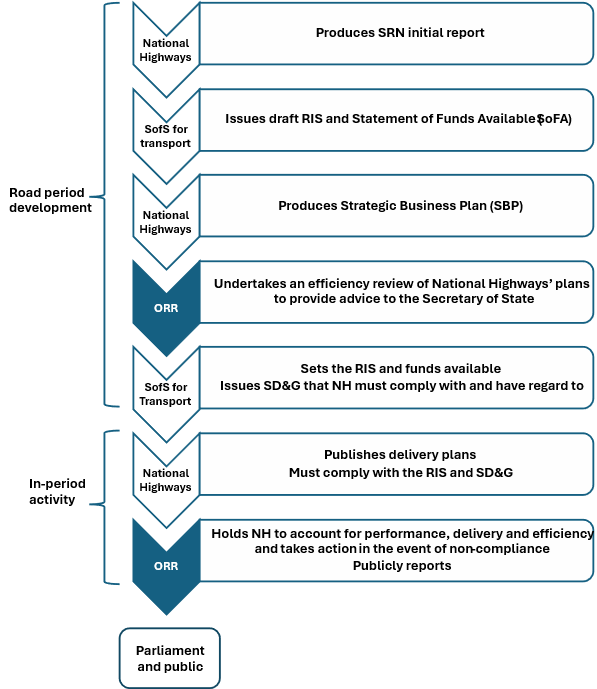
1.17 Figure 1.1 illustrates how our role fits into the wider Roads Reform framework.
Figure 1.1 ORR’s role in the wider framework
Role of the Secretary of State and the department
1.18 The Act refers to the Secretary of State for Transport (‘the Secretary of State’). In practice, officials in the department administer policy on behalf of the Secretary of State, while the Secretary of State remains ultimately accountable (the Carltona principle or doctrine).
1.19 The Secretary of State has the responsibility for setting, varying and publishing the RIS (section 3 of and Schedule 2 to the Act) and issuing any SD&G (section 6 of the Act) to National Highways:
- the RIS must specify the objectives to be achieved by National Highways during the road period to which it relates and the financial resources to be provided by the Secretary of State for the purpose of achieving those objectives. The Secretary of State must follow the process set out in the Act to set or vary a RIS and they must have regard to any advice that we provide (section 10(7) of the Act); and
- SD&G may be issued at any time and for any reason related to how National Highways must (for directions) and should (for guidance) exercise its functions under the Act. SD&G must be published by the Secretary of State in such manner as they consider appropriate. The company’s licence is issued as SD&G.
1.20 The department undertakes its role in two ways:
- client (including setting future RIS) – it is the client for National Highways. This means that, as set out above, it specifies what it wants the company to deliver and provides the funding for the company to deliver it. As the client, the department wants to ensure that what it asked for is being delivered and to ensure that it has appropriate oversight of how much the company has spent for what output.
It can specify changes to its requirements and adjust the funding available. It has well established and understood mechanisms in place to ensure it has effective oversight of Tier 1 enhancements projects (typically over £500m, or novel, contentious or repercussive projects, and are subject to higher levels of scrutiny and oversight by the department and His Majesty’s Treasury); and - shareholder – the shareholder team acts on behalf of and takes direction from the Secretary of State for Transport, as sole Shareholder, and the Department’s Principal Accounting Officer (PAO) and Senior Sponsor for National Highways. It provides advice on holding the Board to account for its stewardship of the Company and manages the Department’s corporate relationship with National Highways to ensure there is a capable, effective, and empowered Board and that organisational objectives are aligned between the Responsible Minister’s priorities and the Company’s priorities. It also supports the PAO in discharging their responsibilities with respect to the Company.
1.21 We work closely with the department in the exercise of our respective statutory functions. Our role is fundamentally to ensure that National Highways delivers what the Secretary of State has specified and taxpayers have paid for and to take action in pursuit of achieving that objective. We provide advice and assurance to the department to support its policy and decision-making with regards to the setting of the RIS and any other relevant matter(s).
1.22 ORR and the department endeavour to ensure that the company is not unduly burdened with duplicative reporting or excessive requests for data and information. We do this by specifying requirements that are clearly linked to our role as set out in the Act.
1.23 More widely, government makes policy. It is responsible for taking policy decisions that affect National Highways. While the department is responsible for making roads policy, other government departments can and do make policy that affects the company’s statutory duties and how it undertakes them. Other government agencies or regulators may have overlapping or complementary powers and responsibilities in these areas. This is explored further insofar as it relates to our role and how we hold the company to account in paragraphs 1.27 to 1.28.
Transport Focus
1.24 Transport Focus’ role is to act as a ‘watchdog’, with a statutory duty to protect and promote the interests of users of the SRN. It may investigate, publish reports or give advice to the Secretary of State on how National Highways’ exercise of its functions or achievement of its objectives under a RIS affects users of the SRN, or any other matters that it considers to be of interest to those users (section 9 of the Act).
1.25 Transport Focus commissions the collection of the Strategic Road User Survey (SRUS). This provides data that informs our holding to account against National Highways’ commitments as regards user satisfaction. It also commissions bespoke studies investigating a wide variety of issues related to road users’ experience, for example, road signs, litter, and accessibility. We engage with Transport Focus regularly; seek its feedback on relevant reports and give it advance sight of publications.
Key documents
1.26 The functions and interactions of the key documents that sit beneath the Act and support the Roads Reform framework are as follows:
- RIS – sets out what the Secretary of State expects National Highways to deliver over a road period and the funds available to deliver it. We hold the company to account to deliver this (sections 3(6), 10(2) and 11(1)(a) of the Act);
- National Highways’ licence – issued by the Secretary of State as SD&G. It sets out how the company must act in carrying out its functions. We hold the company to account to comply with (or have regard to, as the case may be) this (sections 6(3), 10(2) and 11(1)(b) of the Act);
- National Highways’ strategic business plan (SBP) and delivery plan – the company’s plans setting out how it will deliver the requirements in the RIS. The delivery plan is updated annually. We hold the company to account to deliver this (condition 6.25 of its licence);
- Other SD&G – the Act permits the Secretary of State to, from time to time, give National Highways SD&G as to the way it is to exercise its functions. For example, in 2025-26 during an interim period in which there was no RIS the Secretary of State issued SD&G (an ‘interim settlement’) to the company setting out what it expected it to deliver and the funding available. SD&G may be published in such a manner as the Secretary of State considers appropriate. We hold the company to account to comply with (or have regard to, as the case may be) this (sections 6(3), 10(2) and 11(1)(b) of the Act);
- National Highways’ framework document with the department – contains the framework within which the company can fulfil its purposes and carry out its functions with appropriate operational independence while providing assurance for taxpayers. The framework sets out how the governance and decision-making responsibilities of the company are exercised in the context of a public sector body and the responsibilities placed on its Accounting Officer.
The framework does not convey any legal powers or responsibilities. It is not a legal or contractual document, but both parties agree to operate within its terms. The framework also sets out the department’s roles as shareholder and client, how it will work with ORR and Transport Focus to not duplicate work and ensure that relationships work effectively and efficiently; - Statutory guidance from the department and HM Treasury to ORR – issued under section 13 of the Act, it contains information as to how the department sees its role as client and shareholder where those roles interact with ORR and how it wishes ORR to engage in those circumstances. It states that ORR should have a clear policy for how it will undertake enforcement action. We must have regard to this guidance in performing our statutory role; and
- Memorandum of understanding (MoU) between ORR and the department – the MoU is non-binding. It sets out the relationship between the two parties, provides further detail as to ORR’s role and the behaviours expected of ORR and National Highways. It contains information about the sponsorship of ORR within the department, information as to how and when ORR’s roads funding will be agreed and at a high level, for what purposes it may be spent.
Other departments, agencies and regulators
1.27 While the department is responsible for making roads policy, other government departments can and do make policy that affects National Highways’ statutory duties and how it undertakes them. Further, other departments, agencies or regulators may have overlapping or complementary powers and responsibilities in these areas.
1.28 Two important areas where there are complementary responsibilities and regimes are the environment and safety:
- Environment: we hold National Highways to account for the named targets and commitments in the RIS) and SD&G, including conditions in its licence. Other bodies hold regulatory, enforcement or other responsibilities relevant to the company’s environmental responsibilities. We rely on the competent authority to inform us if the company is not meeting its environmental duties in their areas if such a failure might result in it being non-compliant with its licence. Conversely, if we or consultants that we appoint discovered potential concerns about compliance with legal duties in the course of our work, we would refer these to the relevant competent authority; and
- Safety: ORR is not the safety regulator for the SRN. Our safety role under the Act is to hold National Highways to account for the named targets and commitments in the RIS and SD&G, including conditions in its licence. Other organisations have statutory responsibilities for workplace safety, road traffic law enforcement, vehicle standards and local road safety. Their work may inform our understanding of safety on the network, while maintaining our own independent monitoring role.
What we look at and how we do it
1.29 So far, this chapter has explained our statutory role, set out in the Act, and how what we do fits in with the roles and purposes of other parties such as the department and National Highways. The remainder of the chapter explains at a high level how we undertake our role, why we do it that way and the sorts of things we look at. Chapters 2, 3 and 4 then go into further detail of our routine monitoring and assessment, enhanced monitoring and enforcement activities in line with the overall approach illustrated in Annex A.
1.30 Our statutory monitoring powers apply to all National Highways’ functions. In practice, we prioritise our holding to account activity on those matters that we consider have the most impact on road users, taxpayers and communities, and do so having regards for the regulatory principles set out in paragraph 1.46. These are mainly set out in the performance specification and investment plan sections of the RIS (see (a) and (b) below), and/or in SD&G.
1.31 We also scrutinise delivery of National Highways’ plans as set out in its SBP and delivery plan (including annual delivery plan updates). Alongside this we monitor its financial performance relative to the Statement of Funds Available (SoFA) – the funding that government has made available to deliver the RIS:
- RIS performance specification – this sets out the Secretary of State’s expectations for National Highways and the SRN in each road period and measures performance through a range of metrics consisting of key performance indicators (KPIs), performance indicators (PIs) and requirements or commitments. In most cases, numerical targets are set for KPIs. We monitor the company’s performance against these targets and its delivery of the requirements or commitments. Where KPIs do not have associated targets, we monitor and report on them and form a judgement on performance.
PIs are untargeted metrics. They enable us to scrutinise more aspects of the company’s performance beyond the headline KPIs. We use data and information from the company and others to support our assessment of the company’s performance in delivering the specified outcomes; and - RIS investment plan – we hold National Highways to account for the delivery of its major schemes portfolio (enhancements and large renewals) in line with the agreed baseline and scope. The investment plan also sets expectations of the company in maintaining and renewing the SRN and delivering designated funds. We monitor these areas to ensure that the company has the appropriate processes in place to plan and deliver the required outcomes, set by the department. We seek to understand the reasons for any slip in delivery schedules, outputs or outcomes and how the company will remedy them.
1.32 As set out above (paragraph 1.26(b)), National Highways’ licence, issued as SD&G, sets out how it must act in carrying out its functions. We assess National Highways’ compliance with its licence partly through its delivery of the RIS and we look into other areas of licence compliance as appropriate, including by commissioning assurance reviews from independent third parties. We meet with the company regularly to discuss its self-assurance of its licence compliance and to check and challenge the evidence it holds in support of this.
1.33 The RIS takes into account the levers available to National Highways and is set on the understanding that the company will achieve targets to the greatest extent reasonably practicable. We determine compliance accordingly, applying our judgement in line with the principles set out in paragraph 1.46.
RIS targets, plans and commitments
1.34 In line with the better regulation principles (below) and to ensure that our approach is targeted and proportionate, having due regard to the need to minimise administrative burden, we tailor our approach to the requirements written in the RIS. There are three broad categories – targets, plans and commitments.
1.35 Targets – we require National Highways to report to us against the targets set out in the RIS. The company must tell us if it is off track to deliver a target and to take action to course correct. We work with the company to understand the underlying reasons as to why it might be off track and how it can address it. Where it is off track for reasons outside its control we work with the company and the department to determine whether the target should be changed to better reflect what the company can achieve using the levers within its control and the environment it is delivering within. We expect the company to demonstrate, with suitable, high-quality evidence, its proposal(s) for change. We regularly report performance against targets and any in-year changes in our annual assessment (paragraph 1.51).
1.36 Plans – sometimes the RIS (or SD&G) contains a requirement for National Highways to develop and deliver a plan for a specific purpose, usually to demonstrate compliance. We may approve or agree such a plan and/or advise the department on the quality and deliverability of a plan that company has produced to deliver the requirements which the department has set for it. We determine the appropriate approach on a case-by-case basis, usually in discussion with the department.
To limit ambiguity and interpretation between the parties, we expect plans to contain clear, time bound activities against which we can hold to account on behalf of road users and taxpayers. These activities should be able to demonstrate how they achieve specific outcomes and/or outputs aligned to the RIS and its wider commitments. We report delivery against these plans, including in our annual assessment of the company’s performance and annual report of safety on the SRN.
1.37 Where plans are explicitly intended to support the delivery of targets, we would require the evidence provided by National Highways in developing the plans to show how much they would contribute to this outcome and demonstrate in its delivery. Unless explicitly stated in the RIS (or SD&G) that the delivery of a plan is an acceptable alternative to delivering a target, we would treat the two as separate requirements.
1.38 Chapter 3 provides information about plans that we may require National Highways to produce as part of enhanced monitoring. These are often called improvement plans and are different to those specified in the RIS and/or SD&G.
1.39 Commitments – these tend to be in the form of a narrative requirement for National Highways to achieve something. This can range from developing new metrics to undertaking research to improving its capability in specific areas. We expect the company to translate these commitments into clear, time bound deliverables in its delivery plan that demonstrate progress against which we can hold to account on behalf of road users and taxpayers. We provide updates on the delivery of commitments in our annual assessment on a case-by-case basis.
Additional requests on National Highways from the department
1.40 Our statutory monitoring powers apply to all National Highways’ functions. From time to time, the department asks National Highways to undertake or deliver work that is not specified in the RIS or the company’s current delivery plan and asks ORR explicitly to hold the company to account to deliver it. Where a request or requirement from the department is not included in the RIS or SD&G issued under section 6 of the Act, we can engage all our statutory powers short of enforcement. This leaves open to us the approach and all the tools and levers set out in chapters 2 and 3. We endeavour to be transparent as to what the department has asked of the company and what we are expected to hold to account for.
How we treat ranges and tolerances
1.41 Ranges and tolerances are tools for managing uncertainty and risk that are expressed in different ways:
- a range is typically expressed as an upper and lower value where a point target is uncertain (for example, between 90-110); and
- a tolerance is typically expressed as a point estimate, plus or minus a certain magnitude (for example, 100 ± 10%). Compared to a range, a tolerance includes a clear reference point for performance.
1.42 Where a RIS includes ranges and/or tolerances around performance targets or delivery numbers, we consider those requirements individually. We look at:
- the precise wording and intent of the RIS and the evidence underpinning the basis on which any range or tolerance was set; and
- what National Highways has set out in its road period and annual delivery plans as to what, based on its internal data and evidence, it expects to deliver/achieve in-year.
Our primary statutory duty is to promote National Highways’ performance and efficiency (paragraph 1.11). We have regard to this when determining how to effectively ensure that the company is achieving what is expected and what constitutes compliance with the RIS. We would expect to set out our specific approach to determining compliance in writing to the company at the start of the road period.
How we apply the better regulation principles
1.43 As described above, and in more detail in chapters 2 and 3, we support Roads Reform by undertaking our statutory role to promote National Highways’ performance and efficiency in a way that is outcomes focused and does not inhibit the company’s operational independence and approach to delivery.
1.44 This means that we prioritise our resource on the requirements from the department, set out in the RIS and SD&G, that we determine and deliver outcomes that matter to users of the SRN and funders. We aim to identify and resolve issues early before they impact those outcomes.
1.45 This approach reflects two of the better regulation principles to which we must have regard under the Act: proportionality and taking action only where it is needed. We have explained these further below alongside the other principles. We balance these principles at a strategic level and on a case-by-case basis as part of our holding to account activities. From time to time, we must make trade-offs between the principles. We do this with a view as to what would secure the best outcome for users in line with our wider statutory duties to act in a way most likely to promote the performance and efficiency of National Highways.
1.46 In undertaking our statutory role, we are guided by the following principles:
- transparency – we set out clearly our analysis, our decisions and the reasons for them. We consult on and publish our key policies and keep them under review to ensure that they remain fit for purpose. Chapter 4 sets out how we apply transparency to our statutory enforcement – this includes being clear with National Highways and publishing the outcome of our decisions. We also promote greater transparency on the part of the company and encourage it to be open about what it is doing and what it intends to do;
- accountability – we are accountable to the public for our actions through Parliament and the courts. We have an obligation to comply with the rules of administrative law and good public administration. Ultimately, our decisions are subject to judicial review and scrutiny by the courts;
- proportionality – as a general principle, we focus our resources and priorities on sustained failure to deliver outputs, or on individual events of material significance, rather than one-off or localised failures. This is because some measures of performance may be subject to variability over short periods of time.
For example, delays, or the time taken to clear incidents, may fluctuate from day to day, or be subject to seasonal variability. In other cases, the significance that we attach to National Highways missing a deadline or target may be influenced by the impact it has on users, funders and/or other relevant stakeholders. We do however consider where one-off failures may form part of a wider systemic failure and may act accordingly; - consistency – this means, as far as possible, taking a similar approach in similar circumstances to achieve similar ends. We do this through the application of published policies and agreed processes. In deciding on a course of action we have regard to any guidance from the Secretary of State and HM Treasury. We also consider our duty and balance those factors that are set out in the Act; and
- targeting action only where it is needed – we target our routine monitoring and assessment, enhanced monitoring and enforcement at those areas where an issue, such as potential non-compliance, has been identified and is material to delivery of the RIS and/or SD&G. As set out in more detail in chapter 4, where enforcement is concerned, we target our activities at those areas where non-compliance has been established and where action is needed.
Independence
1.47 As set out at paragraph 1.1, we are a non-ministerial government department, accountable to Parliament. This means that we see our independence as a vital aspect of our role. Being independent helps to ensure that our analysis, advice and decisions are based on objective evidence and are not subject to changing government policy. Our independence provides assurance to all stakeholders that our holding to account of National Highways is evidence-based, fair and unbiased.
Assuring our work
1.48 ORR’s governance arrangements support the quality of our outputs. The ORR Board sets ORR’s strategic direction and oversees the executive’s delivery, providing scrutiny and challenge of our advice to the Secretary of State. The Highways Committee (a committee of the ORR Board) advises and supports the Board on matters relating to National Highways and the Strategic Road Network, in line with its terms of reference.
1.49 Our monitoring, reporting, advice and decisions must be based on the best available evidence, high-quality analysis and robust processes. Chapter 2 explains further about the quality assurance we expect from National Highways as regards the data and information it provides to us.
Transparency
1.50 Our public reporting provides transparency on National Highways’ performance, delivery and efficiency to Parliament, stakeholders and the wider public. Our reporting is intended to:
- incentivise National Highways to perform, deliver and be efficient;
- hold National Highways to account to deliver the RIS and comply with SD&G;
- support National Highways, road users and wider stakeholders by reinforcing positive performance, timely delivery and efficiency savings while preventing and tackling poor performance, under delivery and lack of efficiency; and
- encourage and support National Highways to be innovative and facilitate the spread of best practice across the sector.
1.51 As a minimum, we publish an annual assessment of National Highways’ performance, delivery and efficiency. This report is laid before Parliament. We also publish an annual report on the safety of the SRN. Where appropriate, we publish reports from third party expert consultants that we appoint to undertake deep dives into areas of National Highways’ capability, performance and delivery and advise us on areas for improvement (paragraph 3.23).