

Asset sustainability declined beyond expected levels due to renewals reductions.
Network Rail must maintain and renew its assets in an efficient and sustainable way, while ensuring the railway remains safe and operational in the short and long-term. In control period 7 (CP7), asset sustainability is assessed through the Composite Sustainability Index (CSI), which reflects modelled changes in asset condition over time, taking account of renewals, enhancement and maintenance activity.
Network Rail’s latest forecast indicates that the end of CP7 CSI target is unlikely to be met in England & Wales and is likely to be outperformed in Scotland. Overall asset sustainability in England & Wales is expected to reduce by 2.7% during CP7, compared with the target of 2.5%. This reflects further deferrals and descoping of renewals across England & Wales, as a result of constrained renewals funding, as explained below.
Composite Sustainability Index end of CP7 targets and latest forecast (percentage change from the end of CP6)
| CP7 Target | Latest forecast | |
|---|---|---|
| England & Wales | -2.5% | -2.7 |
| Scotland | -2.1% | -1.6% |
| Network-wide | -2.5% | -2.5% |
Each Network Rail region has CSI targets for the end of the control period. Provisional CSI figures for Year 2 indicate that Eastern and Wales & Western are likely to fall short of their targets.
Composite Sustainability Index end of CP7 targets and latest forecast, by Network Rail region (percentage change from the end of CP6)
| Region | CP7 Target | Latest forecast |
|---|---|---|
| Eastern | -2.0% | -2.6% |
| North West & Central | -3.2% | -3.0% |
| Southern | -3.0% | -2.9% |
| Wales & Western | -2.0% | -2.3% |
| Scotland | -2.1% | -1.6% |
We challenged Network Rail to take immediate action and evidence how it will limit any further decline in asset condition and mitigate any impact on short and long-term safety and performance outcomes. The company has responded, explaining its ongoing work and next steps, which are positive. However, further evidence is required to demonstrate what changes are being made and to confirm these are deliverable. We remain concerned and this will be our priority area of focus for the coming year.
Renewals delivery was in line with Network Rail’s revised plan but was below the CP7 baseline.
Network Rail’s renewals delivery is assessed using the ‘effective volumes’ measure. This measures the volume of work undertaken in seven key areas, with different work types (e.g. full renewal, refurbishment or maintenance) weighted based on the life added to the asset.
During Year 1 and into the early part of Year 2, Network Rail reduced its renewals volumes in response to funding pressures, primarily driven by higher than originally forecast inflation. This has resulted in reductions to regional renewals budgets and reduced effective volumes delivery plans for Year 2 and the remainder of CP7.
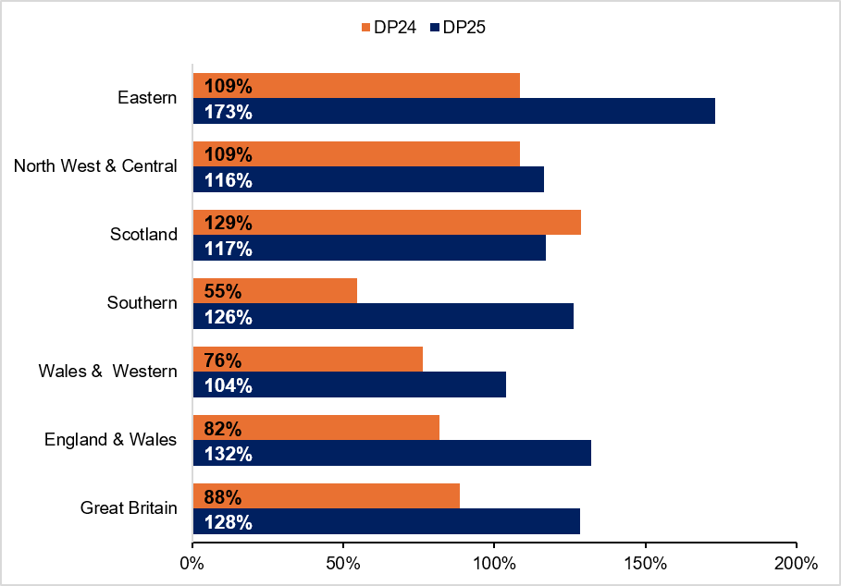
While Network Rail over-delivered against its revised plans in Year 2 (Delivery Plan 2025), this was still below the levels in Network Rail’s original baseline plan for CP7 (Delivery Plan 2024, referred to as DP24), as shown in the graph below. The graph also highlights the regional differences – notably Southern and Wales & Western, where multiple large projects were delayed until later years.
Effective volumes (renewals) percentage completion versus DP24 and DP25, by Network Rail region, April 2025 to March 2026
Source: ORR analysis of Network Rail data
Against the DP24 baseline, Network Rail delivered 88% of the planned effective renewals volumes in Year 2. Based on the volumes delivered in Years 1 and 2 alongside forecasts for the remaining years of CP7, Network Rail will have delivered 88% of its effective volumes (83% in England & Wales) by the end of the control period.
However, we have also seen some evidence of pressure on regional budgets (and hence volumes) due to issues within Network Rail’s control. These include a shift from planned to reactive work (which typically has higher unit rates) and inflexible contracts unable to deal effectively with large reductions in volumes of work. Additionally, some strategic programmes presented in the original plans for CP7 were immature and there has been uncertainty about the scope and timing of them. For example, digital signalling renewals work has slipped beyond CP7 and the West Coast North Modernisation had enduring uncertainty around the scope that would be delivered, which is now stabilising.
These reductions in renewals activity increase the risk of accelerated asset deterioration over CP7 and beyond, with potential implications for reliability, service disruption and future sustainability of the network. We also note a material shift from full renewals to more minor works and reliance on maintenance, which puts pressure on different teams and budgets within Network Rail.
Network Rail has provided some positive evidence of ongoing regional initiatives to rebalance renewals, minor works and maintenance and to stabilise their plans. However, further evidence is required to demonstrate the timely outcomes of these initiatives and that they are deliverable. Continued careful management will be important to maintain as much stability as possible and avoid further volatility over the remainder of CP7. Our concerns here are related to those with respect to asset deterioration (measured by CSI) as set out above – and will be an area that we focus on in the coming year.
Maintenance delivery was broadly in line with plan.
In reviewing Network Rail’s maintenance delivery, we have sought to understand whether it is updating its plans and risk assessments to cope with an increase in assets nearing life expiry (as a result of less renewals). In Year 2, Network Rail has acknowledged our challenge, and its Technical Authority and regional teams have begun exercises to rebalance their plans effectively. We continue to monitor this closely for evidence that changes are being made to plans and outputs are being achieved (i.e. there is no significant increase in maintenance backlogs, or temporary speed restrictions).
The evidence Network Rail provides on maintenance hours delivered suggests all regions are broadly in line with their original plans. Some regions and asset groups are increasing their maintenance delivery and we have also seen positive examples of regions seizing opportunities to over-deliver. For example, Scotland took advantage of access to its assets when Glasgow Central was closed due to a fire and Wales & Western increased its maintenance activity on the Great Western Mainline during the engineering access used for delivering infrastructure-related performance improvements (Project Brunel).
Asset reliability was better than target but is forecast to weaken.
At a national level, asset reliability, as measured by service affecting failures (SAFs) and the Composite Reliability Index (CRI), remained better than target in Year 2. However, performance is forecast to weaken over the remainder of CP7, reflecting the impact of an increasingly ageing asset base on reliability, performance and safety.
All regions performed better than their CRI targets, but these targets assumed asset performance would worsen over the first two years of CP7. SAFs have been marginally better than Network Rail’s forecasts but are expected to be worse than target for the remainder of the control period. Against Year 2 targets, SAFs in North West & Central, Eastern, and Southern were worse than their targets.
Structural assessment and examination non-compliance issues remain.
Last year, we reported issues relating to Network Rail’s compliance with its structural assessment standards. This issue remains, with a continued significant level of non-compliance across the structures and operational property (such as stations) portfolios in several regions. While some action has been taken by the regions to improve the position, and Network Rail’s Technical Authority has undertaken assurance activities, these are yet to deliver the level of improvement required to demonstrate sustained progress towards compliance.
We also remain concerned about structural examination compliance, with progress in addressing a backlog of work varying across the regions.
We have commenced an independent reporter review to identify the root causes and underlying factors causing recurrence of Network Rail’s non-compliance against its standards for structural assets, including examinations and structural assessments. We expect to conclude this review in autumn 2026.
Gaps in resilience of signalling supply power back-up systems are a risk.
Failures of signalling supply power have emerged as a growing risk to network performance and potentially safety, due to the loss of signalling capability. Recent incidents at Stoke, Stone, and Kidsgrove occurred within North West & Central region, but they may point to a wider issue.
We have identified a systemic oversight gap between Network Rail’s electrical & power and signalling disciplines, particularly in relation to the provision and assurance of resilient back-up power arrangements. This gap does not appear to be fully addressed through Network Rail’s internal incident reviews, increasing the risk of recurrence.
We have asked the Technical Authority to provide assurance that all regions have effective arrangements in place to address this gap and ensure the robustness of signalling supply power systems. We expect Network Rail to provide this by September 2026, and we will continue to focus on this area to fully understand the extent of the issue and effectiveness of Network Rail’s response. In Year 3, we will also leverage our findings in this area, to test the robustness of other crucial interfaces, such as drainage and earthworks, and telecoms (including Global System for Mobile Communication - Railways (GSM-R)) which multiple assets and teams rely upon.
There is a lack of long-term strategy for metallic structures.
Our periodic review 2018 final determination identified metallic structures – such as bridges, underbridges, and other steel assets – as being particularly vulnerable to deterioration and required Network Rail to develop a robust, evidence-based sustainable asset strategy by the end of CP6 to manage these assets cost-effectively and safely over future funding periods.
We undertook a targeted assurance review in CP6 which found that, while Network Rail’s Technical Authority has established a general framework for structures, there was no specific national policy for sustainably managing metallic structures. Regional strategies were also limited in scope, with varying levels of maturity and no consistent approach to measure or manage asset sustainability outcomes for this asset type.
During Year 2, we reviewed the strategies developed by Technical Authority and regions and found these are largely short-term and reactive, rather than reflecting a long-term asset sustainability strategy. Network Rail needs to review its strategies to ensure they support long-term asset sustainability, underpinned by appropriate metrics, assurance on deterioration, and resourced plans.
Weather resilience and climate change adaptation plans remain a high priority.
As part of CP7, a new requirement was introduced under asset sustainability measures, making delivery of key Weather Resilience and Climate Change Adaptation (WRCCA) activities a high priority. Delivery of these plans is vital to offset the impacts of severe weather events and climate change, which continue to drive significant disruption to railway operations, asset condition, and service reliability across the network. Network Rail has implemented a structured WRCCA reporting approach, providing updates twice a year to support consistent monitoring and assurance of delivery.
WRCCA delivery continues across the regions through a range of weather resilience activities. Examples include the installation of earthworks monitoring equipment at high-risk sites, trialling new technologies for flood detection and response, and development of natural flood management and nature-based solutions.
Completion of WRCCA actions scheduled for Year 2 was mixed across the regions, with planned completion levels not being achieved in Wales & Western and North West & Central. In Wales & Western, delays were primarily linked to contractor issues in developing resilience sites.
Network Rail continues to progress its climate change adaptation pathways programme, one of the key actions within regional WRCCA plans, to support future resilience planning and investment decisions. We are planning an independent reporter review in Year 3 to provide assurance on the methodology and outputs, alongside a planned targeted assurance review of regional WRCCA planning approaches for the next funding period.