

Passengers value reliable and punctual train services. We look at the percentage of passenger services that are cancelled and the percentage that are delayed – which are the product of both Network Rail and train operator delivery.
In control period 7 (CP7), we are using whole industry (combined track and train) measurements for passenger services. This is to encourage all parties to collaborate for the benefit of rail users. For passenger train service punctuality, we are using arrival at the station within three minutes, known as Time to 3. For passenger train service reliability, we are using whole industry cancellations. In reviewing Network Rail’s performance, we have assessed its contribution to these whole-industry measures.
From Year 3 of CP7, we will be holding Network Rail to account on the new targets set through the CP7 reset, published in December 2025. The reset helps to keep train performance targets for the remainder of CP7 ambitious, realistic and integrated across track and train.
Time to 3, On Time, passenger cancellations and freight cancellations, Great Britain, April 2024 to March 2025, April 2025 to March 2026 and versus targets
| Measure | April 2024 to March 2025 actual | April 2025 to March 2026 actual | April 2025 to March 2026 target |
|---|---|---|---|
| Time to 3 | 84.3% | 84.1% | No target set |
| On Time | 66.4% | 65.9% | 67.2% |
| Passenger cancellations | 4.1% | 3.5% | 3.3% |
| Freight cancellations | 1.5% | 1.0% | 1.3% |
Source: ORR analysis of Network Rail data
Notes: Data for On Time, Time to 3 and Passenger cancellations presented is for Network Rail managed infrastructure only.
ORR targets for Time to 3 have been set from Year 3 of CP7.
Passenger and freight train cancellations decreased.
Total passenger train cancellations improved, from 4.1% at the end of Year 1 to 3.5% at the end of Year 2. This was primarily driven by a reduction in train operating company (TOC) traincrew cancellations. However, Network Rail still has an important role to play in contributing to whole system reliability, including through minimising cancellations related to management of the infrastructure.
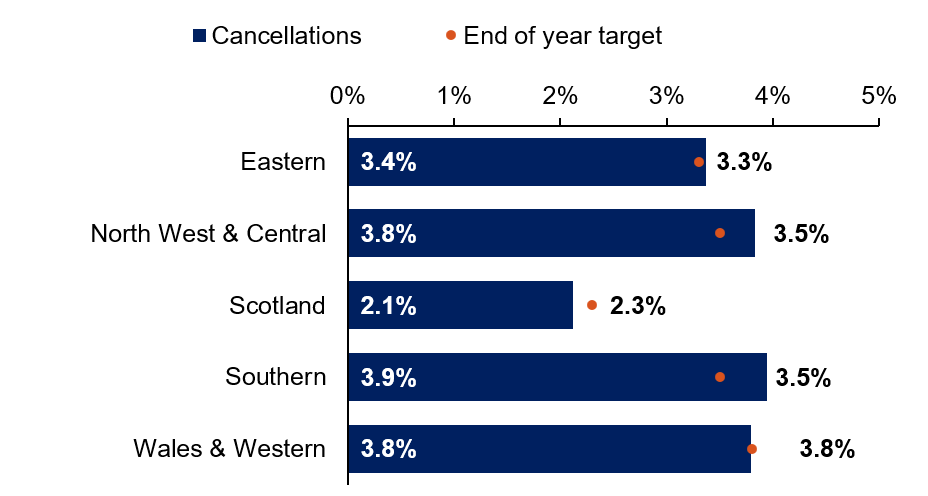
While good progress has been made in reducing passenger train cancellations in Year 2, Network Rail did not meet the network-wide target and further work is needed to return levels towards historic norms.
Passenger cancellations versus targets, by Network Rail region, April 2025 to March 2026
Source: ORR analysis of Network Rail data
Wales & Western, Eastern and North West & Central saw notable reductions in cancellations, largely driven by improving TOC cancellations, and Wales & Western met the end-of-year target set. Cancellations in Southern and Scotland remained at similar levels as the previous year, but with Southern ending the year worse than target and Scotland better than target.
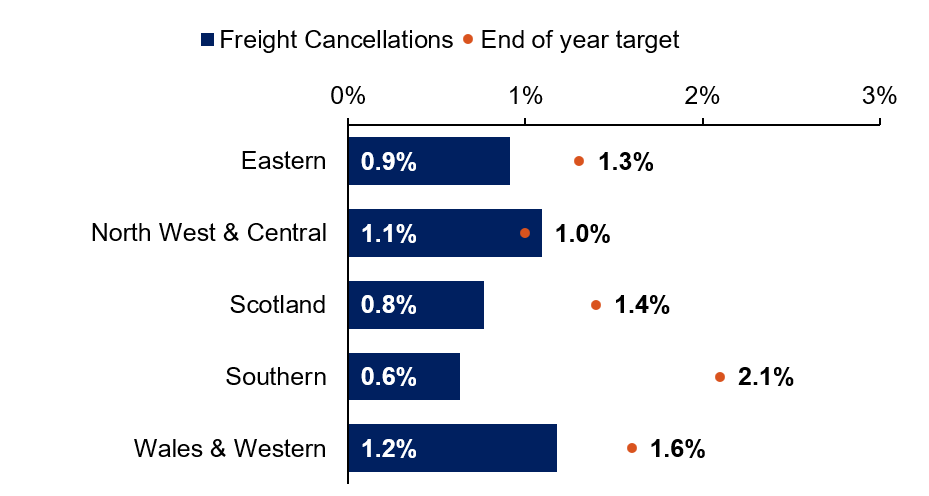
National freight train cancellations fell from 1.5% at the end of Year 1 to 1.0% at the end of Year 2 and met the year-end target set. All regions except North West & Central met end-of-year targets and, although it runs relatively few freight trains, Southern saw the biggest improvement, with freight cancellations falling from 1.5% to 0.6%. The reduction across the network was largely driven by fewer cancellations from severe weather such as storms, fixed infrastructure failures such as track faults, and external factors such as fatalities.
Freight Cancellations versus targets, by Network Rail region, April 2025 to March 2026
Source: ORR analysis of Network Rail data
Passenger train punctuality remained broadly stable, but Network Rail missed the end-of-year target.
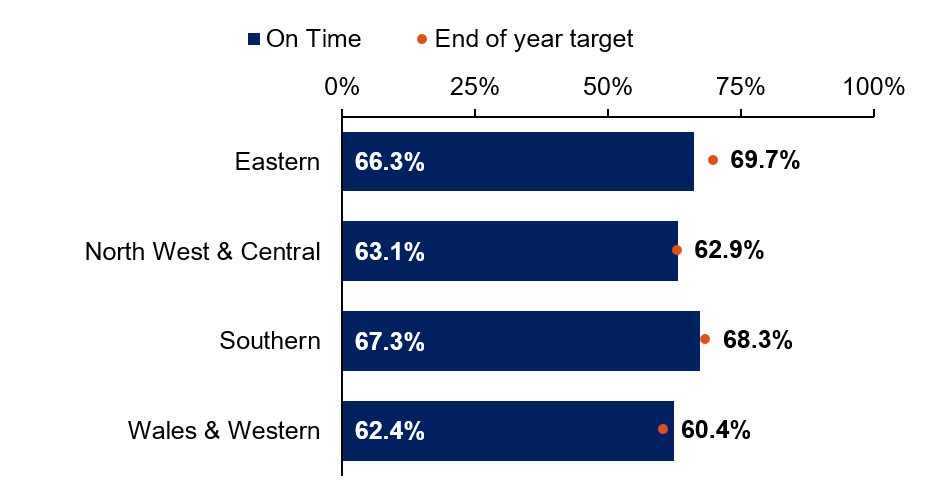
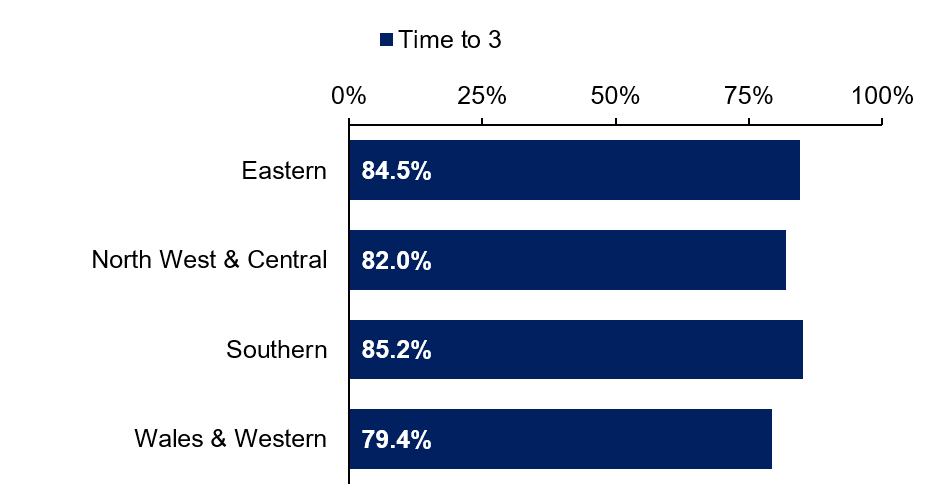
Passenger punctuality as measured by Time to 3 was broadly stable. However, at year end the proportion of trains arriving On Time was 65.9% against a target of 67.2%. Where regional train performance was below target, we scrutinised the regions’ responses and plans for improvement (see sections on Wales & Western and Eastern).
Network Rail is heavily involved in industry work to improve service resilience through better planning, which aims to improve reliability and punctuality on an ‘average’ day. Network Rail and operators need to continue this work to better balance outcomes, between resilience and network capability and capacity (and therefore the ability to generate revenue).
On Time versus targets, by Network Rail region, England & Wales, April 2025 to March 2026
Source: ORR analysis of Network Rail data
Time to 3, by Network Rail region, England & Wales, April 2025 to March 2026
Source: ORR analysis of Network Rail data
Delay increased slightly across most regions.
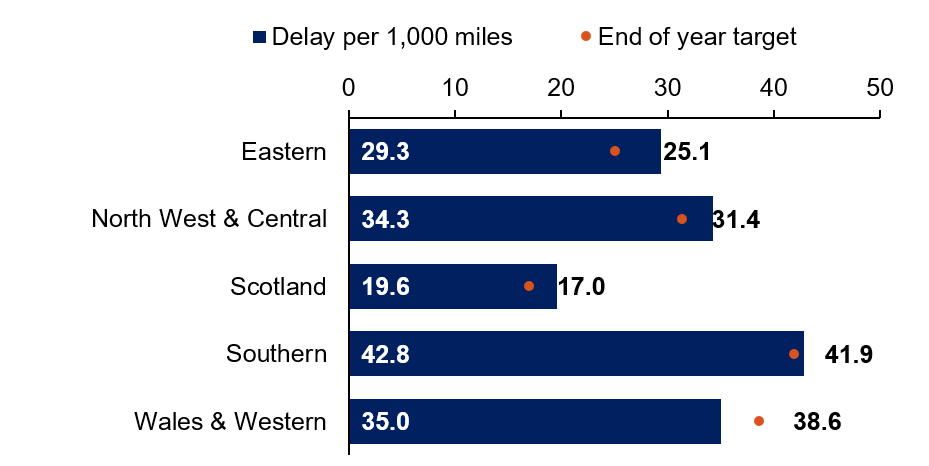
Network Rail-attributed delay (measured by delay minutes per 1,000 train miles travelled) worsened slightly from 32.3 at the end of Year 1 to 33.0 at the end of Year 2. However, delay reduced by 25% across categories relating to severe weather, autumn and structures.
Network Rail delay per 1000 miles missed its targets in four of the five regions, with only Wales & Western delivering better than its target. Scotland saw the biggest percentage increase in Network Rail caused delay, increasing from 17.7 to 19.6 minutes per 1000 train miles. Network Rail Scotland introduced targeted improvements during the year, which appeared to mitigate the rising trend.
Trespass on the railway has been an increasing cause of delay over the past three years and will need to remain an area of focus. After a period of relative stability early in Year 2, the associated network delay experienced by passengers increased. Network Rail continues to work closely with industry partners – including the British Transport Police – to tackle the main causes of delay, including activities to prevent and better manage trespass. Network Rail is also working closely with industry to deliver the Keeping Trains Safely Moving programme, and to ensure that passenger safety and welfare are placed at the heart of the industry’s response to stranded train incidents.
Delay per 1,000 miles (NR attributable only) versus targets, by Network Rail region, April 2025 to March 2026
Source: ORR analysis of Network Rail data
Wales & Western acted on our recommendations to improve train performance. It has improved reliability and punctuality for passengers and freight customers and has established better processes and governance for managing train performance.
Wales & Western has now satisfied the final order we issued in July 2024 that required it to implement its performance improvement plan. It has established better processes and governance for managing train performance. The region has completed 56 out of 63 planned activities, including interventions targeted at key assets, changes to systems and processes, additional training, and organisational and culture change. We will continue to monitor the region’s delivery of the remaining longer-term performance improvement activities, including overhead line headspan renewals, weather resilience and operating model changes.
Time to 3, passenger and freight train cancellations, and Network Rail attributable delay have all improved substantially since the start of the control period. Passenger and freight train cancellations met the end of year targets set. The improvement in passenger cancellations was driven by lower TOC cancellations in both the Western and Wales & Borders routes.
Asset reliability also improved, with the Thames Valley points resilience programme cutting delay by 53% and axle counter monitoring helping reduce incidents. Resilience and governance were also strengthened, supported by weather response tools, clearer programme oversight and better incident learning.
We expect the region to continue to build on the improvement gains it has achieved, embedding its improved ways of working and increasing the predictability and resilience of its network.
We continue to scrutinise the region’s performance improvement, including delivery of the plan’s longer term improvement activities, through regular engagement and review of performance data. The drive and transformed culture the region has demonstrated will be essential to its further development of a high performing and reliable network for its passengers and freight users.
In response to our challenge, Eastern region has delivered on its performance improvement plan, with three out of its four routes showing signs of recovery.
The most substantial gap to target on punctuality was in Eastern, where Time to 3 reduced from 85.0% at the end of Year 1 to 84.5% at the end of Year 2. We challenged the region on the actions it was taking, and in response it implemented a performance improvement plan. As a result, three out of its four routes showed signs of recovery towards the end of the year. Although Anglia remained the most punctual route on the network, a decline in its previous high level of punctuality was the main reason for the reduction in Time to 3 in Eastern region.
Following close engagement and continued review of data trends, we are confident in the route’s understanding of the decline in punctuality and that it is undertaking actions to address this.
Passenger cancellations improved from 3.9% at the end of Year 1 to 3.4% at the end of Year 2. The key driver of this improvement was fewer train operating company traincrew cancellations in three of the region’s four routes.
The timetable change in December 2025 saw significant increases in traffic and changes to timetables across the East Coast Main Line (ECML) route. The change was well prepared for and executed, with evidence of high levels of involvement with affected train operators and stakeholders prior to the change, and effective monitoring and intervention where necessary once the timetable was introduced. In its early stages the timetable has performed broadly as expected, including the period since the full-service pattern was introduced in late March. Ongoing focus is required to sustain the improvements, and to tackle remaining localised issues where further improvement is possible. With a busier network, system resilience will continue to be tested and we will continue to monitor this closely.
Scotland missed its passenger train performance target and must maintain its focus on improving performance for future years of the control period.
Train performance in Scotland, measured by the Scotland Train Performance Measure (STPM), ended the year at 89.8%. This is below the joint recovery target of 90.7% agreed by the Alliance (which consists of ScotRail and Network Rail Scotland).
The Alliance is committed to improving performance, through agreed plans and strategies. However, the required rate of improvement in whole system performance is significant and it places delivery of 92.5% STPM by Year 4 at risk.
Network Rail is maintaining momentum on its use of the Scotland targeted performance fund for performance improving schemes. We continue to engage with Network Rail on its assessment of benefits delivery for the approved projects.
When assessed through consistent metrics, punctuality, reliability and delay for passengers in Scotland continue to compare favourably to each of the regions in England & Wales. At the end of Year 2, passenger cancellations were at 2.1%, the lowest of any region.
Lower freight growth was driven by factors outside of Network Rail’s control.
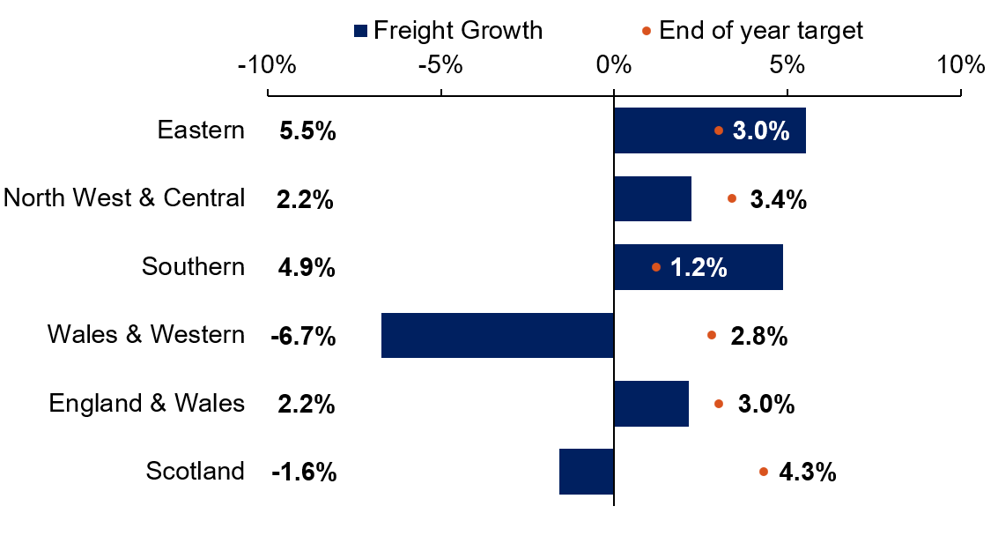
Network Rail did not meet the Year 2 freight growth targets set in England & Wales and in Scotland. Freight growth in England & Wales was 2.2%, against a year-end target of 3.0%. In Scotland, freight moved decreased by 1.6%, whereas the year-end target set was 4.3% growth. Overall, we consider that the underperformance against targets is largely driven by macroeconomic conditions outside of Network Rail’s control.
Freight growth varied across the regions. Eastern and Southern saw comparatively strong growth and ended the year better than the targets set. However, this was offset by North West & Central and Wales & Western missing growth targets. The downturn in the construction and steel markets had a pronounced effect on freight volumes, particularly in Wales & Western and North West & Central. Scotland also continued to be impacted by reducing volumes in its dominant commodities, such as petroleum and construction materials.
Freight Growth versus targets, by Network rail region, April 2025 to March 2026
Source: ORR analysis of Network Rail data
The System Operator continues to provide good leadership in engaging stakeholders across the industry on freight growth. It has worked with the regions to set up freight growth boards and in general these are functioning well and continue to be developed.
Network Rail's delivery of planned activities in its CP7 growth plans is good, having delivered 91% of its planned initiatives for Year 2. During Year 2, we challenged the company to test the effectiveness of the steps it is taking to grow rail freight across the network, including its freight growth initiatives and engagement with its stakeholders.
We conducted deep dive sessions with Wales & Western and Scotland, which highlighted key areas requiring greater focus, such as safeguarding capacity, and developing and progressing future freight growth opportunities. This should continue to be a focus in Year 3 and beyond.