

Analysis in this section is based on draft financial information provided by Network Rail. We will report more fully on these matters in our Annual Efficiency and Finance Assessment (AEFA) of Network Rail, which examines the company’s financial performance in relation to its control period 7 (CP7) delivery plan. The AEFA is scheduled for publication this autumn.
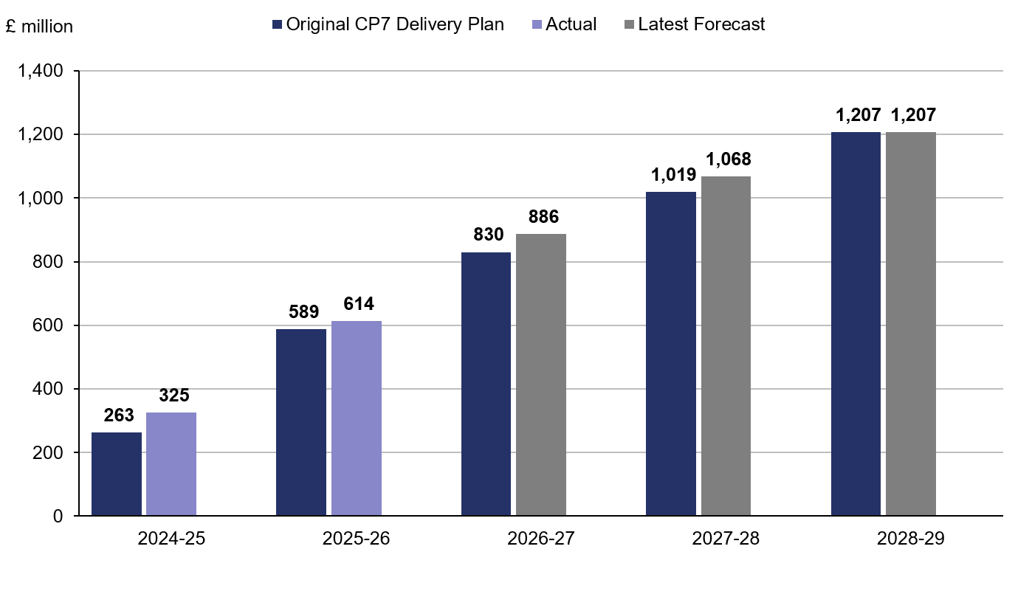
Network Rail delivered £614 million of efficiencies in Year 2 and it is now forecasting to deliver £4.1 billion of efficiencies over CP7.
Delivering efficiencies is a core requirement of Network Rail’s CP7 funding settlement. As set out in our periodic review 2023 (PR23) final determination, Network Rail was funded based on needing to deliver £3.9 billion of efficiencies over the control period to deliver its business plan within the funding available. These efficiencies were built into its CP7 delivery plan and underpin its funding. In practice, this means Network Rail needs to reduce the cost of its core business activities on a like-for-like basis through improved delivery. This is important to help offset upward cost pressures such as inflation.
In Year 2 of CP7, Network Rail delivered £614 million of efficiency savings, exceeding its delivery plan of £589 million by £25 million (4%). This builds on the efficiencies achieved in Year 1 of £325 million and represents good progress in delivering its overall CP7 efficiency plan embedded within its CP7 funding.
As in Year 1, Network Rail continued to face significant financial pressures, most notably from higher inflation. To help offset these pressures, Network Rail identified additional savings and re-forecast its CP7 efficiency target from £3.9 billion to £4.1 billion.
The top five initiatives which supported Network Rail in delivering its Year 2 efficiencies are detailed in the table below.
Top 5 key efficiency initiatives, annual data, April 2025 to March 2026
| Top 5 efficiency initiatives (£ million) | Eastern | North West & Central | Scotland | Southern | Wales & Western | Non-region | Total | Percentage of Year 2 delivery (%) |
|---|---|---|---|---|---|---|---|---|
| Contracting strategies/ packaging/ rates | 38 | 29 | 20 | 24 | 30 | 20 | 161 | 26% |
| Resource Management | 63 | 20 | 4 | 11 | 2 | 16 | 115 | 19% |
| MVP (Minimal Viable Product) | 24 | 32 | 8 | 4 | 2 | 5 | 75 | 12% |
| Workbank Planning/ Synergies | 59 | 2 | 4 | 4 | 6 | 0 | 75 | 12% |
| Innovation and Technology | 2 | 5 | 3 | 8 | 20 | 26 | 63 | 10% |
Source: ORR analysis of Network Rail data. Download this table in Excel format.
The details of each initiative are:
- Contracting strategies/packaging/rates, involves negotiating contracts with improved terms or rates, enhancing market research and monitoring contracts more effectively.
- Resource management, involves managing staff related costs and headcount levels.
- Minimum Viable Product (MVP), involves a framework for rescoping and delivering projects, focusing on the minimum set of requirements necessary to meet the project’s objectives, from concept through to delivery.
- Workbank planning/synergies, relates to internal business actions on works scheduling and more joined-up project planning, with the aim of reducing workbank delivery costs through better coordination and sequencing of activities.
- Innovation and technology, involves utilising improvements in technology to enable more cost-effective ways of working, creating opportunities to deliver efficiencies.
Network Rail’s efficiency delivery in Year 2 supports its long-term plan to deliver efficiencies earlier in the control period. This will help to de-risk future delivery against its rising efficiency trajectory and supports the additional £200 million of efficiencies the company is aiming to deliver over CP7. This approach is also consistent with the recommendations set out in our independent reporter review of Network Rail’s preparedness to deliver its efficiency plans for Years 1 and 2 of CP7, completed at the start of the control period.
Efficiency improvements profile across CP7, annual data, April 2024 to March 2029
Source: ORR analysis of Network Rail data
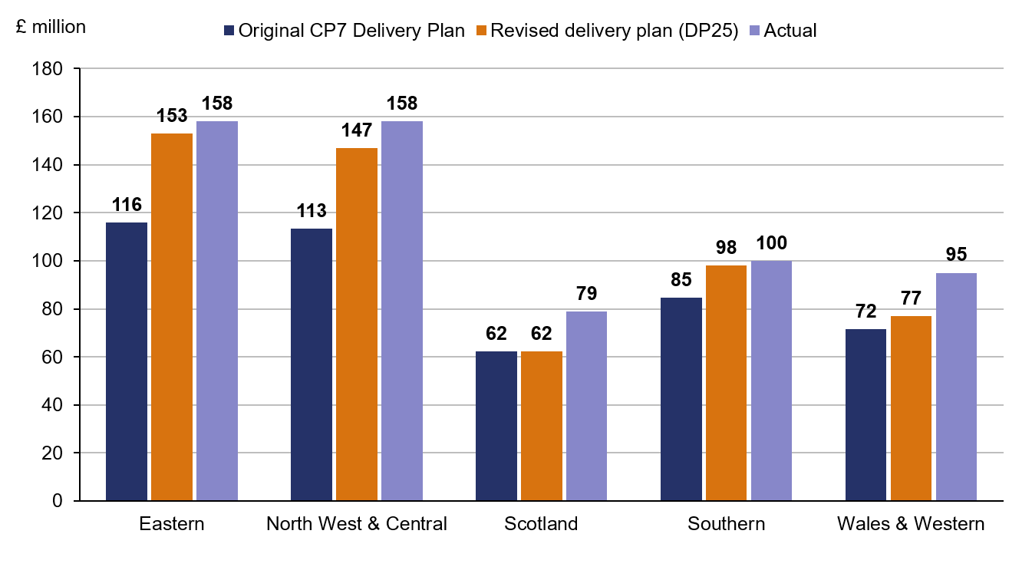
As shown below, all of Network Rail’s regions exceeded their original CP7 delivery plan efficiency targets in Year 2. Network Rail’s National Functions, which support regional delivery, achieved £125 million of efficiencies during the year (excluding a £101 million adjustment for regionally reported efficiencies that have not yet been assured). Further detail is provided in the ‘Network Rail’s National Functions’ section.
Regional contribution to efficiency improvements, annual data, April 2025 to March 2026
Source: ORR analysis of Network Rail data
Continued efficiency delivery, including Network Rail’s commitment to deliver a further £200 million of efficiencies over CP7, will remain a key factor in managing inflationary pressures and in limiting the need for further deferrals of renewals activity, which could otherwise increase reliance on safety mitigations and adversely affect future performance.
With over 75% of required efficiencies still to be delivered, we will continue to monitor Network Rail’s progress in developing and delivering its efficiency plans over the rest of the control period.
Network Rail's leading indicators, which provide insight into the company’s readiness to deliver its Year 3 plans, are in a good position. Regional efficiency plans are 89% completed or well-developed.
In contrast, Network Rail's renewals planning for Year 3 shows a more mixed picture. Financial authorisations to support planned spend was 66%, below the same point in Years 1 and 2 of CP7. Remits issued to carry out planned renewals work reached 94%, however acceptance by the supply chain was notably lower, with national acceptance at 70%, posing a risk to Network Rail’s renewals delivery in Year 3. At the end of Year 2, Network Rail had secured 109% of the required access to carry out its planned work in Year 3, above the same point in the first two years of the control period. Stability in these indicators is important, as it helps manage and reduce costs while providing a stable work profile for the supply chain.
Inflationary pressures and economic uncertainty continue to impact Network Rail’s future renewals delivery and efficiency plans.
Network Rail financially underperformed by £50 million in Year 2 against its annual budget. This means that, net of income, the company spent £50 million more on Year 2 deliverables for what it delivered. The underperformance in Year 2 was despite Network Rail exceeding its efficiency target for the year.
The underperformance was primarily driven by high inflation increasing renewals delivery costs across regions, which contributed £92 million to the overall underperformance. This was partially offset by a £27 million outperformance in the company’s net operating performance, reflecting favourable schedule 4 income associated with planned disruption from engineering possessions and lower-than-planned rates and industry costs. Within this, the schedule 8 performance incentive regime, which relates to compensation for unplanned disruption affecting train performance, underperformed by £10 million, incurring additional costs from below target train performance.
While efficiencies continue to reduce Network Rail’s underlying cost base, the additional costs and delivery challenges, which fall outside of efficiency reporting, have offset these benefits. The movement in these different cost drivers has meant that Network Rail’s total costs have risen even when efficiency performance is strong. The treatment of these cost pressures can be found in our CP7 regulatory accounting guidelines and will be explored further in our AEFA this autumn.
Network Rail continued to face inflationary cost challenges in the year, putting pressure on plans, and more specifically on its renewals delivery. In the first two years of CP7, general price inflation added over £710 million of cost pressure (gross of income effects), with a further £268 million arising from input price inflation (inflationary effects from increases or decreases in costs above general CPI inflation), totalling £978 million. As a result, Network Rail has revised its plans and is now forecasting lower renewals delivery in England & Wales over CP7, placing additional pressure on asset reliability and sustainability in CP7 and beyond. It is partly mitigating this by undertaking more maintenance activities. Alongside inflationary pressures, Network Rail also faced some delivery challenges, including resourcing pressures, emergency works and scope changes.
Across the five-year control period, general price inflation is now forecast to add more than £2 billion compared to forecasts at the time of the plans underpinning the PR23 final determination. In addition, input price inflation is forecast to add a further £255 million. As a result, Network Rail has had to make significant revisions to its plans. With market inflation expectations for the next three years at around 4%, further cost pressures are likely, requiring difficult trade-offs in prioritising renewals.
In addition, higher than forecast inflation and input prices contributed to Network Rail having a funding gap between its funding settlement and planned expenditure in its England & Wales CP7 delivery plan at the start of the control period. By the end of Year 1, the funding gap stood at approximately £500 million. This funding gap was closed in Year 2 primarily through reductions in planned renewals activities. In contrast, Network Rail Scotland did not have a funding gap in its CP7 delivery plan.
Network Rail also set aside £1.6 billion (cash prices) of risk funding (£1.4 billion for England & Wales and £0.2 billion for Scotland) to manage input price inflation risk and unplanned costs. A significant portion of the fund was drawn down and allocated in Year 1, leaving £779 million at the start of Year 2. Further drawdowns and allocations were made during Year 2 to address schedule 8 underperformance and ongoing input price pressures affecting Years 2 and 3. Network Rail ended Year 2 with £443 million remaining in the risk fund and will need to manage this carefully over the remainder of CP7 to minimise the risk of further cost pressures affecting delivery scope, efficiency, and future asset sustainability.
The combination of these challenges continues to affect Network Rail’s CP7 delivery. Lower planned renewals forecast over the control period may impact opportunities to deliver efficiencies, as many initiatives rely on a stable and consistent workbank. These impacts extend beyond short-term efficiency and may affect asset condition, network performance, and the sustainability of delivery over time. We will continue to engage with Network Rail to ensure that it is exploring all available options to managing these pressures before considering further reductions in renewals.