

The performance analysis section provides a more detailed analysis of how we have performed against the strategic objectives and deliverables set out in our business plan for 2025-26.
Strategic objective 1: A safer railway
ORR is the health and safety regulator for all of Britain’s rail industry. Our strategic objective is to enforce the law and ensure that the industry delivers continuous improvement in the health and safety of passengers, the workforce and public, by achieving excellence in health and safety culture, management and risk control.
With rail reform now under way we have played a significant role this year in ensuring that high standards of health and safety are embedded as the sector transforms, working collaboratively with government and industry stakeholders. In the past 12 months we have helped move four train operating companies (South Western Railway, C2C, Greater Anglia and West Midlands Trains) into public ownership through the issuing of safety certificates and authorisations, as required by the Railways and Other Guided Transport System (Safety) Regulations 2006 (ROGS), and our programme to complete applications in a timely manner will continue in the coming year. As an active member of the Department for Transport (DfT)’s Safety Working Group, we have had important early input into the design of the health and safety management system and post-reform structure for Great British Railways (GBR). We also worked to bring trade unions closer to the discussions on reform in the context of health and safety, convening engagement during the year.
We conducted a post-implementation review of ROGS on behalf of the Secretary of State and submitted our report to the Department for Transport in February, well ahead of the planned delivery date of August 2026. The draft report recommends keeping ROGS with minor amendments to reduce the administrative burden for mainline operators, including in relation to the safety certificate application process and safety reporting.
We delivered the recommendations from our cost and benefit of safety interventions report from last year, publishing the completed implementation review recommendations in March. This is a good example of collaborative working both within ORR and across industry to achieve greater efficiency.
In July we published our annual report of health and safety on Great Britain's railways, concluding that the network remains one of the safest in Europe and that the industry has made good progress in several areas, including action to address overdue structure assessments and dealing with weather-related risk. However, serious incidents continue to occur (see risks and interventions below) and we cautioned that industry must retain a relentless focus on safety throughout rail reform.
Network Rail and mainline operators
In the second year of Control Period 7 (CP7) we continued to work with Network Rail to monitor the safety commitments in its CP7 Delivery Plan, including how its ‘modernising maintenance’ programme is delivering safe and reliable assets, and published our final report on this in October.
During the year we have maintained our focus on the types of events and risks that could result in catastrophic train accidents. Overspeeding has been a key focus of our work, following four significant incidents in previous years. These events prompted a detailed review of underlying causes and the effectiveness of existing controls and led to a strategic intervention in October. We convened industry stakeholders to develop a shared understanding of how overspeeding risk is managed and where improvements are needed, highlighting variability in approaches and gaps in assurance across organisational boundaries.
We worked with the Rail Safety and Standards Board (RSSB) and the Rail Delivery Group (RDG) to establish a more consistent, industry-leading framework for managing overspeeding risk. This includes short-, medium- and longer-term actions to strengthen preventative controls, improve data use and support a more proactive safety culture. This work has been supported by valuable engagement with trade unions, recognising their role in promoting workforce awareness, reporting, and adherence to controls to manage overspeeding risk.
Our review of overspeeding also identified weaknesses in the management of certain controls by the infrastructure manager and operators, alongside insufficient reporting and information-sharing between duty holders, limiting the industry’s ability to respond effectively to emerging risks. We will continue to monitor progress closely and hold industry to account for delivering the necessary improvements.
To support our strategic intervention project on Trains Passing the End of their Authority, we commissioned an international literature review to examine how comparable countries manage Signals Passed at Danger (SPAD). The review explored regulatory approaches to SPAD reduction and identified good practice from international comparators. The resulting recommendations have informed the development of our wider strategic intervention project.
In May, we published an updated level crossings Strategic Risk Chapter and in September, we undertook a targeted national inspection campaign, focussing on mainline passive level crossings.
As part of our ongoing fatigue strategic intervention project, we carried out inspections of train operating companies and delivered a training workshop for RMT union health and safety representatives.
With extreme weather events and their impact on buildings and structures management remaining a particular area of concern, we continued our extreme weather multi-year strategic intervention programme and engaged regularly with Network Rail to hold it to account. In February 2025, we wrote to Network Rail regarding their compliance with structures examinations and assessments, requiring improvements, which Network Rail has subsequently delivered in 2025-26. We will continue to work with the company to ensure it fulfils its legal obligations and responsibilities for the asset management and safety of its structures and operational property.
Digital safety continues to be a key focus area, as the use of new technologies, including advanced digital systems and artificial intelligence, becomes more prevalent across industry and the risk profile for software-related failures evolves. Over the past year we have provided targeted training to inspectors to strengthen our in-house capability in managing digital safety risk. We have also engaged with industry stakeholders to develop a digital safety strategy and new digital safety Strategic Risk Chapter.
In October, we delivered a seminar with the RDG on stranded trains, exploring how track and train duty holders can protect passengers during these events. This built on steps we have taken since some high-profile incidents in 2023, including updated industry guidance. Further details on this work can be found in the Better Rail Customer Service section of this report.
The occupational health, safety and wellbeing of railway workers has continued to be a priority this year. Our main area of focus has been on the health impact of exposure to welding fumes and inspecting Network Rail’s risk controls. Our improvement notice, which Network Rail had earlier appealed, was affirmed in December, with the company subsequently taking positive action to achieve compliance against its requirements.
In June we convened a roundtable with senior rail industry leaders and the four main unions on welfare provision for railway workers, to understand the main issues and bring about necessary improvements. Access to appropriate welfare is a fundamental feature of evolving our culture and building a more diverse and inclusive railway workforce. We worked with the RSSB to support industry sign-up to a Welfare Charter and participated in the Freight Safe Steering Group on the particular challenges associated with welfare provision for freight workers.
Our work on new schemes – to foster a culture of safety by design – has mainly focused this year on the creation of GBR. However, we have continued to monitor and influence the Highspeed 2 and TransPennine projects, with a particular focus on the outcomes of HS2’s restructuring.
We continued to provide input on industry policy, legislation and guidance as it relates to health and safety on the railways. We worked with DfT to review both the RDG’s implementation plan for the change to lower the minimum age for a train driving licence from 20 to 18 years, and the legal drafting changes required to bring this change into effect. We also worked with DfT to issue an update to stakeholders on plans for the next stage of wider reform of the train driving licensing regime, including measures to reduce burdens, and a public consultation on proposed changes to the regulations is anticipated during 2026. We also reviewed and updated three of our core train driving licensing guidance documents and in September successfully implemented an improved portal to help us, and operators, manage significant volumes of statutory train driving licensing work.
Non-mainline operators
Our focus with Transport for London has included management of its civil assets and risks from ageing infrastructure. We produced an initial report in October, which summarised the work carried out in respect of civils assets. However, we had insufficient information at that stage to enable conclusions to be reached, so we are continuing to pursue this topic into the next work year.
In the light rail and tramways sector, we focused on crossing safety and contractor management, along with continuing to engage with industry and the Light Rail Safety and Standards Board (LRSSB).
During the quieter winter period for the heritage sector, we partnered with the Heritage Railways Association to deliver six workshops at venues around the country. These focused on: inspection themes, incident trends, asset management, workshop health and safety, and running events safely. We carried out inspections on derailment risk, focusing mainly on narrow-gauge railways, following an increase in incidents in 2024-25, as well as general safety inspections of selected heritage railways across England, Wales and Scotland.
Channel Tunnel
The timescales for implementation of new Channel Tunnel bi-national regulatory arrangements remain subject to UK parliamentary processes and therefore National Safety Authority (NSA) responsibilities for the UK half of the tunnel have not yet been transferred to ORR. We have continued to build positive relations with our colleagues at the French railway national safety authority, Établissement Public de Sécurité Ferroviaire (EPSF).
Regulation and certification
As part of our day-to-day work, we grant a range of health and safety permissions and approvals and, in some cases, we have statutory deadlines to meet. This work helps provide an effective framework for railway safety and, in the case of train drivers, establishes a common regime for licensing.
- 1523 new train driving licences issued
- 1902 train driving licence renewals processed
- 14 doctors, 23 psychologists and 5 training and examination centres recognised and added to our registers
- 50 mainline and 6 non-mainline safety certificates and authorisations issued
- 32 level crossing orders, 15 revocation orders, 3 directions and 2 traffic signs authorisations delivered
- Reported to RAIB on 104 recommendations: 77 closed, 25 open, 2 reported as other public body
Investigation and enforcement
Prohibition notices stop activities that pose a risk of serious personal injury and improvement notices identify serious breaches of the law that require changes to be made. During the year we invested significant professional effort in investigations and issued eight improvement notices. These included two notices relating to occupational health issues, legionella and Hand Arm Vibration, and the Avanti West Coast 2 improvement notices on overspeeding[AS3.1].
Where appropriate we prosecute duty holders in the courts to ensure compliance with health and safety law.
In October, Great Western Railway was fined £1 million and ordered to pay more than £78,000 in costs after pleading guilty to breaches of the Health and Safety at Work etc. Act 1974. This followed a fatal incident near Twerton in 2018 when a passenger suffered a fatal head injury after placing their head outside a droplight window of a moving train and striking a tree branch. Our investigation found that GWR fell short in its responsibilities and had not implemented actions it had already identified to reduce the risk, despite being aware of a number of previous incidents. Following the death, further safety recommendations were issued across the rail industry to prevent passengers from leaning out of droplight windows.
We also undertook significant work in the first part of 2026 to support the Carmont fatal accident inquiry. This is examining the full circumstances surrounding the tragic deaths of three people from the derailment of a train at Carmont, Aberdeenshire, in 2020. We gave evidence to the final hearing in March and the Sherrif’s report is expected in the coming months.[AS4.1]
As part of our readiness for a transformed rail sector, we have invested heavily in our regulatory excellence programme to build regulatory capability, develop digital tools, and focus our resources in the right area. We have recruited 10 new inspectors and strengthened and streamlined our training in the field. We have also enhanced our digital case management system and inspection app.
Our performance against 2025-26 business plan deliverables
| 2025-26 commitment | Status |
|---|---|
| Report on civil assets management by London Underground | Met |
| Carry out industry consultation as part of a statutory review of ROGS | Met |
| Provide an update on progress against the recommendations from our March 2025 costs and benefits of safety report | Met |
| Run a targeted inspection campaign on level crossing safety | Met |
| Working with DfT, implement minimum age change for train drivers and secure wider reform of train driving licensing regime | Partially met [note 1] |
| Release annual rail safety statistics | Met |
| Monitor Network Rail’s CP7 Delivery Plan commitments, including how Modernising Maintenance delivers safe and reliable assets | Met |
| Deliver inspectors training to improve our capability in managing digital safety | Met |
| Undertake inspections on management of worker fatigue risk | Met |
| Deliver joint ORR/Heritage Railway Association workshops | Met |
| Complete review of implementation of recommendations from our costs and benefits of safety report | Met |
Note 1: In 2025-26 we worked with DfT to develop the policy around reducing the minimum age. This policy work was completed. We will work with DfT to implement the age change once the legislation comes into effect in June 2026.
A business plan commitment for 2024-25 remains outstanding. This was to secure the transfer to ORR of National Safety Authority responsibilities for the UK half of the Channel Tunnel. This is subject to the Government’s timetable and is outside of our control.
Future plans
In our deliverables for 2026-27, we have committed to the following priorities:
- launching the formal regulatory training programme for our new inspectors
- delivering a report on the Post Implementation Review of ROGS
- implementing, with DfT, the minimum age change for train drivers
- developing a new occupational health strategy
- engaging with industry on the risk of violence to rail staff
- publishing our first digital safety strategy and new Strategic Risk Chapter
- running a targeted mainline railway workforce inspection initiative on possessions
- undertaking an intervention to assess London Underground’s civil asset management arrangements
- delivering joint ORR and Heritage Railway Association risk management workshops
- reviewing earthwork risk management arrangements at selected light rail systems
- undertaking interventions to assess the management of risks at highways crossings at selected light rail systems
- releasing annual rail safety statistics
Strategic objective 2: Better rail customer service
We have a key role to improve the rail passenger experience and take prompt and effective action to improve the service that passengers receive where it is required.
In fulfilling this key role, we focus on the four areas where we have regulatory responsibility and where we have built enhanced capability:
- The provision of assistance to passengers who depend on additional support to make their journey.
- The provision of passenger information, including when there is disruption, so that passengers can make informed choices.
- The provision of a complaints handling service, awareness of the compensation process where passengers are subject to delay, and independent resolution of escalated complaints through an ombudsman where necessary.
- Ticket retailing, specifically the ease with which passengers can choose and purchase the best ticket for their journey and, where necessary, receive a refund for their ticket.
We do this alongside how we hold Network Rail to account for the quality of the rail infrastructure, which is a contributor to train performance, to ensure a joined-up approach.
Another large area of our work to ensure better customer service on the railway is our regulation of access to the network for passenger services and freight companies. We also provide transparency through publication of key statistics.
Passenger accessibility
Accessibility of the rail network and services for all customers, and particularly those with disabilities, remained a priority area of work for us this year.
In December we published our first annual benchmarking report on train and station operators’ provision of assistance. This has helped us judge how well operators are meeting their obligation to provide assistance free of change to anyone who needs it, irrespective of whether it is booked in advance or requested at the station. Our new benchmarking provides greater transparency and enables us to focus our attention on the poorest performing operators, identified this year as Northern Trains, South Western Railway and West Midlands Railway, to drive improvement for passengers and disseminate good practice across the industry. We have subsequently worked with the three companies to produce improvement plans that adequately address the issues we identified.
In parallel, we continued to drive improvements in the quality of industry data on assistance outcomes and from April 2025 we required companies to report new data to us every month. We now have greater confidence in industry data being reported on the volume of turn-up-and-go assistance and have started to publish this on our website. Further work is required on the quality of data on assistance outcomes.
In May we published a report on how staff at busy stations communicate with other stations about the needs of passengers who have been assisted onto trains, to avoid the risk of them being left without help to disembark at their destination. We asked all operators to look at whether they wanted to try alternative approaches to information handover, to increase both reliability and efficiency, and we have now approved five trials from five different operators on the use of digital communications in place of phone calls.
A new piece of work during the year was to consult on and implement a proposed amendment to our Assisted Travel Policy (ATP) guidance to require operators to assess claims for redress for failed assistance on a case-by-case basis. The consultation was prompted by concerns that some operators’ policies could appear to restrict compensation to the ticket price. We subsequently implemented the change to our guidance, requiring all operators to review and amend their ATPs, and they have now all implemented the relevant changes.
Another unplanned piece of work was a licence investigation into Northern Trains’ provision of disability awareness training for its passenger-facing staff, and whether staff have the skills and knowledge to provide disabled people with the support they rely on. In March, following the investigation, we found Northern Trains in breach of its licence and the company acknowledged the failings we identified. It took steps to address gaps in training before the end of the year and has committed to a further package of reparations worth £550,000. We are now monitoring progress in implementing the additional measures, which should make a meaningful difference for passengers.
Passenger information and ticketing
We continued to hold operators to account for better quality passenger information, monitoring performance against companies’ customer information pledges, and maintaining our focus on how passengers are kept informed during unplanned disruption.
In October, we convened a seminar involving more than 100 representatives from across the rail industry to consider how the industry responds when trains become stranded. The focus was on ensuring passengers receive timely information, appropriate support and a safe journey, whether remaining on board or completing their journey by other means.
Delivered jointly with the Rail Delivery Group (RDG), the seminar built on work undertaken following the high-profile stranded train incidents in late 2023 and the recommendations set out in our joint 2024 report with Transport Focus. This included updated guidance from Network Rail and RDG. Since then, further steps have been taken by Network Rail and train operators to strengthen local arrangements, improve coordination and leadership during disruption, and make more effective use of operational data. These developments demonstrate continued industry focus on improving outcomes for passengers when disruption occurs.
In 2024 we were asked by the Secretary of State for Transport to review train operators’ and retailers’ revenue protection practices, such as how they communicate ticket conditions and the use of penalty fares and prosecutions. The aim was to achieve the right balance between punishing people who are trying to evade fares and recognising genuine mistakes. This is in the context of at least £350 to £400 million in revenue being lost to fraud and ticketless travel every year, according to the RDG. We published recommendations to Government in May, setting out proposed improvements to how industry enforces revenue protection that are good for passengers and operators alike. Our recommendations were accepted in full by the Secretary of State, who has now written to all operators asking them to engage with her department and RDG to take this forward, including sharing good practice through the cross-industry working group that was set up on this issue.
Our findings from the revenue protection review also informed our review of the Retail Information Code of Practice, which we concluded and published in January. The Code helps rail sector retailers comply with consumer law as it applies to selling rail tickets. Our updated guidance will support retailers in understanding and meeting their obligations and will strengthen the clarity, accuracy and transparency of information provided to passengers.
Complaints handling and redress
During the year, we have continued to monitor and enforce the Rail Ombudsman’s delivery of its workplan, according to the terms of its contract, and engaged with ticket retailers to encourage them to join the service. One area for improvement that we have focussed on has been delivery of the Ombudsman’s accessibility road map, which sets out actions to ensure that the service is working well for disabled people and others with specific accessibility needs. In July the Ombudsman launched a redesigned website that meets current accessibility standards with a range of enhanced features and functionality to significantly improve user experience and accessibility. At the same time, a new case management system has strengthened the way cases are managed for both passengers and industry.
In 2022, as part of our decision on proposals to implement a new Rail Ombudsman operating model, we made a public commitment to commission an independent review of the scheme within the first two years of operation. Subsequently rail reform led us to pause this work. With confirmation that sponsorship of the Ombudsman will now transfer to a new Passenger Watchdog, ORR will no longer be responsible for commissioning such a review and it will be for the new body to determine whether and how any review should be taken forward.
Access (capacity use including timetabling) and licensing
Access to the network and licensing of railway operators remained a significant area of work this year through both our usual day-to-day regulatory duties and supporting and informing changes proposed through rail reform.
We continued to perform our statutory role of reviewing, approving and where necessary directing alternative decisions taken by Network Rail on operators’ use of network capacity and station and depot assets. We had to take an unusually high number of direction decisions this year, but these were all delivered on time.
A major piece of work during the year was concluding our examination of depot capacity for new international train services and in October we granted Virgin Trains access to Temple Mills international depot, an important first step towards the company operating cross-border train services using the Channel Tunnel. Our decision unlocks plans for around £700 million of private investment in new services and the creation of 400 new jobs – a boost for passengers, customer choice, and economic growth. Virgin Trains can now be confident it will have access to the light maintenance facilities it needs to begin its planned international services in 2030, and we will work with Virgin Trains as its plans develop.
Elsewhere on open access, we approved extensions of services on the East Coast Mainline but had to reject three track access applications on the West Coast Main Line due to insufficient capacity, concluding that we could not approve these without a serious negative impact on the level of train performance that passengers experience on the route. We have continued to work with other open access operators we have approved as they prepare to introduce their services. First Group’s London to Stirling services commenced in May, bringing competition onto the West Coast Main Line for the first time. The same company’s London to Carmarthen services are on track to commence after the December 2027 timetable change. However, Go-Op did not provide sufficient evidence that it secured the finance it needed to introduce its regional open access service in the west of England so its access contract lapsed at the end of May.
High-performing and resilient timetables are an essential part of providing a good service to passengers and freight customers and we have continued to hold Network Rail to account on complying with industry timescales. Our work on access decisions and monitoring helped ensure that the new East Coast Main Line timetable was introduced successfully in December. In November, our decision not to grant access rights for the 07:00 Manchester to London Euston service attracted media attention. Following an internal review, we concluded that our original decision was reasonable based on the information available at the time, although it did not reflect the full picture. When new information was received, we acted quickly to maintain the service for passengers. This was an unusual situation, and we moved promptly to reassess our position. We have also identified lessons to inform our approach in future.
Our day-to-day licensing work protects the public interest by ensuring that operators of rail assets are fit and proper. During 2025-26, we issued 20 licences or licence exemptions for operators of railway assets, meeting our timescale commitments to industry in every case. The focus of much of the contractual changes that we have managed this year has been to help train operating companies move into public ownership, as part of the transition to GBR. Another important proposal under rail reform is the establishment of ORR as an appeals body for access applications and we have worked throughout the year on proposals, which were set out in our discussion document published in December. (See the Transformation section for more details.)
As a condition of its network licence, Network Rail must not dispose of its land and property assets without our consent, to ensure that land that has a reasonably foreseeable railway use is not lost from the railway. During the year, we reviewed five proposed disposals, giving consent to each. We also completed to time our annual audit of Network Rail’s land disposals, further safeguarding the continued operation and future development of the network. Network Rail’s licence also prohibits it from operating passenger train services without our consent. To support the process of greater integration between Network Rail and passenger operators, a key step on the road to GBR, we gave Network Rail consent to do so on four occasions during the year.
We conducted our annual reviews of the network statements of each major UK rail network operator: Core Valley Lines, Crossrail Central Operating Section, Eurotunnel, Heathrow Airport, London St. Pancras Highspeed, Network Rail and Northern Ireland Railways. Our activity in this area ensures that all operators, including new entrants to the market, are clear about the arrangements for getting access to these networks, improving the prospects of them introducing new services that will improve passenger choice.
We published six-monthly data on ORR and industry’s compliance with timetabling and sale of network access deadlines, to ensure transparency around the industry’s delivery.
Our performance against 2025-26 business plan deliverables
| 2025-26 commitment | Status |
|---|---|
| Publish report on effectiveness of communications between stations about passengers who require assistance to travel | Met |
| Publish recommendations to government on rail companies’ revenue protection practices | Met |
| Publish response to consultation on benchmarking train operating companies’ provision of assistance to passengers | Met |
| Conclude examination of depot capacity for new international train services | Met |
| Publish six-monthly data on ORR and industry’s compliance with sale of access and timetabling deadlines | Met |
| Complete review of the Retail Information Code of Practice | Met |
| Review our Accessible Travel Policy (ATP) guidance requirements on redress for failed passenger assistance and consult on any proposed amendments | Met |
| Conduct and publish annual review of Network Statements for all regulated infrastructure managers | Met |
A deliverable rolled over from the 2024-25 business plan, to consult on proposals to require operators to take passenger views into account when considering station staffing changes, has now been superseded as we are engaging with operators on the accessibility impacts of any changes to station and train staffing under current requirements set out in the ATP guidance. There is therefore no current need to proceed with the consultation.
Future plans
In our deliverables for 2026-27, we have committed to the following priorities:
- publishing an update on policy work on disabled passengers’ redress for failed assistance
- publishing an annual benchmarking report on operators’ provision of assistance
- reviewing the delivery and quality of industry’s disability awareness training for passenger-facing staff
- reporting on Network Rail’s stakeholder engagement
- publishing six-monthly data on ORR and industry’s compliance with sale of access and timetabling deadlines
- determining 10 passenger open access applications no later than the end of 2026
- conducting and publishing an annual review of Network Statements for all regulated infrastructure managers
Strategic objective 3: Value for money from the railway
ORR works to ensure that the railway is run in the most efficient way for users and funders and holding Network Rail to account is a key role for us. We also regulate other significant elements of the national rail infrastructure, including London St. Pancras Highspeed and the UK portion of the Channel Tunnel. We have several additional roles that help secure a better deal for rail users now and in the future.
We have continued to engage with Government throughout the year on how our regulatory activity can achieve these goals and support the right environment for investment and growth at a time of transformation in the industry. (Further details can be found in the Transformation section of this report).
Holding Network Rail to account
This year, the second year of control period 7 (CP7), we have focused on improvements to train performance, recognising that reliable and punctual services are a priority for passengers, freight customers and the economy. We worked with Network Rail and other industry stakeholders to reset Network Rail’s targets for passenger train performance in England and Wales for the remaining three years of CP7 (April 2026 to March 2029), a commitment made in our periodic review (PR23). In December we published our conclusions on the new targets, which are intended to be ambitious, realistic and integrated across track and train. We held a webinar with industry and other interested stakeholders to answer any questions and in March issued notices for the necessary amendments to train operator contracts reflecting the reset.
In July we published our annual assessment of Network Rail’s delivery to its stakeholders across its regions and functions in the first year of CP7 (2024-25). We found that the company was delivering efficiently, that passenger train punctuality was largely stable and that Britain’s railway remains one of the safest in Europe. However, we highlighted that financial constraints require careful management and that the industry must retain a relentless focus on safety throughout the process of rail reform.
In October we followed up with our annual efficiency and finance assessment to report on how well the company’s funding is being spent. This concluded that during the year 2024-25, Network Rail delivered £325 million of cost savings in how it operates, maintains and renews the rail infrastructure, £62 million above its efficiency target. However, we found that, despite these savings, the company financially underperformed against its delivery plan. Net of income, the company spent £243 million more, in terms of operating, maintaining and renewing the railway, than it was funded to deliver. This is equivalent to approximately 2% of its annual expenditure.
London St. Pancras Highspeed
In July we published our annual report on London St. Pancras Highspeed, reviewing the operator’s delivery of services on the High Speed 1 route during the year 2024-25. Alongside increases in traffic volumes, we found significantly improved train performance, with reliability and punctuality much higher than the mainline network. Performance issues are now dominated by low likelihood, high impact incidents and we urged London St. Pancras Highspeed to review how it recovers from major incidents. We also required the company to make improvements to its asset management, in light of ongoing issues around assets like lifts and escalators at stations.
Cross-industry reporting and government engagement
In March 2026 we published our annual report on productivity across the whole rail industry, covering both train operating companies and infrastructure. Productivity is a major driver of economic growth and value, and our report examined the outputs the industry delivers for the resources it uses (such as people and capital). We found continued recovery in productivity since the pandemic and stronger productivity growth than the wider economy. One of the key aims for government with rail reform is reducing the net subsidy to the railway. Revenue growth is clearly central to this, but so is increasing productivity. Our analysis provides a useful baseline for how we might measure some of the future benefits of integration under rail reform.
Throughout the year we have continued to engage with Government on wider aspects of reform and how our regulatory activity can support the right environment for investment. In October, we published the findings of our deep dive into the Rail Network Investment Framework, initiated at the request of the Chancellor, resulting in new streamlined guidance to remove barriers and encourage third party investment.
Promoting competition
Fair and effective competition is an important driver of value for money. In December we concluded our review of the Transparency Order originally imposed by the Competition Commission (now Competition and Markets Authority (CMA)) in 2009. The aim was to determine whether there had been a material change in the passenger rolling stock leasing market that alleviated the competition problems identified. Following consultation and engagement with stakeholders, we decided that the Transparency Order continues to be appropriate and proportionate but recommended that the terms be brought up to date in light of legislative changes, to ensure that it is fit for purpose. We will continue to monitor this market and the effectiveness of the Transparency Order throughout the rail reform process.
During the year we continued to provide competition advice to government and to the CMA on rail-related mergers.
Our annual open access monitoring report was published in September. We found that open access operators performed better on punctuality and reliability than long-distance contracted operators, but had higher complaint levels, although complaints had fallen for both types of operators, and satisfaction for complaint-handling was higher and improving for long-distance open access services. Both passenger numbers and kilometres have recovered more strongly for long-distance open access operators.
Information and analysis
We are the publisher of official statistics for rail, and our transparent reporting and analysis helps us hold industry to account.
In November we published our annual rail industry finance (UK) statistics, an important barometer of the financial health of Britain’s railways. We reported that in the year 2024-25 train fare revenue for Great Britain’s rail network rose 8% to £11.5 billion compared to the previous year. The revenue continues to lag pre-pandemic levels, but the rise contributed to a fall in funding required from the UK and devolved governments towards operation of the railway. Our statistics showed that passengers in Scotland received the highest level of government support per passenger kilometre travelled compared with other regions.
Throughout the year we have continued to improve the efficiency of our data capture, storage and reporting through increased automation. Feedback has been positive on the ease with which users can now extract useful data from our portal.
Our performance against 2025-26 business plan deliverables
| 2025-26 commitment | Status |
|---|---|
| Consult on CP7 passenger train performance reset | Met |
| Publish annual assessment of Network Rail | Met |
| Publish annual assessment of HS1 | Met |
| Monitor and report on open access | Met |
| Conclude CP7 passenger train performance reset | Met |
| Publish annual efficiency and finance assessment | Met |
| Release rail industry finance statistics | Met |
| Complete review of rolling stock market transparency order | Met |
| Report on Network Rail’s stakeholder engagement | Met |
| Release statistics on annual estimates of station usage | Met |
| Report on productivity in the rail industry | Met |
Future plans
In our deliverables for 2026-27, we have committed to the following priorities:
- publishing our annual assessment of Network Rail
- publishing our annual efficiency and finance assessment of Network Rail
- concluding changes to Network Rail’s rail investment framework
- reporting on productivity in the rail industry
- launching a new market review and publishing an update
- monitoring and reporting on open access
- releasing rail industry finance statistics
- releasing annual estimates of station use statistics
Strategic objective 4: Better highways
National Highways operates the strategic road network, managing motorways and major roads in England. Our role is to monitor and hold it to account for its performance and delivery, so that its customers enjoy predictable journeys on England’s roads.
Assessing National Highways’ performance
Our work this year has focused on closing out the second road period (RP2), which ended on 31 March 2025, overseeing the interim settlement for April 2025 to March 2026, and preparing for the third road period (RP3) which started this April. In July we published our annual assessment of National Highways, which reviewed the company’s performance in the year 2024-25 and the whole of the RP2 period. We reported that the company had delivered significant improvements for road users during RP2 but must learn lessons from missed commitments to deliver better performance in future.
Specifically, National Highways opened 30 major enhancement schemes and met targets on incident-clearing, roadworks impact mitigation, road surface maintenance and environmental improvements. The company achieved £2.2 billion in efficiency savings, exceeding its target in a challenging fiscal climate. This is a key area on which ORR holds the company to account, to deliver value for road users and taxpayers. However, the company missed five of its 12 key performance indicators, for reasons both within and outside its control.
Following our 2024 investigation into National Highways’ performance and capability, we wrote to the company in September 2025 with our decision that it had come into compliance with its licence in relation to information it must collect, record and provide to allow us to perform our statutory duty. This reflected the fact that the company had substantially implemented its improvement plan and that activities were being embedded in the business, with a demonstrable commitment to transparency and building capability. When we brought the investigation to a close, the company was proactive in offering a continuous improvement plan to build on its work over the previous 12 months and include lessons learnt from RP2 to deliver better performance in the next road period.
During the year, we asked National Highways to improve its ability to understand and report renewals spend by asset type, across the year. We also required the company to better apportion spend that was not asset specific, like traffic management or design costs. We required this so that the company could improve its understanding of costs and programme delivery, and to better demonstrate that it is making efficient renewals investment decisions. In response the company has developed an improvement plan ahead of the start of the third road investment strategy (RIS3).
In July we also published research on National Highways’ stakeholder engagement. This concluded that, overall, stakeholders appreciated the challenging role National Highways has, and praised its efforts to engage in a professional and polite manner, particularly on enhancement schemes. It identified that more work is needed by the company to communicate effectively on its renewals programme. National Highways is developing a customer plan for RP3 to deliver improvements.
Our regional benchmarking is an important means of improving National Highways’ delivery and efficiency. In February, we published detailed data comparing the performance of the company’s six regions against the national RP2 targets on: safety and environmental improvements; average delays and incidence clearance; maintenance of the network; road user satisfaction; and timeliness and accuracy of information.
Safety on the strategic road network including smart motorways
Our annual assessment of safety performance on the SRN was published in March 2026. We reported that casualty rates per mile travelled remain at the lowest level on record (excluding the pandemic year of 2020). National Highways has now achieved a 38% reduction in the number of people killed or seriously injured (KSIs) on the SRN compared to a 2005-2009 average baseline. However, while the company continues to work hard to deliver its plans to improve safety, latest figures confirm that it is almost certain to have missed its target of a 50% reduction in KSI casualties by the end of 2025. We said that it is important that the company implements its learnings from RP2 to inform and improve actions to deliver safety benefits in RP3.
We also looked at the effectiveness of safety systems in place on smart motorways. During the year, National Highways completed a programme to build 151 additional emergency areas on all lane running (ALR) smart motorways and stopped vehicle detection technology continues to meet national level performance requirements set by the company. However, its programme to improve availability of safety technology on these roads has taken significantly longer than expected. We required National Highways to assure us that it can reliably and effectively deliver renewals of roadside technology across the SRN in RP3.
Preparing for the third road investment strategy (RIS3)
During the year, we have worked with the Department for Transport and National Highways to develop RIS3 and ensure that a refreshed performance framework was in place for the start of the next five-year road period in April 2026, with challenging and deliverable commitments on which we can hold the company to account.
In November we completed our efficiency review of National Highways’ draft Strategic Business Plan, looking at whether the company’s proposed plans are both deliverable within the available financial resources and sufficiently challenging. Our advice was published in March.
Supporting growth
Following last year’s public consultation, and in line with government policy to minimise the administrative burden of regulation, we completed our review and refresh of our policy on holding National Highways to account, effective from 1 April 2026. Our approach builds on progress made over the last decade since roads reform and looks ahead to the challenges in RP3 and beyond, as an ageing network has to withstand the impacts of climate change and increases in traffic, within a tight fiscal environment. With greater focus on renewals, it is even more vital that public funds are invested wisely to ensure the network can sustain and support growth by connecting the nation. We will continue to hold the company to account to support these outcomes for road users, taxpayers and communities.
During the year we have also worked with the Government to develop its regulatory framework for the new Lower Thames Crossing, a key strategic growth project for the UK. More information on ORR’s work to support regulatory reform and economic growth can be found in the Transformation section.
Our performance against 2025-26 business plan deliverables
| 2025-26 commitment | Status |
|---|---|
| Publish our Annual Assessment of National Highways’ performance | Met |
| Publish a consultancy report on how National Highways engages with stakeholders | Met |
| Carry out Efficiency Review of National Highways’ Strategic Business Plan for RIS3 | Met |
| Publish regional benchmarking of National Highways’ performance | Met |
| Publish our Fourth Annual Assessment of Safety Performance on the Strategic Road Network | Met |
| Publish our refreshed policy on how we hold National Highways to account | Met |
We have completed a deliverable outstanding from 2024-25, to refresh our policy on how we will hold National Highways to account for the third road period (RP3).
Future plans
In our deliverables for 2026-27, we have committed to the following priorities:
- publishing our Annual Assessment of National Highways’ performance
- publishing a capital delivery and benchmarking dashboard of National Highways’ performance
- publishing regional performance summaries
- publishing our Annual Assessment of Safety Performance on the Strategic Road Network
Our people and performance
To ensure we have the right people and processes in place to support a changing railway sector and the drive for economic growth, we launched our own organisational transformation programme in 2025-26. The aim is to increase our efficiency, reduce bureaucracy and build our capabilities to achieve regulatory excellence in the delivery of our duties.
Alongside our investment in technology to streamline internal processes, a first significant step this year has been the restructuring of our Rail Safety Directorate, to build regulatory capability and focus resources in the right areas, including recruitment of new inspectors (see A Safer Railway section for more details).
Technology, data and processes
In the first year of our three-year technology strategy ‘Empowering ORR through Digital Transformation’ we focussed on three objectives: transformed systems, digital skills at scale and driving digital adoption.
Our investment in integrated systems, automation and AI aims to provide time-saving tools that improve delivery, enabling our people to focus on more value-add activity. A key example this year has been the launch in September of our new online portal to improve the processes for issuing and renewing train driving licences. More functions are now available directly on the portal, which will also reduce administration costs for operators as much as possible within the current regulations. A prioritised programme of enhancements to the portal has been developed post launch, with discovery work starting in January to inform ongoing development and functionality.
Our online HR Helpdesk, which has now been embedded across the organisation, has successfully freed up internal resources for other priorities; and the introduction of Oracle Guided Learning, to help colleagues navigate the use of Oracle, and our new applicant tracking system have both also provided simplified self-service opportunities for our people.
As part of our commitment to innovation and AI, we have been rolling out the use of Microsoft Copilot, with 100 licences deployed to colleagues so far, around one for every four members of staff. We have ensured there is a strong use-case and that training is completed, and we are monitoring usage. We have already seen efficiency benefits in, for example, faster email management and document summaries.
This year we also started work developing bespoke AI applications that will help us operate more efficiently and effectively. The WAISI Project (Workshopping Artificial Intelligence Support Individual) is an AI agent within Microsoft Copilot designed to support internal evidence-based workshopping and delivers strong value when historic data is available, depending on access and user prompting.
We also worked with a trusted supplier to deploy a Copilot AI agent for our public correspondence team that automates the initial intake and classification of enquiries on the ORR website and assists with drafting accurate, context-aware responses that improve as more enquiries are handled. With seamless integration into our case management system, it reduces administrative burden while maintaining alignment with organisational and regulatory standards, creating a more efficient process for colleagues and external stakeholders.
Robust cyber security has continued to be a priority. Work began in April to align ORR with the government’s cyber security policy for 2030 and throughout the year we performed regular penetration testing against applications in our network, with remedial actions where necessary. We elevated some of our vulnerability scanning tools to a higher grade to provide better visibility of security risks, and have carried out hardware and software reviews, rolling out new hardware to replace out-of-date devices and bring them into our mobile device management solution.
We have formed a new Digital Systems Delivery Group, which works collaboratively across the organisation to implement and improve IT projects and deliver our technology, information and data strategies in a joined-up way. Our strengthened Information Governance Group has also ensured we are managing our information assets correctly and holding ourselves to account on data governance and protection.
An employee network of IT champions has also been established to support colleagues in accelerating our digital readiness. Sessions with the champions have given them tools to help advance key IT objectives, such as the Copilot deployment, hardware testing and software updates.
Supporting and developing our people
As part of our focus on building new capabilities, the launch of our new applicant tracking system is helping us attract new talent by improving the efficiency of our recruitment processes. We also updated our career pages to showcase ORR’s compelling employee value proposition.
We continued to support early careers, through our eight-week internship and multi-discipline apprenticeship programmes. During the year we also ran three business insight days, expanding the programme to locations across the UK. In London we worked with Access Aspiration to support students from underprivileged backgrounds; in York we worked with York College; and in Glasgow we worked with the Civil Service’s Northern Ireland and Scotland Schools Outreach Network.
Developing our existing talent and providing a supportive workplace culture to drive retention is equally important. In February we launched a new learning experience platform that will house all our learning offerings to colleagues and in year two of our Diversity and Inclusion Strategy, we are pleased to have an active diversity network running initiatives on topics such as neurodiversity awareness. In the autumn, we rolled out sexual harassment training in line with new legislation in the Employee Rights Bill, and further training is planned in the coming year.
As a result of external health and safety audits of our offices and policies, we began a significant piece of work in December to review and update our policies and improve procedures and equipment in our office spaces. This has enabled us to hold ourselves to the same standards as industry when it comes to protecting our people and we now have a comprehensive action plan to take forward. We also responded to changes in our workforce numbers by taking more space at our Bristol and York offices and started preparations for our move to the new regional government office hubs in Bristol and Manchester.
| Category | Key highlights |
|---|---|
| Recruitment activity | 6,264 total applications received leading to 66 new starters. |
| Our people survey | A response rate of 75% and an engagement score of 65% overall. |
| Learning and development | 96% of all staff completed sexual harassment at work training. 3 business insight days were held in the London and Glasgow offices. |
| Employee benefits | 52% of staff are active users of the Reward Gateway benefits portal. |
Our performance against 2025-26 business plan deliverables
| 2025-26 deliverable | Status |
|---|---|
| Conduct IT hardware review and begin phased rollout of new hardware | Met |
| Formalise the Digital Champions Network within ORR | Met |
| Embed new HR Helpdesk | Met |
| Launch new recruitment applicant tracking system | Met |
| Provide staff training on new sexual harassment legislation | Met |
Future plans
In our deliverables for 2026-27, we have committed to the following priorities:
- completing our 2030 cybersecurity review
- completing our hardware refresh
- launching a new digital recognition and rewards platform
- delivering training on new sexual harassment legislation
- enhancing governance in place for internal health and safety management
- updating internal health and safety management documentation
- laying the ORR Annual Report and Accounts 2025-26 in UK Parliament and providing it to Scottish and Welsh ministers
Reform
This year has been one of significant change in our sector. The Government has embarked on fundamental reforms to the rail industry and also to the role of regulators and regulations to drive economic growth, tackle complexity and reduce regulatory burden. Over the 12 months, we have worked to support and begin implementing these changes, alongside our day-to-day work, and this will continue to be a major focus for ORR in the coming business year.
Rail reform
Rail reform is now firmly under way and there are two linked parts: one moving the English passenger train operators into public ownership and the second centred on the setting up of Great British Railways (GBR).
Over the past year, we supported the transfer of train operators into public ownership through providing the necessary safety permissions for South Western Railway, C2C, Greater Anglia and West Midlands Trains. We will continue our programme to certify the remaining services by the end of 2027. We have worked closely with stakeholders throughout to ensure that all change in the sector is managed safely, by providing scrutiny and constructive challenge to all proposals and to operators’ safety management systems.
A major milestone this year was the introduction of the Railways Bill to Parliament in November, which will establish GBR as the sector’s directing mind, with streamlined regulation and greater accountability to the Secretary of State for Transport. The Bill is likely to receive Royal Assent by the end of the year and is subject to change during the parliamentary scrutiny process. However, the Bill has now given ORR a clear baseline from which to work and greater clarity on our new role and responsibilities in a reformed rail sector, including as an independent, expert advisor to the Secretary of State.
During the year we have taken a proactive role in providing advice to government, parliamentarians and other stakeholders to support their thinking on rail reform and have carried out a significant amount of engagement on what the Bill means for ORR, industry and the future of regulation. To adapt to our new role under rail reform we have created a transformation programme, with committees at Board and Executive level, a programme management function, and clearly defined workstreams to support our process of internal transformation.
We published a briefing on our new roles and responsibilities, and, in November, we gave in-person evidence to the Transport Select Committee, followed by the Railways Bill Committee in January. We have held well-attended events for parliamentarians, including a webinar in December and a Westminster drop-in session in February, attended by more than 45 parliamentarians and other guests. In the same month we took part in a panel discussion organised by the All-Party Parliamentary Rail Group. We have also engaged with industry throughout the year, such as at the conferences of the Rail Freight Group and the Rail Industry Association and at our annual Year in Rail event in July, which we expanded to look at “the track ahead”.
Alongside this, there has been significant ongoing work in supporting DfT in the development of the new licence and the governance and funding frameworks for GBR. Key deliverables over the past 12 months are outlined below.
- We led the development of a new GBR access appeals mechanism, which will be the responsibility of ORR, and published our discussion document in December to start early engagement with industry. The Government’s aim is for our new appeals function to provide a clear, credible and accessible route for directly-affected third parties, such as freight or open access operators, to challenge GBR’s decisions on network capacity allocation, access and charging that they believe to be unfair or inconsistent with GBR’s duties and its access and use policy. The discussion document sets out our proposals for how ORR will operate as a robust and independent appeals body, drawing on existing good practice to outline proposed principles, policy and process, and we continue to engage industry on these ahead of a formal consultation during 2027.
- We began work on a reformed retail model and new retail Code of Practice, following advice in early March from the Secretary of State on the Government’s requirements. The code will set out how GBR will carry out both its ticket retailing and retail industry management functions in a way that avoids conflict of interest and secures a fair and open retail market. The code will be owned and managed by ORR and we will be responsible for enforcing any breaches through GBR’s licence. In the coming year we will work with DfT and rail retailers to develop a draft for consultation.
- Under rail reform, a new passenger watchdog is being created to advocate for passengers and hold both GBR and non-GBR operators to account for improving the passenger experience. Work began on the transfer of ORR colleagues to the new watchdog, and we will be publishing a draft Memorandum of Understanding in autumn 2026, setting out how ORR and the watchdog will work together and how enforcement action will be taken.
- We started work with funders on developing a new financial framework for GBR, determining our role in assessing business plans, and settlement viability and assuring major changes to GBR’s plans or funding within the five-year period.
Reform of regulators and regulations
In early 2025, HM Treasury published ‘A new approach to regulators and regulations supporting growth’, which stated a commitment to reduce bureaucracy and cut administrative costs for business by 25% by the end of the Parliament.
We have supported the streamlining of our functions and duties to align them with this goal, with the new railway sector model above and with wider government priorities to promote economic growth across the UK.
In the past 12 months we have already made strong progress on our programme of workstreams to reduce administrative burdens and improve regulatory effectiveness across the companies we regulate or provide services to.
- Early in the year we published the initial findings of our deep dive into the Rail Network Investment Framework, initiated at the request of the Chancellor. The framework provides guidance for anyone who wishes to invest in rail infrastructure, and the aim of the review is to encourage more third-party direct investment. Our initial findings identified improvements that could remove barriers and encourage third-party investment, and we followed this with publication of phase two conclusions in October, focussing on risk fee funds. The review has resulted in new streamlined investor guidance, designed to make it easier to navigate the framework and invest across different parts of the rail network, and this has been published on our website. Work on phase three will be taken forward in the coming year.
- In September, we published the findings of our review of rail industry-facing service standards and are implementing 15 new service standard commitments, including measurable commitments to speed up our work.
- In December we published details of the initial reduction in regulatory burden we have agreed with Network Rail and, following consultation with stakeholders, agreed a set of streamlined governance and reporting arrangements for London St. Pancras Highspeed.
- In July we developed a programme of work on how we can reduce administrative burden on National Highways as part of our preparation for the third road period. As a result, we agreed changes with National Highways and in March we published our refreshed approach that streamlined processes while aiming to preserve what works effectively in the system (see the Better Highways section for more detail).
- We have also worked at pace with government this year to support its ambitions on private investment and growth in England’s roads infrastructure and expect to take on a new and significant regulatory role for the Lower Thames Crossing.
- We continued to facilitate new services and infrastructure to enable growth and connectivity, such as our approval in October of Virgin Trains’ access to Temple Mills International depot – a key step toward expanding cross-border services via the Channel Tunnel. We are supporting Virgin Trains on the commercial agreements and providing advice to government on its desire to see trains stopping at Ebbsfleet and Ashford. (See the Better Rail Customer Service section for more detail.)
- We continued to use our competition powers to reduce barriers to effective competition and ensure the right conditions are in place for market growth, completing our review of the remedies on rolling stock leasing in December and continuing to monitor implementation of recommendations from previous market studies. We also worked with government on its review of the UK competition regime, including the arrangements for concurrent regulation between sector regulators and the Competition and Markets Authority (CMA). This review aims to improve the pace, predictability, proportionality and process of engagement of the competition regime, which we support.
- We continued to work with industry to implement our recommendations on assessing the costs and benefits of health and safety interventions in rail and completed a stocktake of progress.
Throughout the year we have provided additional suggestions to government and contributed to the House of Lords inquiry into regulators and growth; and will also incorporate into our workplan our response to any recommendations from the independent review of ORR led by Dr Richard Judge for the Department for Business and Trade.
Our performance against 2025-26 business plan deliverables
| 2025-26 commitment | Status |
|---|---|
| Publish the initial findings of our deep dive into the rail investment framework | Met |
| Report on our initial engagement with Network Rail to reduce administrative burdens we impose | Met |
| Review of our rail industry-facing KPIs following engagement with the sector | Met |
Future plans
In our deliverables for 2026-27, we have committed to the following priorities:
Rail reform
- consulting on and publishing a new Retail Code of Practice
- launching a consultation on ORR’s GBR monitoring policy
- launching a consultation on ORR’s licence enforcement policy
- developing the MoU between ORR and the new Passenger Watchdog
- organisational design and development, including redefining values, behaviour and purpose and defining and implementing our Target Operating Model
Reform of regulators and streamlining of regulations
- publishing the London St. Pancras Highspeed annual report, including an assessment of implemented administrative burden reduction measures
- publishing monitoring reporting guidelines and performance monitoring statement templates for RIS3
- publishing an update letter to Network Rail on reducing the administrative burden
- reviewing progress of our new commitments for rail industry-facing service standards
- concluding our deep dive into the rail investment framework
Delivery of service standards
Much of ORR’s business-as-usual work involves providing services to those in the industry or others with an interest in our work. As an organisation that is largely funded, directly or indirectly, by the public, it is essential that we publish service standards as part of our commitment to transparency.
In 2025-26 we engaged with the rail sector to review our key industry-facing service standards to check they are both relevant and challenging, and whether other standards would be more useful. The service standards below were either published in our business plan for 2025-26 or were added part-way through 2025-26 following our review. The table shows how we performed against each of these.
| Provision | Service standard | Percentage achieved |
|---|---|---|
| Issue new or revised train driver licences | 100% of applications decided within one month of receipt of all necessary documentation | 85% [note 1] |
| ROGS safety certificate and authorisations (Railway and Other Guided Transport Systems Regulations) | 100% determined within 4 months of receiving completed application | 100% |
| ROGS safety certificates and authorisations/RSR exemptions (new from Q3) | 100% of certificates & authorisations to be published (including RSR exemptions) within 5 working days | 100% |
| ROGS safety certificates and authorisations/RSR exemptions (new from Q3) | 100% of expired certificates & authorisations (including RSR exemptions) to be removed from the website within 5 working days | 100% |
| Report to Rail Accident Investigations Branch (RAIB) on the progress of its recommendations | 100% response to RAIB recommendations within 1 year of associated RAIB reporting being published | 100% |
| Efficient processing of technical authorisations | 100% of responses within 28 days of receiving complete submission | 95% [note 2] |
| Efficient processing of technical authorisations (replaced the provision above from Q4) | 100% of responses within 21 days of receiving complete submission | 100% |
| Approve the accessible travel policy of a new licence holder | 100% approved within 6 weeks of receipt of all relevant information | 100% |
| Approve the accessible travel policy of a new licence holder ((replaced the provision above from Q3) | 100% approved within 4 weeks of receipt of all relevant information | 100% |
| Track, station and depot access applications | 100% decided within 6 weeks of receipt of all relevant information | 100% |
| Track, station and depot access appeals (new from Q3) | 100% decided within 6 weeks of receipt of all relevant information | None received |
| Operator licence and licence exemption applications | 100% decided within 2 months of receipt of all relevant information | 100% |
| Freedom of information requests | 100% of requests for information responded to within 20 working days of receipt | 100% |
| General enquiries and complaints, including adjustment to account for cases investigated* | 95% of enquiries and complaints responded to within 20 working days of receipt | 100% |
| Data access rights requests | 100% of all data access requests responded to within 1 month of receipt | 100% |
| Prompt payment of suppliers’ invoices to ORR | 90% paid within 5 days of valid invoice | 93% |
| Prompt payment of suppliers’ invoices to ORR | 100% paid within 30 days of valid invoice | 100% |
| Publication of the four accredited official quarterly statistical releases | 100% published within 4 months after quarter end | 100% |
| Market studies | 100% of interim market study reports published within 6 months of launch of market study | None in 2025-26 |
| Market studies | 100% of final market study reports published within 12 months of launch of market study | None in 2025-26 |
| Competition complaints | 100% will receive an initial response within 10 days | 83% [note 3] |
| Proactive preventative regulatory interventions | 50% (minimum) of ORR inspector time spent on proactive, preventative regulatory interventions. | 52% |
*includes responding to the requestor to indicate a time extension beyond 20 days will be necessary, for example to consider the application of a public interest test.
Note 1: This is the first year that renewals of licences have been included in the service standard. This has been challenging due to the increased volume and challenges with the portal. Resilience in the team has now been increased, and the risk of not meeting the standard again has reduced.
Note 2: One authorisation was one day late. No significant issues have been noted.
Note 3: This new standard was missed due to internal issues with cases reaching our competition team, which have now been resolved.
Risk profile
The key corporate risks managed by ORR during 2025-26 were as follows:
| Principal risks and mitigating actions | Risk category | Change in the year |
|---|---|---|
| We do not keep pace with emerging cyber security threats which results in a cyber-attack on the critical infrastructure of the business. We continue to monitor both internal and external security threats. Additional systems and security tools have been implemented to identify vulnerabilities and monitor potential risks. Vulnerability policies have been established, with SLAs in place to ensure remediation is completed within agreed timeframes. A vulnerability triage group has also been created and meets weekly to monitor threats, assess risks and track remediation activities. We have established a roadmap aligned to the Government Security Strategy 2030, with a clear action plan designed to adopt best security practices, strengthen our security posture and ensure we continue to keep pace with the evolving cyber threat landscape. | Security | Score was raised in Q4 |
| ORR's reputation as a health and safety regulator is diminished by critical public scrutiny, challenges to enforcement decisions or application of the legal framework, or negative media coverage. We maintained clear and consistent engagement with stakeholders and the media, supporting confidence in our regulatory decision-making and ensuring informed external dialogue. We applied a strategic, proportionate approach to high-profile issues, including the Carmont Fatal Accident Inquiry, ensuring effective handling and organisational focus where needed. We strengthened oversight and assurance of enforcement decisions, improving consistency and robustness while drawing on learning from legacy incidents through prior role reviews (PRRs) and cross-agency collaboration on health and safety policy. We continued to embed findings from our review of industry approaches to cost–benefit assessment, supporting greater consistency in health and safety decision-making and application of reasonable practicability. | Reputational | Score reduced in Q4 |
| New plans for rail may not consistently reflect the current industry structure and regulatory framework. We engaged with DfT and other government organisations to inform and shape policy, providing support to DfT to identify and resolve emerging issues, and supporting DfT with development and implementation of their delivery plan. We ensured our internal experts fed into discussions on rail reform to ensure quality and effectiveness of our input to DfT and others. | Strategic | Score reduced in Q3 |
| ORR’s transformation programme does not deliver coherent, organisation-wide readiness for Day 1 of Great British Railways owing to internal resourcing and capability and external dependencies. We have created a transformation programme, with committees at Board and Executive level, a programme management function, and clearly defined workstreams with key programme tools such as a risk registers, highlight reports and PIDs in place to ensure delivery of benefits and careful management of interfaces with both our stakeholders and internally to the organisation. | Operational | New risk in 2025-26 |
| Delays and challenges in setting RIS3 lead to a loss of confidence in the roads reform system and impact ORR’s advice to the Secretary of State. Government published its draft RIS3 in August 2025. This allowed National Highways to complete its draft Strategic Business Plan. We undertook an efficiency review of the company’s plans and provided our advice to the Department for Transport in November 2025. RIS3 was subsequently published in March 2026, to allow the third Road Period to commence on 1 April 2026. | Reputational | Risk was removed in Q4 following publication of the RIS |
Sustainability report
ORR supports the delivery of UK and devolved governments’ sustainable development policy objectives through our regulatory functions. Our duties are different for rail and road, which are subject to different goals and legislation across England, Wales, Scotland and Northern Ireland. Environmental issues impacting the rail and roads sectors are monitored through the Regulation and Policy Committee.
Over the past year we have engaged with statutory environmental bodies and forums to understand the key sustainability challenges for the companies we regulate, and the best practice approaches that can address these challenges, taking a proportionate and appropriate approach.
For example, we took part in a Department for Transport project on implementing circular practices in major transport infrastructure projects and adopted an active role with the Rail Safety and Standards Board (RSSB) on a range of sustainability design guides.
In December we published a report for the Welsh Government demonstrating how we, as a public body, are meeting our duty under The Environment (Wales) Act 2016 to seek to maintain and enhance biodiversity in the exercise of our functions in Wales.
Holding Network Rail to account
In the past year we have continued to hold Network Rail to account for its environmental sustainability across the national rail network, with a focus on moving to a more resource efficient, lower emissions railway that is conserving and enhancing biodiversity, in a manner consistent with its legal duties and relevant government environmental targets.
In July we reported on progress as part of ORR’s annual assessment of Network Rail (covering the period April 2024 to March 2025, the first year of Control Period 7 (CP7)). In March this year we wrote to the company clarifying our expectations against the robust the key environmental performance measures we set for CP7, so that there is transparency for funders and rail users.
Carbon emissions
We previously identified a lack of clarity and ambition in Network Rail’s forecasting of its scope 1 and 2 carbon emissions (emissions caused, respectively, by Network Rail itself and indirectly through the generation of electricity it purchases). This year the company is exceeding its forecasts to reduce emissions, with the strongest performance in Southern. However, this reduction is largely a result of decarbonisation of the national grid (which had not been factored into the forecasts Network Rail set at PR23), and re-affirms our view that Network Rail should set a more ambitious forecast for the remainder of CP7. In the next annual assessment, we will differentiate between reductions achieved through activities within and outside Network Rail’s control.
This year has seen the following developments in terms of carbon emissions from wider activities, such as through the supply chain:
- A measure and forecast have been agreed with Network Rail Scotland for scope 3 emissions (as required by the Scottish Government and our PR23 final determination). Network Rail has already exceeded its target for the end of CP7 and we will expect a more ambitious forecast to be set for the remainder of the period.
- Following our work to ensure that Network Rail continues to work to develop a better measure, baseline and forecast for Whole Life Infrastructure Carbon (WLC), we have worked with the company on continuing development of an interim and more enhanced measure. In the next year we will work with Network Rail to ensure it updates its baseline and forecast for the control period and acts quickly to adopt processes and activities to reduce carbon intensity.
Biodiversity
Network Rail has a target of a more than 4% net gain in biodiversity units on the railway by the end of CP7. This year we have agreed additional assurance performance measures and mechanisms by which it will report on improvements, including habitat management plans and nature-based solutions (such as habitat restoration projects).The company has responded positively to our nature-based solutions proposals, and we have seen first-hand a variety of innovative activities across Network Rail’s estate. We are concerned, however, with a lack of clarity on reporting progress with producing habitat management plans to ORR.
Circular economy
During the year we agreed Network Rail’s new circular economy performance metric on waste and material reuse. A baseline and CP7 forecast were produced and the company has begun reporting to us on a regular basis. Good progress has continued on network-wide reuse and recycling, with 99.8% of its waste diverted from landfill but performance on reuse from capital delivery projects has been mixed. We expect Network Rail to improve its forecasting, data and assurance and to demonstrate that it is starting to integrate circularity with infrastructure and scope 3 carbon.
Air quality at stations
We agreed a CP7 air quality performance measure, reviewed all Network Rail’s station air quality improvement plans (AQIPs) and started to receive progress reports against the plans’ performance milestones. This represents significant progress in this area, which is subject to greater scrutiny now that all station air quality data is publicly available, and we will continue to hold Network Rail to account.
Weather resilience and climate change adaptation
Extreme weather continues to cause disruption across the network and this year saw storms Goretti and Chandra followed by a hot, dry spring and summer. However, Network Rail was proactive and successful in minimising impacts on services, and we continue to meet regularly with the company’s weather response team to understand its operational readiness.
Following the introduction of the new Weather Resilience and Climate Change Adaption (WRCCA) metric for CP7, Network Rail has implemented a structured reporting approach, providing biannual updates. Delivery of WRCCA actions due for completion this year was mixed across regions, so we continue to monitor progress closely.
Network Rail has made progress with its climate change adaptation pathways programme. Given the strategic importance of this in guiding future resilience needs and investment planning, we have planned an Independent Reporter review to assure the robustness and usability of the methodology and its outputs and will undertake an assurance review of Network Rail’s regional WRCCA planning approaches to support our advice for the next funding period.
We continued our engagement with bodies including the Environment Agency, Natural Resources Wales, DfT, RSSB and the Climate Change Adaptation Working Group to help ensure coordinated approaches to risk and long-term planning.
Holding National Highways to account
National Highways has a commitment to deliver better environmental outcomes on the strategic road network (SRN). During the year we have held the company to account on its performance against three key performance indicators (KPIs) on biodiversity, corporate carbon and noise, as set out in its 2025-26 interim settlement, and also tracked progress against performance indicators on air quality, supply chain carbon emissions, cultural heritage assets, water quality and litter.
Final data for the year will be confirmed when we publish our next annual assessment in summer 2026, but last July we reported on National Highways’ sustainability performance in 2024-25 and across the whole second road period (RP2, 2020-25), as follows:
- By the end of RP2, National Highways had met and exceeded its target to achieve no net loss in biodiversity by the end of RP2, with a net gain of 596 units across its estate. The company responded well to our challenge earlier in RP2, when it was forecasting to miss its target, by developing a robust plan for a substantial pipeline of biodiversity schemes. For 2025-26 we expect to see National Highways assuring delivery of at least 2,700 biodiversity units.
- Network Rail fell short of its 56% target for reducing its own carbon emissions (against a 2017-18 baseline) achieving a 51% reduction by the end of RP2. Factors contributing to this included higher than modelled business travel emissions. We will continue to scrutinise the company’s carbon action plans. For 2025-26 we expect to see a 75% reduction in emissions against a 2019-20 baseline.
- National Highways met and exceeded its target to mitigate noise for 7,500 households living near the SRN. Closely tracked by ORR, the company delivered mitigation measures to 7,776 households through a mixture of lower-noise road surfacing, noise barriers and upgrading insulation in affected properties. The company has been working on a noise mitigation plan ready for implementation in the third road period.
- On air quality, we engaged regularly with government and the Joint Air Quality Unit (JAQU) to monitor National Highways’ progress on its target to bring nitrogen dioxide levels into legal compliance in the shortest time possible on 128 sections of the SRN identified by the government. By the end of RP2, 19 sections were exceeding the legal limit. Of these, two had mitigation measures in place, 12 had measures in development and 5 had none. Recognising that National Highways has limited control over many factors influencing air quality, we considered the company had made all reasonable efforts to deliver its obligations but expect to see continued effort.
- As the UK experiences more intense rainfall periods, we asked National Highways to work on how it can prioritise improvements to its drainage assets to respond to flooding risk on the SRN. For 2025-26 we expect to see 41 flooding hotspots mitigated across the network.
Sustainability in ORR
Our corporate environmental strategy sets out the role we can play in our day-to-day operations to help advance the UK’s sustainable development goals, the progress we have already made and further practical actions we can take, both as an organisation and as individual employees.
We report environmental data to the Department for Transport (DfT) on a quarterly basis. This data is then aggregated with DfT’s own data and data from other DfT bodies, and is collated by Defra, who produce an overall annual report of progress against the Greening Government Commitments.
Task Force on Climate-related Financial Disclosures (TCFD) Compliance Statement
We have reported on climate-related financial disclosures consistent with HM Treasury’s TCFD-aligned disclosure application guidance which interprets and adapts the framework for the UK public sector. We have complied with the TCFD recommendations and disclosures around:
- Governance - recommended disclosures (a) and (b)
- Risk management – recommended disclosures (a) to (c)
- Metrics and targets – recommended disclosures (b).
We have not provided metric and targets disclosures (a) and (c) or strategy disclosures (a) and (b) as climate is not deemed a principal risk for ORR.
Board oversight
The ORR Board provides oversight of climate-related risks and opportunities in its role in holding to account Network Rail and National Highways and receives regular reports for each organisation which cover performance against environmental targets. Board governance arrangements are set out in the governance statement. In its annual horizon scanning exercise, the board looked at the increasing and diverse impacts of climate change on transport infrastructure and considered the strategic risk that climate change impacts on the rail and road industries are more severe than modelled in current and future funding settlements.
Management’s role
The executive team is responsible for managing climate-related risks and opportunities on a day-to-day basis and for delivering our corporate environmental strategy. Executive governance arrangements are set out in the governance statement. Environmental issues impacting the rail and roads sectors are monitored through the Regulation and Policy Committee.
Risk management
Climate is not a principal risk for ORR as we are either sub-tenants in government premises or are the tenant of a private landlord in London, so we are limited in our ability to control utilities or waste. Within our control, the most significant impact on climate is business travel. Climate risks from business travel are managed through the travel and expenses policy which provides guidance on sustainable travel options. This is not considered to be a key corporate risk. We have not considered information from external risk frameworks as climate is not a principal risk for us.
The identification, assessment and management of climate-related risks in relation to the industries we regulate are integrated into our regular review of strategic risks as set out in the governance statement in the 'Risk management' section. As noted above, the risk that climate change impacts on the rail and roads sectors are more severe than modelled in current and future funding settlements features in our strategic risk register. The director-level risk owner for this risk is responsible for ensuring that it is actively managed.
Metrics and targets
We have previously aligned our reporting to the Greening Government Commitments (GGCs) framework covering the period 2021 to 2025, using 2017-18 as a baseline. GGCs for the next period covering 2026 to 2030 have not yet been published. We will measure ourselves against the new targets when they become available.
We have presented the data as transparently as possible and have noted where it has not been possible to obtain some information. Building-related data is provided only for the offices for which we are leaseholders (our London office and our Glasgow office up to November 2022, when we relocated to government premises). We have started to receive data for some of the Government Property Agency offices in which we are resident but are not currently required to report this to DfT and have therefore excluded it from the data reported below.
Mitigating climate change: working towards Net Zero by 2050
Sub-targets for 2025-30 have not yet been set. We will aim to meet these when in place.
Greenhouse gas emissions
Tonnes CO2e
| Scope | 2018-19 | 2019-20 | 2020-21 | 2021-22 | 2022-23 | 2023-24 | 2024-25 | 2025-26 |
|---|---|---|---|---|---|---|---|---|
| Scope 2: Indirect emissions from the consumption of purchased gas, electricity and oil | 274 | 107 | 24 | 99 | 116 | 153 | 138 | 122 |
| Scope 3: Emissions from domestic and international travel | 169 | 195 | 31 | 77 | 126 | 150 | 136 | 122 |
| Total emissions | 443 | 302 | 55 | 176 | 242 | 303 | 274 | 244 |
We do not have any scope 1 emissions. Scope 3 includes emissions from domestic and international travel. For a breakdown of domestic and international travel, see travel data below.
Energy consumption
| Category | 2018-19 | 2019-20 | 2020-21 | 2021-22 | 2022-23 | 2023-24 | 2024-25 | 2025-26 |
|---|---|---|---|---|---|---|---|---|
| Electricity – non-renewable (KWh) | 480,562 | 243,175 | - | - | - | - | - | - |
| Electricity – renewable (KWh) | 33,342 | 103,567 | 88,734 | 109,752 | 110,280 | 96,567 | 97,398 | 103,862 |
| Gas (KWh) | n.a. | n.a. | n.a. | 414,783 | 509,160 | 709,462 | 646,615 | 556,920 |
| Oil (KWh) | 209,180 | 66,742 | - | - | - | - | - | - |
| Energy (Expenditure (£)) | 82,709 | 73,896 | 75,411 | 77,007 | 162,873 | 172,608 | 271,284 | 108,549 |
n.a = Data not available
Electricity consumption covers the London office and the Glasgow office until November 2022, after which the office relocated to premises where another government department holds the responsibility for reporting. Gas reporting is for the London office only and based on an apportionment of the building. The figure for total expenditure is for all utilities for the London office and for Glasgow until November 2022. The fall in expenditure in 2025-26 is the result of a rebate received from our landlord relating to the prior year.
Business travel
| Type | 2018-19 | 2019-20 | 2020-21 | 2021-22 | 2022-23 | 2023-24 | 2024-25 | 2025-26 |
|---|---|---|---|---|---|---|---|---|
| Domestic travel | ||||||||
| Air (Tonnes CO2e) | 28 | 39 | 1 | 7 | 21 | 32 | 34 | 29 |
| Rail/underground/tram (Tonnes CO2e) | 89 | 98 | 5 | 30 | 54 | 62 | 57 | 59 |
| Car (personal vehicle) (Tonnes CO2e) | 40 | 40 | 22 | 28 | 34 | 23 | 31 | 18 |
| Hire car (Tonnes CO2e) | 4 | 8 | 3 | 11 | 13 | 10 | 8 | 11 |
| Total domestic travel | 161 | 185 | 31 | 76 | 122 | 127 | 130 | 117 |
| International travel | ||||||||
| Air – short haul (Tonnes CO2e) | 8 | 6 | - | 1 | 3 | 6 | 5 | 3 |
| Air – long haul (Tonnes CO2e) | - | 4 | - | - | 1 | 17 | 1 | 2 |
| International rail (Tonnes CO2e) | - | - | - | - | - | - | - | - |
| Total international travel | 8 | 10 | - | 1 | 4 | 23 | 6 | 5 |
| Total business travel | 169 | 195 | 31 | 77 | 126 | 150 | 136 | 122 |
| Expenditure on official business travel (Expenditure £) | 651,810 | 784,837 | 100,104 | 283,916 | 522,771 | 664,318 | 611,381 | 570,029 |
| Km | 2018-19 | 2019-20 | 2020-21 | 2021-22 | 2022-23 | 2023-24 | 2024-25 | 2025-26 |
|---|---|---|---|---|---|---|---|---|
| Domestic air travel | 210,798 | 299,279 | 6,608 | 81,502 | 160,347 | 200,862 | 210,917 | 210,589 |
| International air travel | ||||||||
| Short haul – economy | 90,666 | 75,494 | 3,396 | 16,718 | 29,855 | 59,322 | 47,175 | 41,027 |
| Short haul - business | - | - | - | - | - | - | - | - |
| Short haul – first class | 601 | 2,956 | - | - | 880 | - | - | - |
| Long haul – economy | - | - | 2,288 | - | 9,846 | 19,373 | 10,972 | 19,698 |
| Long haul – premium economy | - | 35,087 | - | - | - | 38,746 | - | - |
| Long haul - business | - | - | - | - | - | 24,027 | - | - |
| Total international air travel | 91,267 | 113,537 | 5,684 | 16,718 | 40,581 | 141,468 | 58,147 | 60,725 |
| 2018-19 | 2019-20 | 2020-21 | 2021-22 | 2022-23 | 2023-24 | 2024-25 | 2025-26 | |
|---|---|---|---|---|---|---|---|---|
| No. of domestic flights | 139 | 564 | 14 | 155 | 311 | 409 | 418 | 414 |
Business travel is reported for the whole organisation. Greenhouse gas emissions from travel increased in 2021-22 and 2022-23 as more normal travel requirements resumed following the pandemic. Our travel and expenses policy includes a sustainable travel hierarchy, encouraging colleagues to consider public transport first and to choose electric vehicles when hiring a car for business purposes where practical. Air travel can only be considered in specific circumstances.
Minimising waste and promoting resource efficiency
Sub-targets for 2025-30 have not yet been set. We will aim to meet these when in place.
Municipal Waste
| Type | 2018-19 | 2019-20 | 2020-21 | 2021-22 | 2022-23 | 2023-24 | 2024-25 | 2025-26 |
|---|---|---|---|---|---|---|---|---|
| Total waste recycled (tonnes) | 11 | 20 | 1 | 3 | 1 | 1 | 1 | 1 |
| Total waste incinerated with energy recovery (tonnes) | 7 | 36 | 5 | 7 | 4 | 1 | 2 | 1 |
| Total waste composted (anaerobic digestion)/ food waste (tonnes) | - | - | - | - | - | - | - | 1 |
| Total waste arising | 18 | 56 | 6 | 10 | 5 | 2 | 3 | 3 |
| Waste collection (expenditure (£)) | 8,125 | 36,415 | 1,795 | 3,242 | 1,818 | n.a | n.a | n.a |
n.a = not available
Waste figures are for London and Glasgow only. The waste figures include data for the Glasgow office until November 2022, after which the office relocated to premises where another government department holds responsibility for reporting. London waste figures are for a percentage of the building until September 2022, and actual weights for ORR thereafter. Waste collection costs are for London only and are based on an apportionment of the building. We do not have any waste that goes to landfill. Costs are now included as part of the service charge and are not separately available. All waste from the ORR is municipal waste and no other categories of waste are produced. The categories on how waste is treated have changed in 2025-26 but are in line with the categories previously presented and therefore the historic data has been restated against the new categories.
ICT and digital waste
We have continued our cloud-first approach to information technology and remain a predominantly cloud-based organisation. We have continued to utilise professional waste management organisations to ensure that our end-of-life technology is sustainably recycled or reused where possible.
| 2025-26 | ||
|---|---|---|
| Number of Units | End-user devices (i.e., desktops, laptops, tablets, smartphones, thin clients) | 125 |
| Tonnes | Total Waste Recycled | - |
| Tonnes | Reuse (donated within government; to charities, schools, or other non-government organisations (NGOs); or sold) | - |
| Tonnes | Total waste arising | - |
| Value Returned (£) | ICT Waste | - |
2025-26 is the first year of reporting ICT and digital waste and will form the baseline. The amount of waste produced is above zero but is minimal and rounds down to nil. The value returned is nil.
Paper use
| 2018-19 | 2019-20 | 2020-21 | 2021-22 | 2022-23 | 2023-24 | 2024-25 | 2025-26 | |
|---|---|---|---|---|---|---|---|---|
| Paper consumption (A4 reams) | 1,520 | 995 | 150 | 100 | 355 | 386 | 455 | 343 |
| Expenditure (£) | n.a | n.a | n.a | n.a | n.a | 615 | 1,229 | 1,334 |
n.a = not available
Paper consumption is for all offices. The increase since 2022-23 is because of a legal requirement to print hard copies of review notices in relation to PR23 in 2023-24, and subsequently the need to purchase more paper in 2024-2025 due to depleted stocks (the paper consumption figure represents paper purchased rather than paper used).
Reducing our water use
Water
| 2018-19 | 2019-20 | 2020-21 | 2021-22 | 2022-23 | 2023-24 | 2024-25 | 2025-26 | |
|---|---|---|---|---|---|---|---|---|
| Water consumption (m3) | 2,063 | 866 | n.a | 971 | 1,285 | 1,332 | 1,240 | 1,526 |
| Expenditure (£) | 4,820 | 2,628 | 1,992 | n.a | n.a | n.a | n.a | n.a |
n.a = not available
Water consumption and expenditure figures are for London only. Most water usage is controlled by the landlord. We work with our landlords to ensure they implement water-saving measures, such as fixing leaks, auditing appliances and installing sensor taps and low flush toilets. Dishwashers in our London office are controlled by cleaning colleagues to reduce use.
Procuring sustainable products and services
Environmental and social factors are considered within procurement activity where proportionate to the value and nature of the procurement.
Crown Commercial Service (CCS) frameworks are used for a significant proportion of common goods and services, from everyday office supplies to comprehensive, end-to-end solutions, alongside other compliant procurement routes where appropriate. These arrangements support the consideration of environmental, social, and economic factors alongside price and quality, and provide assurance that procurement decisions are made on a value of money basis. A transparent and proportionate approach is applied, supporting fair competition and encouraging participation from small and medium-sized enterprise (SME) to maintain a diverse and resilient supply chain.
Procurement activity aligns with Government Buying Standards where applicable and supports wider government environmental objectives, including the transition to net zero, contributing to a sustainable future.
Adapting to climate change
We occupy most of our accommodation as sub-tenants of offices, therefore are limited in what is achievable and practical for us. In our corporate sustainability strategy we have committed to contributing to our landlords’ efforts in our regional offices.
Our finances
The public sector budgeting framework
The budgeting system is designed to support the UK’s public spending framework. Estimates are the mechanism by which Parliament authorises departmental spending and are presented using the public sector budgeting framework. Through the Estimates process, Parliament is required to vote limits for different budgetary categories of spending. For ORR, these are the:
- Net resource departmental expenditure limit (RDEL) requirement.
- Net capital departmental expenditure limit (CDEL) requirement.
- Net cash requirement (NCR) for the Estimate as a whole.
A breach of any of these voted limits would result in an Excess Vote. Parliament must be asked to vote an actual amount for any control limit. Therefore, in ORR’s case, as our income fully covers our costs, the Estimate shows a token £2,000 to be voted.
A summary of our income and expenditure and capital outturn compared to the 2025-26 Estimate is shown in the table below.
| 2025-26 outturn (£000) | 2025-26 Estimate (£000) | 2024-25 outturn (£000) | |
|---|---|---|---|
| Economic regulation income | (20,279) | (19,813) | (18,898) |
| Health and safety regulation income | (19,803) | (20,254) | (18,711) |
| Highways regulation income | (3,351) | (3,432) | (3,212) |
| Total income | (43,433) | (43,499) | (40,821) |
| Staff costs expenditure | 32,755 | 33,389 | 31,440 |
| Other costs expenditure | 10,606 | 10,028 | 9,295 |
| Finance costs | 74 | 84 | 88 |
| Total expenditure | 43,435 | 43,501 | 40,823 |
| Net operating cost/net resource outturn (RDEL) | 2 | 2 | 2 |
| Net capital outturn (CDEL) | 1,004 | 1,020 | 846 |
| Net cash requirement (NCR) | 1,428 | 2,000 | 370 |
This table ties directly to the statement of outturn against Parliamentary Supply on the section on 'Statement of Outturn Against Parliamentary Supply', a key accountability statement which is audited.
Variances between Estimate and outturn
Income
All rail-related costs are recovered via licence fees or the safety levy which are invoiced based on estimated costs. Therefore, any over-recovery is treated as deferred income and any under-recovery as accrued income, as set out in note 5 to the accounts. All highways-related costs are recovered in full from the Department for Transport.
Income from economic regulation comprises income from the licence fee, London St. Pancras Highspeed and our monitoring of Northern Ireland. Health and safety regulation income includes income from railway service providers and from the Channel Tunnel.
Resource expenditure
In 2025-26 we spent a total of £43.5m compared to a budget of £43.5m and an outturn of £40.8m in 2024-25.
The majority of ORR’s costs are staff costs, which accounted for £32.8m (76%) of total costs, compared to £31.4m (77%) in 2024-25. We spent £0.6m (2%) less on staff costs than budgeted, due to recruitment being slower than expected. Our average staff cost per full-time equivalent (including employer’s National Insurance and pension contributions) in 2025-26 was £86,156 compared to £83,175 in 2024-25.
We spent £0.8m (42%) more on consultancy than planned and £1.2m (87%) more than last year. The increase in consultancy spend was mainly a result of adding projects in year in preparation for our changed role under rail reform.
Assets and liabilities
At 31 March 2026, ORR remains in a net liability position. Net liabilities have decreased from £2.2m at 31 March 2025 to £0.7m at 31 March 2026. This has been mainly driven by a £2.1m reduction in liabilities largely in: deferred income (£0.9m) as much of the income received in the year was utilised for in-year expenditure and; lease liabilities (£0.9m) as another year’s worth of liabilities are settled.
There has also been a decrease of £0.5m in assets which is largely due to both property, plant and equipment and right of use assets incurring a further year of depreciation.
Long-term expenditure trends
The chart below shows our spending pattern, in cash terms, over the last five years and for the 2026-27 plan, split by key work area.
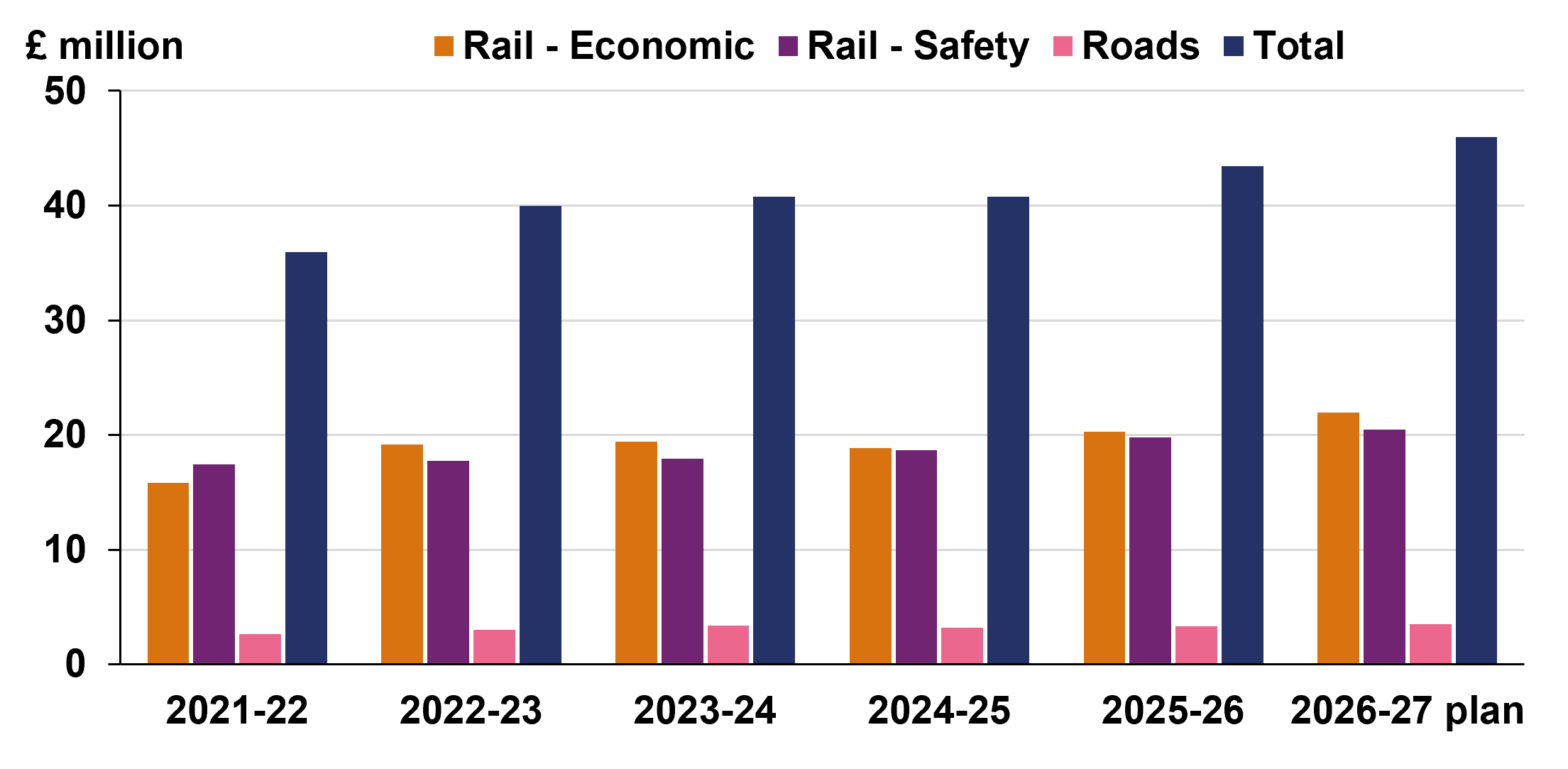
The following chart shows how our spending breaks down by category of spend over the last five years and for the 2026-27 plan.
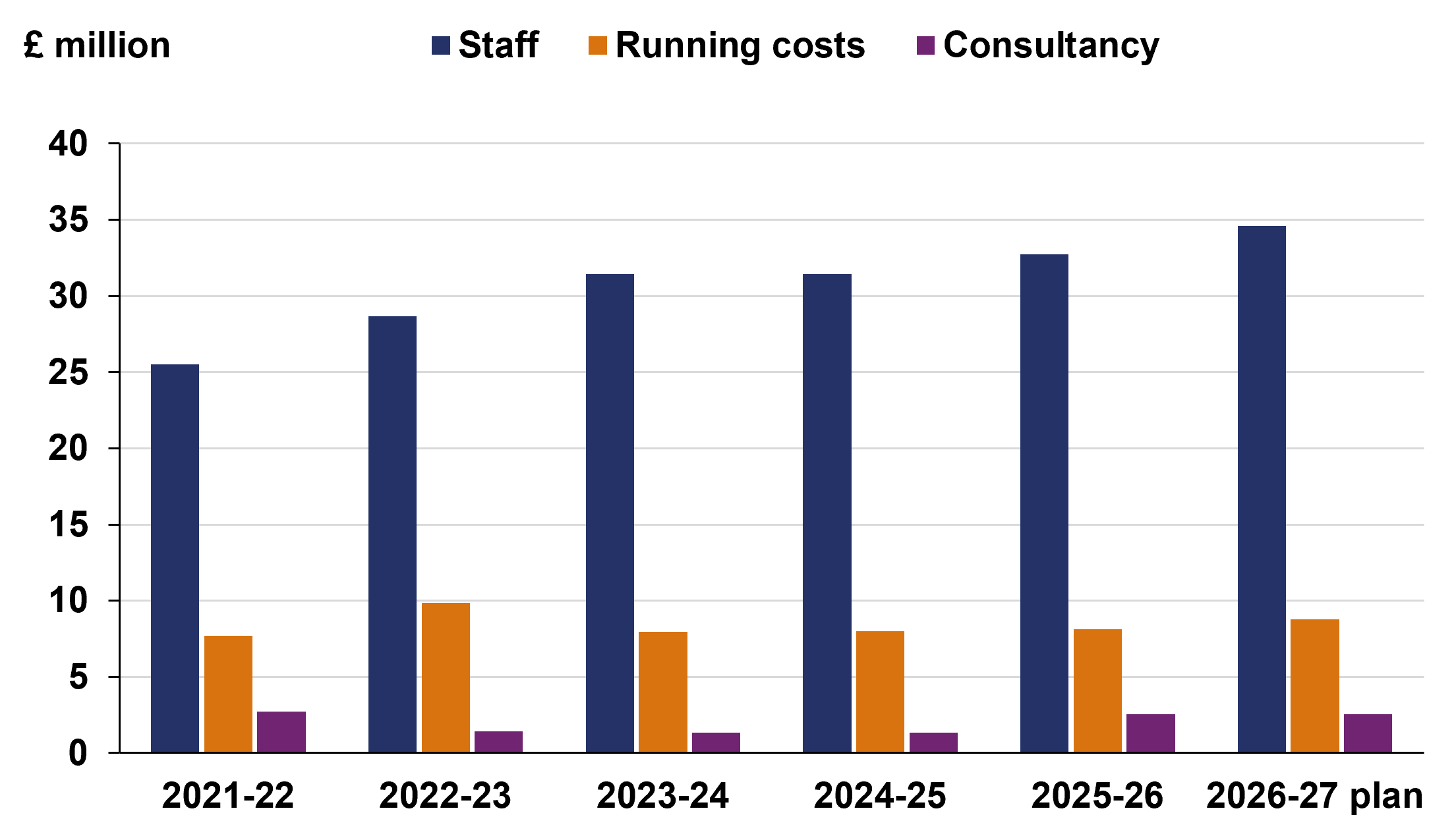
Capital expenditure
Net capital expenditure was £1.0m which was in line with the budget requested as part of the Estimates process. The chart below shows CDEL outturn for the last five years and for the 2026-27 plan. Capital expenditure was higher than usual in 2023-24 and 2024-25 due to new IFRS 16 leases being entered into.
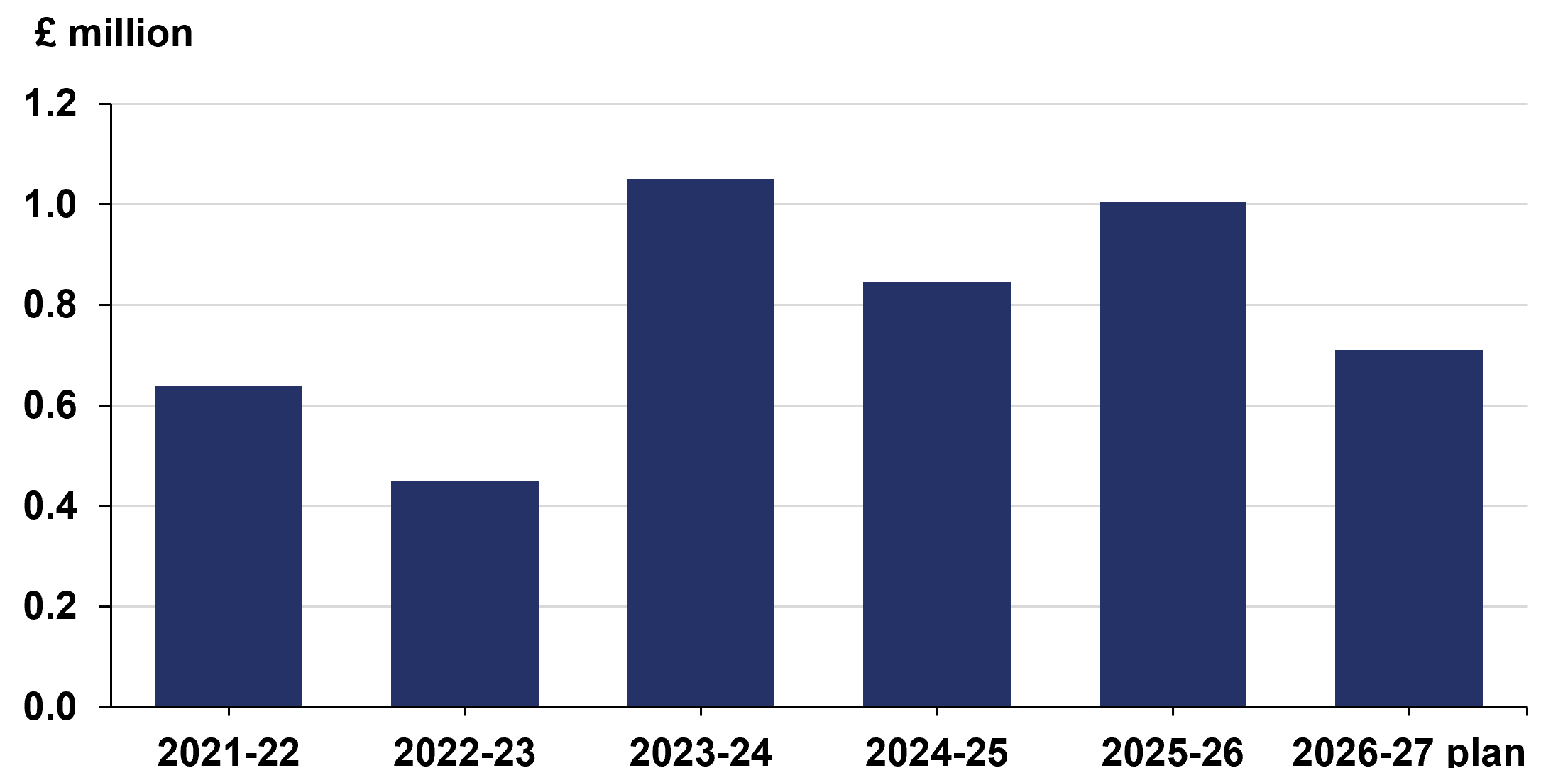
Net cash requirement
We had a net cash requirement (NCR) of £1.4m compared to £2.0m requested in the Estimate. We request an NCR to cover timing differences.
Future plans
We agreed our budget excluding depreciation, covering the period 2026-27 to 2028-29, with HMT Treasury through phase 2 of Spending Review 2025 (SR25). Our overall operating expenditure budget excluding depreciation will be as follows:
- 2026-27: £44.1m
- 2027-28: £44.4m
- 2028-29: £44.5m
The increase in expenditure reflects the ORR's expanded future role as a result of rail reform.
We have also secured £0.7 million of capital budget up to 2029-30, which we will use largely for renewal of operational assets.
Performance in other areas
Prompt payment
We are committed to the prompt payment of our suppliers and seek to pay all valid invoices as soon as possible. During 2025-26 92% of invoices were paid within 5 days (90% in 2024-25) and 100% of invoices were paid within 30 days (100% in 2024-25).
Complaints made to the Parliamentary Ombudsman
If someone is unhappy with the service they have received from us, they can raise a formal complaint in writing with the head of the public correspondence team. Their complaint will be acknowledged and passed to the relevant director to respond. If the complainant remains unhappy, they can escalate their concern to the Parliamentary and Health Services Ombudsman (PHSO). In 2025-26 we received ten formal complaints which were investigated, with none being escalated directly to the PHSO.
Responding to public correspondence
The majority of correspondence we receive relates to concerns about the rail industry and the strategic road network. ORR is represented at the cross-government complaint handlers’ forum and the DfT complaint handlers’ working group.
We aim to respond to 95% of all such enquiries within 20 working days of receipt, excluding safety cases which can often take longer than 20 days to investigate due to the complexity of often multi-part enquiries. We aim to respond to 100% of freedom of information requests withing 20 working days or within a permitted extension deadline.
| 2025-26 | 2024-25 | |
|---|---|---|
| No. of general enquiries and complaints received | 1,481 | 1,419 |
| % cleared within 20 working days | 96% | 98% |
| No. of freedom of information requests received | 183 | 156 |
| % responded to within 20 working days or within the permitted extension deadline | 100% | 100% |
Regulatory reform and growth agenda
We continued to support the government’s regulatory reform and growth agenda laid out in its Regulatory Action Plan: ‘A new approach to ensure regulators and regulation support growth’ during 2025-26.
We progressed a programme focussing on administrative burden reduction measures with Network Rail, National Highways and London St. Pancras Highspeed. This included streamlining governance, clarifying monitoring expectations and embedding more proportionate risk-based approaches to oversight, helping to reduce duplication and regulatory friction. We engaged on administrative burden reduction measures with Getlink who own and operate the UK side of the Eurotunnel and will progress identified opportunities in 2026-27.
To support investment in the rail network, we advanced our deep dive into the Rail Network Investment Framework, engaging with government and industry to identify improvements to the framework and related processes. This work is intended to improve confidence and transparency in funding and risk arrangements, supporting long-term investment and value for money. We implemented a number of findings including commissioning a Government Actuary’s Department (GAD) assessment of Network Rail’s funding, risk and reserve arrangements.
We undertook a review into our rail industry-facing service standards and in September 2025 identified 15 new commitments. Commitments included introducing new service standards, reducing processing times and making improvements to the processes and guidance that underpin existing standards. We committed to providing quarterly updates on all of our Key Performance Indicators (KPIs) and service standards to a new government owned Regulator Dashboard.
In October 2025 ORR was announced as the first regulator to be independently reviewed as part of the government’s Regulatory Action Plan. We supported the independent reviewer, Richard Judge, and officials from the Department of Business and Trade (DBT) who undertook both ORR focused and external engagement to examine how ORR is positioned to deliver its existing statutory responsibilities while preparing for significant rail sector reform and organisational transformation.
We responded to the Government’s AI and innovation agenda, developing an AI Action Plan setting out how our regulatory frameworks can enable safe, responsible adoption of new technologies without creating unnecessary barriers to innovation. Our AI Action Plan will be published in May 2026.
We contributed to wider regulatory reform and growth initiatives including engagement with the Department for Transport (DfT) on the development of regulator Growth Goals and a Regulator Sponsorship Charter.
Fraud prevention
We have a fraud prevention policy that ensures all employees understand how to prevent fraud and what to do if they suspect that fraud may be taking place. The policy sets out employees’ responsibilities under the Fraud Act 2006, the Bribery Act 2010 and the Public Interest Disclosure Act 1998, as well as under Managing Public Money. The policy is reinforced through ORR’s conduct and discipline policies. We have assessed ourselves against functional standard GovS 013 Counter Fraud and consider that we comply with all mandatory elements. No incidents of fraud or bribery have been identified in 2025-26. Fraud awareness training was provided to all colleagues in corporate functions during the previous financial year.
Engagement with Parliament
We are accountable to Parliament and the courts for our role as an independent health and safety and economic regulator of the railways and in our role as the regulator of National Highways in England. Our parliamentary accountability manifests itself practically in several ways, including the appointment of our Chair being subject to scrutiny by the Transport Select Committee and senior officials regularly contributing to parliamentary committee inquiries.
This year we have contributed to the parliamentary process at Westminster by giving oral evidence to the public bill committee stage of the Railways Bill and the Transport Select Committee’s examination of the Bill.
We offer expert and impartial information and advice to governments and parliamentarians, including members of the Welsh and Scottish Parliaments, to inform their scrutiny of rail and road issues. This year we have met with staff from the Transport Select Committee; the research and information service based in Parliament to assist MPs and their staff, on several occasions; and with members of staff from the House of Commons library.
We also provide independent assessment of delivery across key transport strands. We actively engage with parliamentarians on issues which are of interest to them and their constituents through briefings, correspondence, and proactive engagement. In 2025-26 we met with a number of parliamentarians from across the political spectrum. We hosted a parliamentary drop-in event at Westminster which all MPs and Peers were invited to as well as relevant members of staff, and an online webinar explaining rail industry finance for all parliamentarians. We held regular meetings with parliamentarians from across the political spectrum and answered their correspondence on matters they raised. We held roundtable meetings for MPs on open access and international rail travel access. We also produced four parliamentary newsletters which went to all MPs and Peers.
Feras Alshaker
Accounting Officer
3 July 2026