

This report explains the composition and organisation of ORR’s governance structures and how they support the achievement of our strategic objectives.
Directors’ report
Directors
Executive and non-executive members of the ORR Board are listed in the Governance Statement in 'the Board' section.
Register of interests
The register of interests of Board and Executive team members is reviewed annually and published on our website. The Board’s rule of procedure includes procedures for managing potential or perceived conflicts of interest.
Personal data-related incidents
There were no personal data-related incidents requiring notification to the Information Commissioner’s Office during the year.
Feras Alshaker
Accounting Officer
3 July 2026
Statement of Accounting Officer’s responsibilities
Under the Government Resource and Accounts Act 2000, HM Treasury has directed ORR to prepare for each financial year resource accounts, detailing the resources required, held, or disposed of during the year and the use of resources by ORR during the year. The accounts are prepared on an accruals basis and must give a true and fair view of the state of affairs of ORR and of its income and expenditure, statement of financial position and cash flows for the financial year.
In preparing the accounts, the Accounting Officer is required to comply with the requirements of the Government Financial Reporting Manual and in particular to:
- Observe the Accounts Direction issued by the Treasury, including the relevant accounting and disclosure requirements, and apply suitable accounting policies on a consistent basis;
- Make judgments and estimates on a reasonable basis;
- State whether applicable accounting standards, as set out in the Government Financial Reporting Manual, have been followed, and disclose and explain any material departures in the financial statements;
- Prepare the financial statements on a going concern basis; and
- Confirm that the annual report and accounts as a whole is fair, balanced and understandable, and take personal responsibility for the annual report and accounts and the judgments required for determining that it is fair, balanced and understandable.
HM Treasury has appointed the Chief Executive as ORR's Accounting Officer. The responsibilities of an Accounting Officer, including responsibility for the propriety and regularity of the public finances for which the Accounting Officer is answerable, for keeping proper records and for safeguarding ORR's assets, are set out in Managing Public Money published by HM Treasury.
As the Accounting Officer, I have taken all the steps that I ought to have taken to make myself aware of any relevant audit information, and to establish that ORR’s auditors are aware of that information. So far as I am aware, there is no relevant audit information of which the auditors are unaware.
Governance statement
This statement represents my assurance to Parliament that I am satisfied that ORR’s system of internal control is effective and supports good decision-making and risk management.
The performance described in this report does not happen by accident. It is the product of deliberate governance — a Board and executive team that set clear direction, scrutinise delivery against it, and are willing to challenge and be challenged. The accountability arrangements described in the pages that follow are not a separate exercise from ORR's regulatory work; they are what makes that work reliable, consistent and worthy of public trust. In a year of significant external change, that internal discipline has been particularly important.
I was appointed Accounting Officer on 27 April 2026. This statement covers the period 1 April 2025 to 31 March 2026, when John Larkinson was Accounting Officer. I have taken assurances from him in providing this statement.
Governance structure
Our governance structure for 2025-26 is shown below:
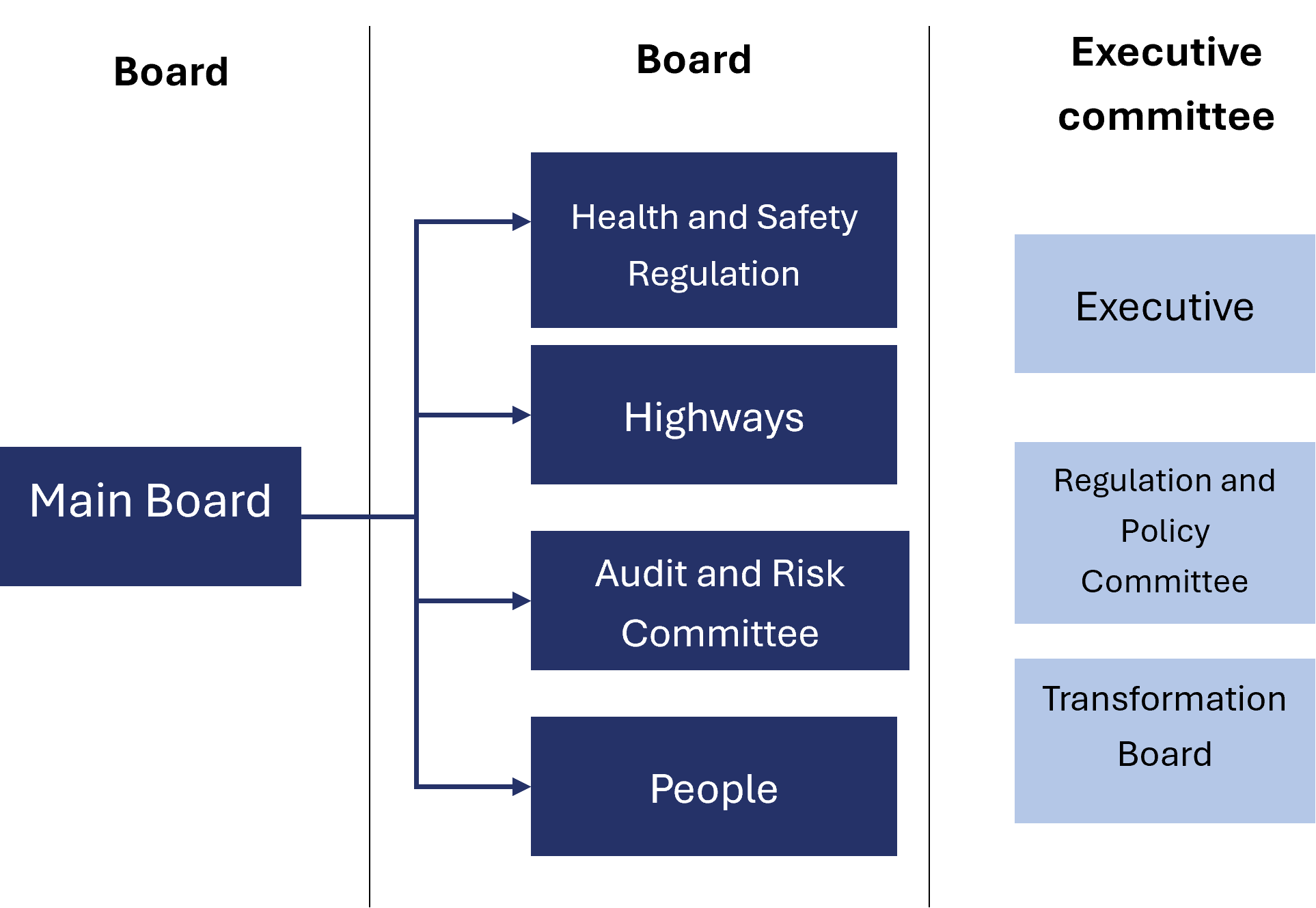
*The Board has agreed to establish a Transformation Subcommittee in 2026-27.
The Board
ORR is a non-ministerial government department led by a statutory board consisting of non-executive directors (including the Chair) and executive directors (including the Chief Executive). The Secretary of State for Transport makes appointments to the board for a fixed term of up to five years, which is renewable, but can only remove individual members for grounds specified under paragraph 2 of Schedule 1 of the Railways and Transport Safety Act 2003.
The Board provides support and challenge on the effective running and long-term strategy of ORR as well as on the department’s performance and risk management, and progress against delivery of our objectives and priorities. Members’ duties and responsibilities are set out in a code of conduct included in the Board’s rules of procedure. The Board’s objectives are aligned to key business and risk management activities.
Membership and appointment terms of ORR’s Board as at 31 March 2026 were as follows:
Non-executive directors
- Declan Collier, Chair, reappointed to 31 December 2028
- Xavier Brice, appointed to 16 January 2027
- Ian Dobbs, appointed to 1 December 2029
- Lindsey Fussell, appointed to 9 November 2030
- Madeleine Hallward, reappointed to 12 April 2030
- Anne Heal, reappointed to 30 September 2026
- Ann Metherall, appointed to 16 November 2030
- Daniel Ruiz, appointed to 16 January 2027
- Catherine Waller, appointed to 16 January 2027
Executive directors
- John Larkinson, Chief Executive, reappointed to 27 March 2027
- Richard Hines, Director, Railway Safety, appointed to 26 June 2029
Changes to board membership
The following changes to Board membership took place this year:
- The term of appointment of Justin McCracken (non-executive director) ended on 30 September 2025.
- Lindsey Fussell and Ann Metherall were appointed as non-executive directors from 10 and 17 November 2025 respectively.
During the year John Larkinson announced his plan to retire on 29 April 2026.
Board meetings
The Board held 11 formal meetings in 2025-26. During 2025-26, the Board applied focused scrutiny to a range of strategic and operational matters, including those arising directly from the pace of external change. Amongst the issues it examined and tested are as detailed below:
Key areas of discussion
- Regular reports on health and safety risks across the rail industry, with the Board reviewing emerging issues and systemic risks, such as the safety implications of adverse weather events and concerns around overspeeding, alongside ORR’s regulatory interventions.
- Regular updates on rail reform, including implications for ORR’s statutory responsibilities and initiating its transformation.
- Performance of Network Rail, including key messages from the Network Rail Annual Assessment, and scrutiny of efficiency, operational performance, asset reliability, and relevant environmental performance measures.
- CP7 passenger train performance reset, with oversight of readiness, delivery, and expected outcomes for passengers.
- Annual Assessment of London St. Pancras Highspeed (LSPH), including key messages and oversight of ORR’s approach to holding LSPH to account in PR24.
- Performance of National Highways, including review of Annual Assessment key messages and the Annual Assessment of Safety Performance on the Strategic Road Network, as well as efficiency, capability, and environmental performance.
- RIS3 Efficiency Review, with oversight of emerging findings on performance and improvement opportunities to be more efficient.
- Consideration of supply chain challenges influencing industry capability, performance outcomes, and the delivery of planned enhancements.
- Consideration of the implications of the Government’s approach to ensuring regulators and regulation support growth, including expectations around proportionate, transparent and outcomes-focused regulation, and how ORR can continue to deliver its statutory duties while supporting wider economic growth.
- Oversight of the work on the costs and benefits of safety, including the application of reasonable practicability in health and safety decision-making, and promotion of consistent, proportionate and value for money safety interventions across the rail industry.
- Findings and recommendations from ORR’s revenue protection review, including regulatory follow up actions and implications for industry compliance.
- Open access decisions on the West Coast and East Coast Main Lines, including regulatory judgments on consumer benefits, network capacity, and competition.
- Temple Mills International Depot – access decision under section 17 of the Railways Act 1993.
- Licence investigation into Northern Trains Limited, including review of evidence, regulatory approach, and next steps.
- Approval of ORR’s role in Transport for London’s funding framework, including governance and financial oversight implications.
- Candidate markets for potential market reviews or studies, informing future economic regulation priorities.
- Lower Thames Crossing, including emerging statutory duties and consideration of the regulatory regime required for the new infrastructure.
- Participation in a programme of engagement to better understand the needs of our stakeholders, including external speakers at Board meetings as well as field visits and stakeholder meetings focused on rail and road (in Cardiff and Leeds).
- Proposals for achieving efficiency savings under the Spending Review 2025, with scrutiny of organisational impacts, prioritisation, and delivery implications.
- Regular reporting of ORR’s financial performance and capability, progress against the business plan for 2025-26, Greening Government Commitments, and communications strategy, as well as corporate and strategic risks.
- The triennial independent review of Board effectiveness, with the Board considering the findings and agreeing actions to support continued good governance.
Audit and Risk Committee
The Audit and Risk Committee supports the Board in its responsibilities for issues of risk, control and governance and associated assurance. Its role is to review whether assurances presented are sufficient and comprehensive enough to meet the Board and the Accounting Officer’s needs, and to assess the reliability and integrity of those assurances, as well as to provide an opinion on how well the Board and Accounting Officer are supported in decision making and in discharging their accountability obligations (particularly in respect of financial reporting and risk management).
The Audit and Risk Committee comprises four non-executive directors (one of whom chairs the committee) and an independent member.
Lindsey Fussell was appointed to the Audit and Risk Committee from November 2025.
Xavier Brice stepped down from the Audit and Risk Committee in November 2025.
The Committee met five times during the year. Throughout the year, the Committee exercised active and enquiring oversight, probing both the adequacy of ORR's control environment and the management of risks specific to this period of reform. Among the substantive matters it scrutinised and challenged were the following key areas of discussion:
Key areas of discussion
- Key strategic and corporate risks, and how they are managed, including biannual reviews of the strategic risk register and quarterly reviews of the corporate risk register.
- Deep dives into areas of heightened risk, including the impact of digital systems failure on the railways and cyber security.
- Regular reporting on cyber, IT and security, covering threats, trends, incidents, and overall cyber effectiveness.
- Assurance on internal whistleblowing, including a standing item to notify the Committee of any disclosures at each meeting and provision for confidential escalation of any high impact disclosures.
- Assurance on the Non Executive Board Member declaration of interests process, including review of updated Cabinet Office guidance and confirmation that ORR’s arrangements remain effective and proportionate.
- The annual report and accounts and draft Governance Statement, as well as review of the draft framework agreement between ORR and the Department for Transport.
People Committee
The People Committee fulfils the functions of a remuneration and nominations committee. It has a specific role in reviewing the performance and remuneration of ORR’s senior civil servants including the Chief Executive, as well as advising the Chair on non-executive recruitment and induction. It maintains oversight of our people-related strategies (such as our reward strategy for employees below the senior civil service) and culture.
Xavier Brice and Ann Metherall were appointed to the People Committee from November 2025.
The Committee, which comprises four non-executive directors, met four times during the year.
Key areas of discussion
- The performance of ORR’s senior civil servants during 2024–25.
- ORR’s pay policy and non consolidated performance related pay awards for senior civil servants, ensuring alignment with Cabinet Office guidance.
- Implementation of ORR’s pay and reward strategy and diversity and inclusion strategy.
- People and employee relations data, including a deep dive into ORR’s recruitment processes.
- Refresh of the Trade Union Terms of Reference.
- The annual Civil Service People Survey results and progress against actions arising from the previous survey.
- Succession and talent management arrangements, including oversight of critical roles.
- Advice and updates on the recruitment of non executive directors and review of the induction plan for new non executive directors.
Health and Safety Regulation Committee
The Health and Safety Regulation Committee’s role is to develop, maintain, review and update ORR’s health and safety regulatory strategy and the overall adequacy of arrangements to meet ORR’s statutory duties. It consists of a mix of non-executive and executive members.
The Committee met four times during the year.
Justin McCracken stepped down as Chair of the Health and Safety Regulation Committee in September 2025. Ann Metherall was appointed as Chair of the Committee in November 2025.
The Committee applied rigorous scrutiny to safety performance across the network, with particular focus on emerging risks and the implications of rail reform for health and safety standards. Key matters considered during the year are below:
Key areas of discussion
- ORR’s strategic approach to health and safety regulation, including key performance indicators, risk profiling, formal enforcement activity, and planning of regulatory interventions.
- Industry and dutyholders’ health and safety performance, with scrutiny of emerging risks, incident trends, and operator-specific safety issues.
- Safety performance and management of mainline and non mainline sectors, including heritage operators, London Underground, trams, and the Channel Tunnel (as an internationally regulated cross border railway with specific bi national safety obligations).
- Relevant ‘lessons learned’ reviews, drawing on incidents and regulatory findings from within and outside the rail industry, to inform improvements in ORR’s oversight and industry practice.
- Proposal for reform options for the Train Driving Licences and Certificates Regulations 2010 (TDLCR), including potential updates to competence and licensing arrangements for train drivers.
- Consideration of appropriate Board engagement with safety enforcement decisions, ensuring clarity on timely communication.
- Outline and monitoring of the Railway Safety Directorate’s regulatory excellence programme, supporting continuous improvement in ORR’s regulatory capability.
- Measures to drive sustainable improvements in health and safety investigations, including consistency of methodology, timeliness, and quality assurance of investigation outcomes.
Highways Committee
The purpose of the Highways Committee is to oversee the work of the highways team, advise the ORR board and act as a forum for policy development with senior colleagues. It consists of a mix of non-executive and executive members.
Lindsey Fussell was appointed to the Highways Committee from November 2025.
The committee met four times in the year.
Key areas of discussion
- Reports from ORR’s monitoring framework for National Highways, providing oversight of delivery against the Road Investment Strategy and licence requirements.
- National Highways’ capital planning and asset management, including approaches to long term investment, renewals planning and the condition of the network.
- Operational performance across the Strategic Road Network, with particular focus on safety, efficiency and incident management.
- National Highways’ safety performance, including progress in delivering its safety improvement plan and strengthening its safety management systems.
- Consideration of emerging issues relating to major road projects, including early oversight discussions on potential future regulatory responsibilities for schemes such as the Lower Thames Crossing.
- Updates to the National Highways Holding to Account Policy, ensuring ORR’s enforcement and escalation approach remains clear, effective and proportionate.
Meeting attendance
Meeting attendance in 2025-26 was as follows:
| Member | Board | Audit and Risk Committee | People Committee | Health and Safety Regulation Committee | Highways Committee |
|---|---|---|---|---|---|
| Declan Collier | 11/11 | - | - | 4/4 | - |
| Xavier Brice | 11/11 | 4/4 | 1/1 | 4/4 | - |
| Ian Dobbs | 10/11 | 5/5 | - | 3/4 | - |
| Lindsey Fussell | 3/4 | 1/1 | - | - | ½ |
| Madeleine Hallward | 9/11 | - | - | 4/4 | 4/4 |
| Anne Heal | 11/11 | - | 4/4 | - | 4/4 |
| Richard Hines | 11/11 | - | - | 4/4 | - |
| John Larkinson | 11/11 | - | - | 4/4 | 4/4 |
| Justin McCracken | 5/6 | - | 2/2 | 2/2 | - |
| Ann Metherall | 4/4 | - | 1/1 | 2/2 | - |
| Daniel Ruiz | 10/11 | 5/5 | - | - | 3/4 |
| Catherine Waller | 9/11 | 3/5 | 4/4 | - | - |
| Nicholas Bateson [note 1] | - | 5/5 | - | - | - |
Note 1: independent member of the Audit and Risk Committee, reappointed to 30 September 2027.
Meetings of the Board, Highways Committee and Health and Safety Regulation Committee were rescheduled in March 2026, affecting attendance of those meetings.
Board effectiveness
The Board reviews its own performance, and that of its committees, each year, with an external review conducted at least every three years.
An independent review of Board effectiveness, carried out by RedQuadrant this year, concluded that ORR has a high-performing Board, with members described as highly competent, skilled and resilient. The review highlighted particularly strong relationships within the non-executive cohort and between non-executive directors and the executive leadership team — a foundation that has proved important during a period of significant organisational and sector-wide change.
The review found the Board to be collaborative, respectful and well-chaired, with the Chair playing an active role in supporting and developing Board members. The culture at Board was described as collegiate and inclusive, with constructive challenge and clear, well-structured decision-making processes.
The review highlighted several areas of good practice, including:
- strong strategic focus and a shared understanding of the Board’s role;
- well-prepared meetings supported by high-quality board packs and excellent secretariat support;
- effective engagement with stakeholders, including through regional meetings, external speakers and joint workshops;
- positive Board-Executive dynamics that support informed debate and balanced challenge;
- active oversight of organisational performance and sector developments, underpinned by an outward-facing Board with a strong interest in the industries ORR regulates.
It also identified opportunities to strengthen effectiveness further as ORR prepared for rail reform and organisational transformation. The following were identified as broad areas in terms of recommendations and future focus:
- Maintain an awareness of the respective roles of ARC and the Board in relation to risk and continue to ensure that the Board retains the overview of strategic risk management.
- Explore a mechanism (key performance indicators) for the Board to assess progress against the strategic objectives of the organisation.
- Allow time for, and development of, the Board (and the new non-executive directors) to help them lead the ORR through the transition to the ‘new’ state.
- Consider an increase in the number of ‘strategy’ days given the scale of change within the organisation whilst potentially slightly reducing the number of main board meetings.
- Regularly review the organisational risk appetite in the context of significant sectoral-related organisation change.
The Board remains committed to continuous improvement and is acting on the recommendations from this year’s external review.
The Board and its standing committees operate within the Board's Rules of Procedure, which set out the governance framework for decision-making and oversight. The Board also reviews its Rules of Procedure biennially, with the most recent updates agreed in November 2025. All Board members, including executive members, are subject to a formal annual appraisal led by the Chair, and committee chairs report to the Board after each meeting, with minutes circulated to all members.
Conflicts of interest
The Board’s rules of procedure include strict guidelines on conflicts of interest. A register of Board members’ interests is available on our website, and members declare interests on agenda items at the start of every Board and Committee meeting. Where there is a potential risk of a conflict of interest, the Board determines whether the relevant member should withdraw from the discussion of the item. During the year, a small number of such withdrawals took place in line with our procedures, and all instances were recorded in the minutes as required.
Compliance with the Code of Practice on Corporate Governance
ORR is a non-ministerial government department with its functions vested in a statutory Board appointed by the Secretary of State. On that basis, there are some departures from the model envisaged in the ‘Enhanced Departmental Board Protocol’ for ministerial departments, as follows:
- The Board reserves to itself any changes in its governance and scrutiny thereof, so there is no committee with responsibility for governance.
- The senior management team and the Board do not include a finance director as ORR is not a spending department.
- The Board has a role in deciding individual reward for senior civil servants (further to the recommendation of the People Committee). This approach adds a useful element of independence and objectivity given the small size of the department.
These exceptions aside, the Board considers that ORR is compliant with the principles established in the Code for central government departments. The Board and senior team operate according to the recognised precepts of good corporate governance in business, namely: leadership, effectiveness, accountability, and sustainability.
The Executive
As Chief Executive, I head ORR and am also the Accounting Officer. Executive governance arrangements are based around three committees. Each committee involves a sub-set of executive directors as appropriate.
- The Executive Committee meets weekly and oversees operational issues such as progress against the business plan and allocation of resources for business planning.
- The Regulation and Policy Committee meets three times a month and assists the development of safety strategy, policy, and reviews the overall adequacy of arrangements to meet ORR’s statutory duties.
- The Transformation Board meets once a month and provides strategic oversight of ORR’s transformation programme, ensuring that programmes are aligned with organisational priorities and that progress, risks, and benefits are managed effectively.
Managing outside interests
Leavers from ORR are reminded of the business appointment rules (BARs) in place for departing civil servants, as part of our leaving process. Similarly, as part of the onboarding process new joiners are asked to disclose any conflict of interest (this is in addition to an annual disclosure process) and are referred to the employment handbook and policy available on our intranet.
Application of business appointment rules
In compliance with business appointment rules, we are transparent in the advice given to all grades of employees and those at SCS level. Our conflict of interest policy is published on our intranet and we advise our employees that there must never be any reason for people outside ORR to suspect that our decisions may be influenced by private interests. We therefore impose certain restrictions on employees’ financial and non-financial activities. These requirements form part of their employment contract and the Civil Service Code. In 2025-26 there were no exits where BARs were requested or set. In 2024-25 there was one exit where BARs were set which was at the SCS1 grade.
Internal whistleblowing
All employees at ORR are required to comply with the terms of the Civil Service Code, including the core values of integrity, honesty, objectivity and impartiality. The Code also sets out what an employee must do if they believe they are being required to act in a way that conflicts with the Code, or if they become aware of actions of others which they believe are in conflict with the core values.
Our ‘whistleblowing and raising a concern’ policy is available to all colleagues on our intranet. In 2025-26 one internal whistleblowing complaint was raised and closed after an investigation (2024-25: one complaint raised and closed).
Internal whistleblowing incidents are notified to the Audit and Risk Committee.
Our internal whistleblowing arrangements are considered to be effective, with appropriate governance in place, appropriate channels for raising concerns, and appropriate protections for whislteblowers.
External whistleblowing
ORR is a prescribed person under UK whistleblowing law and values the role whistleblowers can play in ensuring effective regulation. The law allows employees and ‘workers’ to make disclosures of information in the public interest, by giving them protection from victimisation or detriment by their employer.
Whistleblowers can talk to ORR about their concerns of things that have happened, are currently happening, or are likely to happen, if they believe it raises a matter of wider public interest relating to: the provision and supply of railway services; or any activities related to the Office of Rail and Road’s functions.
An annual report of whistleblowing disclosures received by ORR in its capacity as a prescribed person is published on our website.
Risk management
Responsibility for the day-to-day management of risk is delegated to the Executive Committee. The Audit and Risk Committee provides assurance to the Accounting Officer and the Board on the adequacy and effectiveness of our risk management framework.
Risk is managed in accordance with our risk management strategy, which has been approved by the Executive Committee and endorsed by the Audit and Risk Committee. The strategy has been in place for the reporting year and remains in place at the date of approval of this report. The strategy is underpinned by a risk manual that sets out practical guidance for colleagues on the operational application of risk management. The strategy complies with the main principles set out in HM Treasury’s risk management guidance, ‘The Orange Book’. Risk management is the responsibility of all colleagues, supported by organisation-wide training available through our e-learning platform.
Our corporate risk dashboard focuses primarily on operational and reputational risks with a close proximity that require active management. Each directorate maintains its own risk register, with nominated risk champions responsible for collating risks at directorate level and ensuring that risks identified at working level are appropriately captured. Risk champions meet quarterly to review the most significant risks within their areas and to provide challenge and insight on risks across the organisation.
The corporate risk dashboard is reviewed by the deputy directors’ group, which moderates risk scoring and provides assurance on risks within their respective areas. The dashboard is then interrogated by the Executive Committee, which tests and challenges the most significant risks. Corporate risks are reviewed quarterly by the Audit and Risk Committee, which also undertakes deep dives into specific areas where additional scrutiny is considered beneficial. The key corporate risks actively managed during the year are set out in the Performance Analysis section under 'Principal risks'. Towards the end of the year, we began to incorporate resilience-based thinking into our risk methodology, with further work planned to embed this approach in 2026-27.
The strategic risk register identifies risks that could have a serious, critical or existential impact on our ability to deliver our strategic objectives. These risks are typically longer-term in nature, change less frequently, and require less active day-to-day management. Strategic risks are informed by an annual horizon-scanning exercise and are reviewed quarterly by the Executive Committee and biannually by the Audit and Risk Committee. The Board scrutinises the key strategic risks facing ORR on an annual basis.
Quality assurance of analysis and publications
We have up-to-date quality assurance guidance, including an analytical assurance framework, robust processes and accessible tools in place for effective risk management of analysis and decisions. This helps to inform and support our analysts, policy, and decision makers.
We publish our list of business critical models (BCMs) on our website. We assess the fitness for purpose for each of the BCM quality assurance and governance processes using a five-pillar methodology and a scoring system. This is in alignment with the recommendations from Sir Nick Macpherson’s review of quality assurance of government models, the Aqua Book, the government functional standard and best practice across government. The internal BCM panel continues to support cross-working between model leads and to strengthen quality assurance processes.
Information assurance
We have an information strategy that forms part of our overall technology strategy. ORR is registered with the Information Commissioner as a data controller and follows the requirements of the Data Protection Act 2018 and the UK General Data Protection Regulation. As required by law, we have a data protection officer who advises us compliance. Our privacy notice is available on our website.
We maintain a risk register on information risk and oversee our compliance with our government information assurance requirements through quarterly reporting to the Audit and Risk Committee and yearly assurance to Cabinet Office through the Departmental Security Health Check. This checks our compliance with the requirements of the Cabinet Office’s minimum security standards where they apply to us in relation to physical, personnel and incident management standards.
Cyber security standards for information systems are regularly reviewed both internally by our security team, and externally through the Cabinet Office’s GovAssure programme, as well as through independent audits using penetration test, tabletop exercises or purple team events. Our ongoing cyber security plan delivers continuous improvements and enhances the resilience of our networks and devices against cyber-attacks. This oversees alignment with the Government’s Security Strategy 2030 and helps ensure appropriate safeguards against emerging threats are in place.
Internal audit
Our internal auditors for 2025-26 were RSM. Throughout the year RSM delivered a programme of audit reviews which was developed jointly with the Executive and endorsed by the Audit and Risk Committee. The plan was designed to address the key risks facing the organisation and to provide assurance that our key business processes are fit for purpose. The most that the internal audit service can provide to ORR is reasonable assurance that there are no major weaknesses in those systems audited. Based on the reviews undertaken and specific testing and evaluation performed during the year to 31 March 2026, RSM’s opinion is that ORR has an adequate and effective framework for risk management, governance and internal control, with some further enhancements to the framework needed to ensure that it remains adequate and effective.
During the year we have implemented a number of recommendations arising from the 2024-25 audits of cyber risk assessments, data governance and business continuity.
Recommendations made by RSM during 2025-26 have either been implemented or, where not yet completed, there are action plans in place to complete them in 2026-27.
Functional standards
We adhere to Cabinet Office’s functional standards and perform an annual assessment of our compliance against these. Most mandatory elements have been met at 31 March 2026. Where they have not been met and they are considered appropriate for ORR, there is an action plan in place to achieve compliance.
Conclusion
As Accounting Officer, I am personally responsible and accountable to Parliament for the organisation and quality of management in the department, including its use of public money and stewardship of its assets. The system of internal control in place to support me in this capacity accords with all relevant HM Treasury guidance.
I have considered assurances provided by my predecessor, John Larkinson, alongside ORR’s governance framework, evidence supporting this statement, assurances provided by the Audit and Risk Committee and senior management, and the work of internal audit.
I have taken all the steps that I ought to have taken to make myself aware of any relevant audit information and to establish that ORR’s auditors are aware of that information. I am not aware of any relevant audit information which has not been disclosed to the auditors.
I have concluded that ORR has a strong system of internal control and risk management in place, with the necessary policies and procedures to support ORR in achieving its strategic objectives.
I confirm that the annual report and accounts are fair, balanced and understandable. I am personally responsible for them, and for the judgments required to determine this.
Feras Alshaker
Accounting Officer
3 July 2026