

The performance overview provides a short summary of the annual report and accounts.
Our purpose
To protect the interests of rail and road users, improving the safety, value and performance of railways and roads, today and in the future.
Our values
We are part of the Civil Service and its code underpins our values, which are:
- Inclusive
- Professional
- Ambitious
- Collaborative
Our strategic objectives
- A safer railway: ORR is the health and safety regulator for all of Britain’s rail industry. Our strategic objective is to enforce the law and ensure that the industry delivers continuous improvement in the health and safety of passengers, the workforce and public, by achieving excellence in health and safety culture, management and risk control.
- Better rail customer service: we have a key role to improve the rail passenger experience in the consumer areas for which we have regulatory responsibility and take prompt and effective action to improve the service that passengers receive where it is required.
- Value for money from the railway: we support the delivery of an efficient, high-performing rail service that provides value for money for passengers, freight customers, governments, and taxpayers. We also regulate other significant elements of the national rail infrastructure, including London St. Pancras Highspeed and the UK portion of the Channel Tunnel.
- Better highways: National Highways operates the strategic road network, managing motorways and major roads in England. Our role is to hold it to account for its performance and delivery, driving value for the taxpayer.
Who we are and how we work
The Office of Rail and Road (ORR) is an independent, non-ministerial UK government department, established by and accountable directly to Parliament. We protect the interests of current and future rail and road users, overseeing the safety, value and performance of the railways and the performance and efficiency of England’s strategic road network.
We regulate Network Rail, including setting the targets it is expected to achieve, and report regularly on its performance. We regulate health and safety standards and compliance across the whole rail industry. We oversee competition and consumer rights issues – driving a better deal for rail passengers and taxpayers. We also regulate the London St. Pancras Highspeed link to the Channel Tunnel.
We hold National Highways to account on its commitments to improve the performance and efficiency of England’s strategic road network.
As an independent regulator, we operate within the framework set by UK legislation and are accountable through Parliament and the courts.
ORR comprises a governing board appointed by the Secretary of State for Transport and over 360 professionals including engineering, railway safety, legal, economics and competition, operating from six offices across the country.
Organisational structure
The diagram below shows how we are structured. Each directorate is headed by a director. Within each directorate, there are typically several teams.
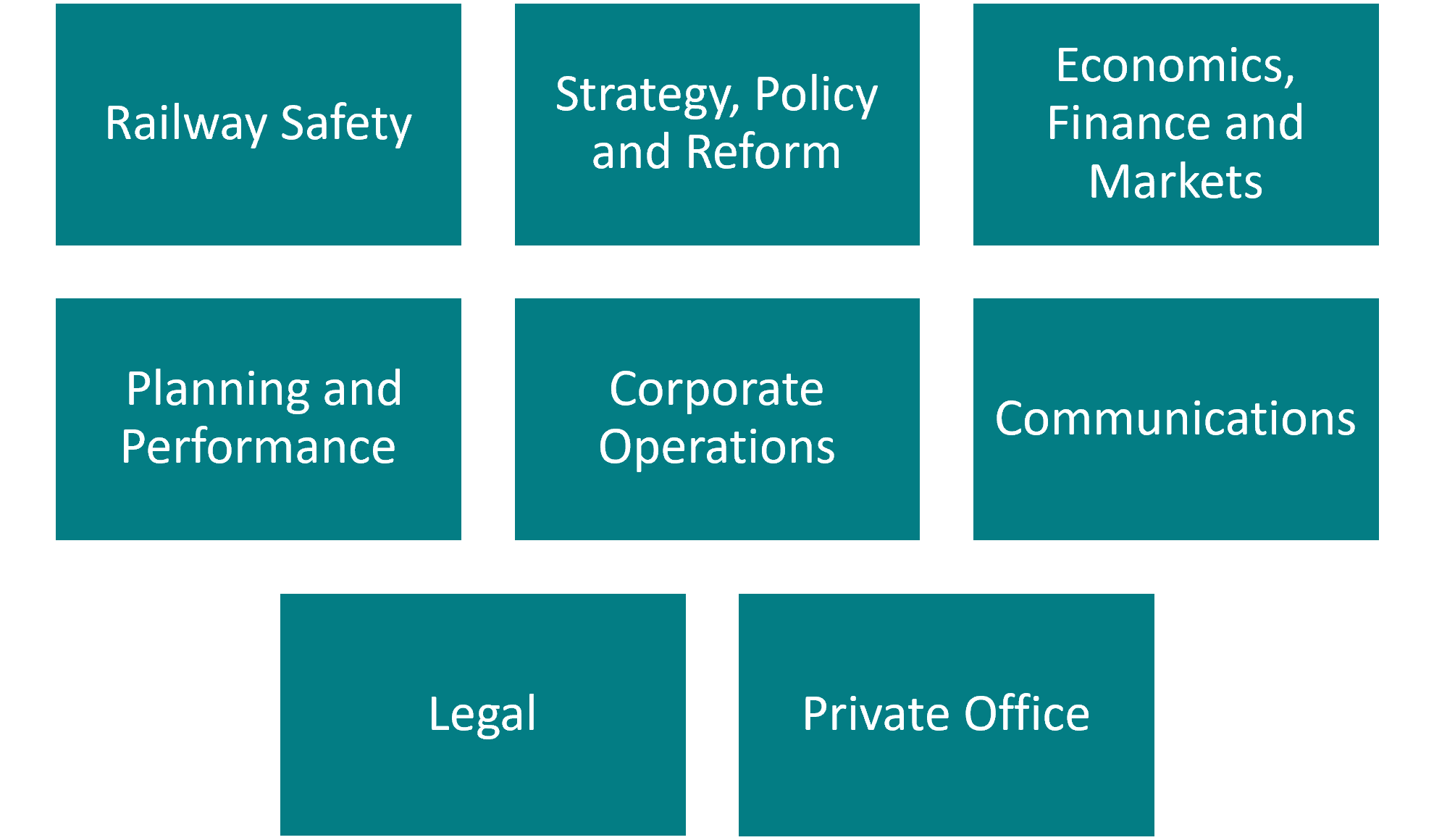
The focus of each of the directorates in 2025-26 was as follows:
Railway Safety – ensuring duty holders across Britain’s rail industry manage health and safety risks effectively and meet their statutory duties.
Strategy, Policy and Reform – strategic direction of ORR and our role in rail reform; issues around access to the rail network, the licensing of rail operators, international policy, and our role in protecting rail passengers by monitoring and enforcing passenger-facing licence conditions as well as consumer law.
Economics, Finance and Markets – preparation and delivery of funding period reviews; monitoring and reporting on Network Rail’s financial performance and efficiency; cross-industry financial and economic analysis; competition work including market studies and casework.
Planning and Performance – holding Network Rail to account for its performance and its stewardship of the national railway network infrastructure; olding to account London St. Pancras Highspeed, the company which operates the line between St. Pancras and the Channel Tunnel; production of rail statistics; monitoring whether the Government’s Road Investment strategy is being delivered in our role overseeing National Highways and its management of the strategic road network.
Corporate Operations – finance, procurement, HR and organisational development, IT, facilities, estates.
Communications – explaining ORR’s role, decisions and impact and supporting transparency, accountability and confidence among stakeholders and the public.
Legal – providing legal services to the ORR.
Private Office – providing day-to-day support to the Chief Executive while contributing to the effective functioning of the Board and supporting the Non-Executive Directors.
2025-26 overview
April
- We concluded the final industry engagement, evidence gathering and analysis phase in the development of our Revenue Protection Review report.
- We launched our deep dive into the Rail Network Investment Framework, as part of a commitment to support the Government's new approach to ensure regulators and regulation supports growth.
May
- We published an updated level crossings Strategic Risk Chapter, followed by a targeted national inspection campaign focusing on safety at mainline passive level crossings.
- We recommended improvements to how industry enforces revenue protection, improving fairness, consistency and transparency for customers while ensuring that train operators and retailers can robustly address deliberate and persistent fare evaders.
- We reported on how staff at busy stations communicate on the needs of passengers who have been assisted onto trains, leading to the start of trials by five operators on a switch to digital communications.
June
- We convened a roundtable with senior rail industry leaders and the four main unions on welfare provision for railway workers, to understand the main issues and bring about necessary improvements.
July
- We published our annual report of health and safety on Great Britain's railways, concluding that the network remains one of the safest in Europe but must retain a relentless focus on safety throughout rail reform.
- We published our annual assessment of Network Rail, concluding that the company is delivering efficiently but that financial constraints require careful management.
- As part of our control period 7 (CP7) train performance reset, we consulted on the passenger train performance targets for the remaining three years of the control period (2026-2029).
- We published our annual report on London St. Pancras Highspeed, finding significantly improved train performance.
- We held our annual Year in Rail event, for stakeholders to hear about our work, expanding the discussion to cover rail reform and “the track ahead”.
- We continued our successful summer internship programme to develop early career talent, part of our focus on building new capabilities.
August
- We published our provisional findings from our review of the Transparency Order, that was put in place by the Competition Commission in the franchised passenger rolling stock leasing market.
- We continued to monitor progress in Network Rail’s Western & Wales region, as it continued to make improvements to train performance following our licence breach investigation in the previous year.
September
- We closed out our investigation into National Highways’ performance and capability, finding that the company had come into compliance with its licence, following substantial implementation of its improvement plan.
- We launched a new online portal to modernise train driver licensing processes, support anticipated increases in application volumes, reduce administrative burden for operators, and prepare for forthcoming policy changes. While initial implementation created delivery pressures, resilience has since been strengthened and performance is improving.
- We issued our annual market monitoring report on open access services, giving an overview of the trends in passenger outcomes, service growth and revenues and comparing these outcomes to those for contracted passenger services.
October
- We undertook a strategic intervention on overspeeding, following several significant incidents on the rail network. We convened sector stakeholders to better understand risk and set short-, medium- and long-term actions to deliver necessary improvements.
- We approved Virgin Trains’ application for access to Temple Mills International depot, opening the door to future international train services through the Channel Tunnel and unlocking up to £700 million in private sector investment.
- As part of our early careers programme, we ran the first of three business insight days to promote career opportunities for young people and those from disadvantaged backgrounds.
- We published new streamlined guidance for rail investors, to remove barriers and encourage more third-party investment in Britain’s rail infrastructure, contributing to economic growth.
November
- We completed our efficiency review of National Highways’ strategic business plan for the third road investment period, holding the company to account on whether its proposals are sufficiently challenging and deliverable within the available financial resources.
- We published our annual rail industry finance (UK) statistics, an important barometer of the financial health of Britain’s railways, reporting that a rise in train fare revenue has contributed to a fall in government funding required.
- We gave in-person evidence to the UK Parliament’s Transport Select Committee on rail reform and the establishment of Great British Railways under the Railways Bill, followed by evidence to the Bill Committee in January.
December
- Our improvement notice to Network Rail to control railway workers’ exposure to welding fumes was affirmed following an earlier appeal, driving action by the company to achieve compliance in this important area of occupational health and safety.
- We published new targets for passenger train performance in England and Wales for the remaining three years of control period 7 (2026-2029).
- We concluded our review of the Transparency Order designed to improve competition in the passenger rolling stock leasing market.
- We published a report for Welsh Government demonstrating how, by setting biodiversity performance measures for the railway, we are meeting our legal duties to seek to maintain and enhance biodiversity in Wales.
- We published details of the initial reduction in regulatory burden we have agreed with Network Rail.
January
- We published the findings of our review of the Retail Information Code of Practice, to strengthen the clarity, accuracy and transparency of ticketing information provided to passengers.
February
- We completed safety certifications and authorisations for train operating companies South Western Railway, C2C, Greater Anglia and West Midlands, which is central to bringing them into public ownership as part of the government’s rail reform programme.
- We published regional benchmarking data providing transparency on the performance of National Highways’ six regions against a variety of targets including safety, delays and maintenance.
- We held a Westminster drop-in session on rail reform, attended by more than 45 parliamentarians and other guests, and took part in a panel discussion by the All-Party Parliamentary Rail Group.
March
- We published our refreshed policy on how we hold National Highways to account, supporting government goals to minimise regulatory burden, while ensuring that public funds are invested wisely to sustain and support growth.
- We produced our assessment of safety performance on the strategic road network, reporting that National Highways would miss its target for the end of 2025.
- We found Northern Trains in breach of its licence in relation to provision of disability awareness training for its passenger-facing staff.
- We reported on rail industry productivity, looking at how the system as a whole was performing in terms of outputs delivered for the resources used, as well as passenger, freight and infrastructure manager productivity.
Performance against the business plan
The work we have carried out in the year is set out in more detail in the ‘strategic objective’ chapters in the performance analysis section. We achieved 16 out of 19 valid service standards for 2025-26 and 43 out of 44 business plan deliverables.
Our funding
Our budget is agreed with HM Treasury through the Spending Review process and is subsequently authorised by Parliament through the Supply Estimates procedure. Our 2025-26 budget was agreed with HM Treasury during Phase 1 of Spending Review 2025, with budgets for the period 2026-27 to 2028-29 agreed during Phase 2.
Our rail functions are funded almost entirely by the railway industry, principally passenger and freight operating companies and Network Rail. We operate within a defined budget and recover our costs through a safety levy and an economic licence fee charged to the industry. We also recover regulatory costs associated with the Channel Tunnel, London St. Pancras Highspeed and Northern Ireland by charging the relevant organisations. Charges are calculated on a full economic cost basis and are set to recover costs only, with no element of profit. Taken together, our charges and other income fully cover our rail-related costs. Our highways function is funded through a grant from the Department for Transport (DfT). In addition, Parliament provided a token resource budget of £2,000.
Our capital departmental expenditure limit (CDEL) was £1.02 million in 2025-26 (2024-25: £1.22 million).
Where we spent our money
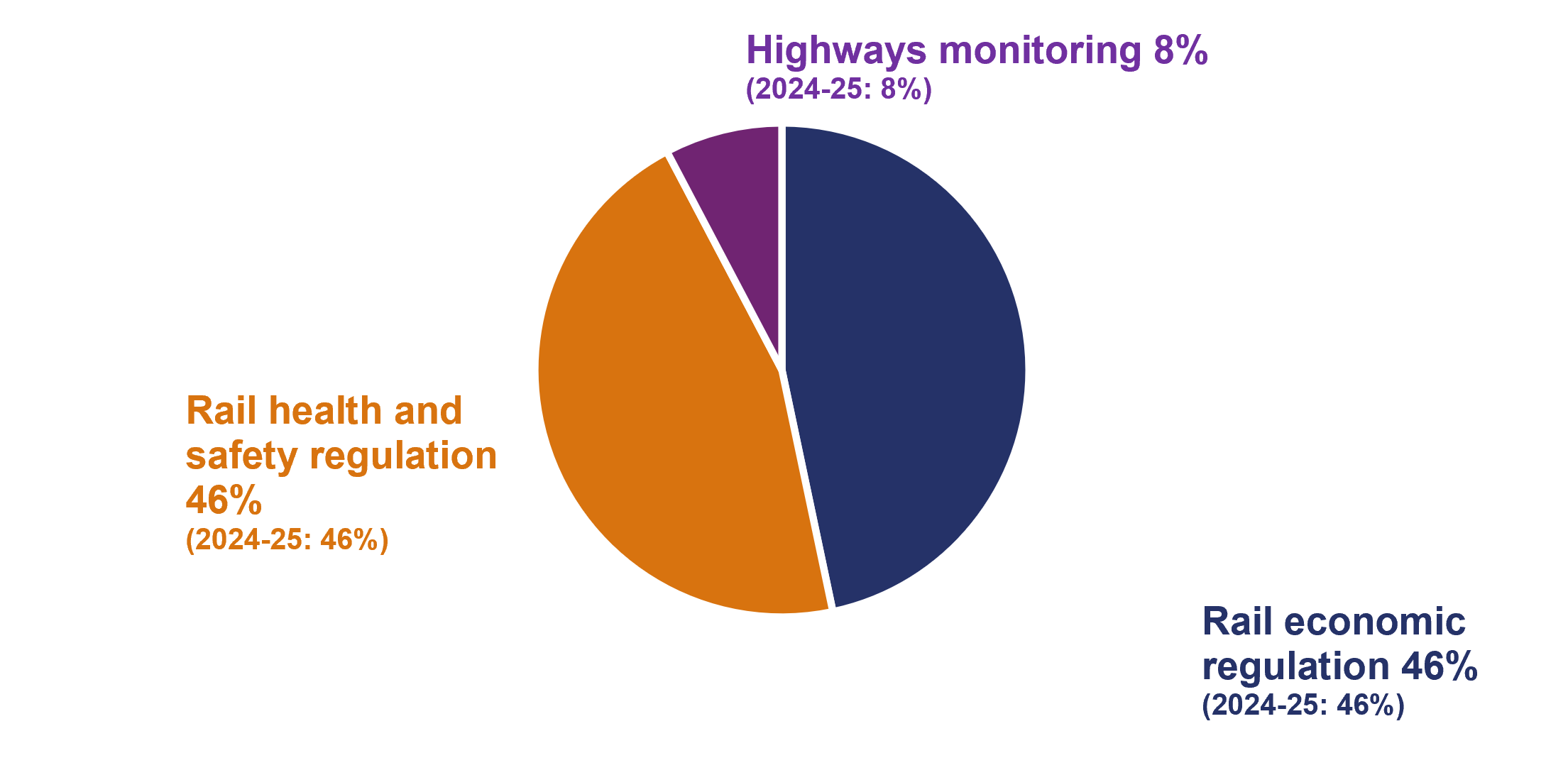
In 2025-26 we spent a total of £43.5m (2024-25: £40.8m) which was in line with our budget of £43.5m. The chart below shows expenditure by key work area.
A more detailed comparison of what we spent this year compared to the Estimate is provided on the section on our finances.
Principal risks
The key corporate risks we faced and actively managed in 2025-26 were:
- not keeping pace with emerging cybersecurity threats which results in a cyber-attack on the critical infrastructure of the business;
- our reputation as a health and safety regulator is diminished by critical public scrutiny, challenges to enforcement decisions or application of legal framework, or negative media coverage;
- new plans for rail may not consistently reflect the current industry structure and regulatory framework;
- ORR’s transformation programme does not deliver coherent, organisation-wide readiness for Day 1 of Great British Railways owing to internal resourcing and capability and external dependencies; and
- delays and challenges in setting the Road Investment Strategy (RIS3) lead to a loss of confidence in the roads reform system and impact ORR’s advice to the Secretary of State.
Details of how we mitigated these risks in the year are set out in the performance analysis on our section on risk profile.