

Asset performance, condition and data
Overall asset performance remained strong this reporting year, with London St. Pancras Highspeed (LSPH) continuing to meet its operational requirements across both route and station assets. Asset capability remains unchanged, with the infrastructure supporting high‑speed passenger services without constraint.
Station asset performance met target this year. Lifts, escalators and travelators (LETs) achieved 98.4% availability against a 98.0% target, and all four stations delivered average asset availability of 99% or better. This represents an improvement compared with the previous three years (when we reported that LSPH had been missing its target for these assets) and reflects targeted operational and maintenance interventions.
However, while there has been an overall improvement, a few specific LET assets have caused significant disruption to stakeholders. At Stratford, there have been escalator availability issues during high-demand periods. There were planned outages for renewals, but then faults occurred after renewal, resulting in reduced capacity at critical times. Train operators expressed concern that these issues required additional operational resource to manage passenger flows and that this should be considered when looking at the headline availability metrics.
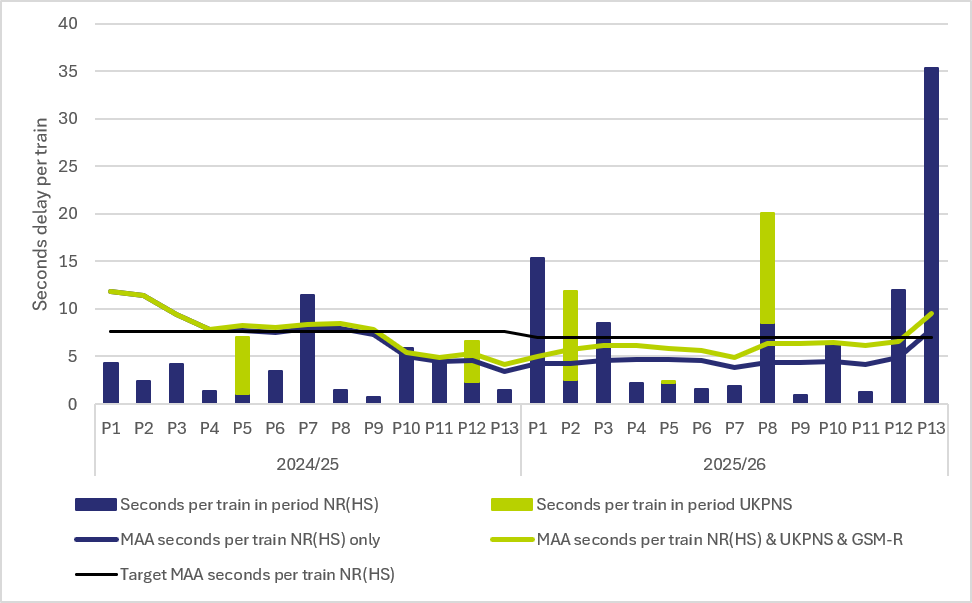
Route performance remained strong this year, with an average delay of around 9.5 seconds per train and most periods delivered as expected, supported by improving asset reliability and reduction in underlying infrastructure faults. Figure 3.1 shows delays for each four-week period and the moving annual average (MAA).
Figure 3.1 Summary of asset-related performance impact
Source: London St. Pancras Highspeed AMAS, 1 April 2025 to 31 March 2026
Over the last two years the number of frequent, low-impact faults is decreasing, and performance impacts are dominated by a small number of high-impact events. This year there were nine significant asset incidents causing more than 200 delay minutes, compared with five in the previous year. These events are listed in Table 3.1. In the first half of the year the largest incidents related to the power supply network (managed by UK Power Networks Services) and were largely outside of LSPH’s control. However later in the year there were track circuit and points issues, which were within LSPH’s control.
Table 3.1 Causes of Significant Asset Performance Incidents
| Period | Date | Delay (minutes) | Cause |
|---|---|---|---|
| P1 | 18/04/2025 | 1,126 | Lineside fire under underbridge |
| P2 | 15/05/2025 | 807 | Power outage |
| P3 | 16/06/2025 | 430 | Track circuit failure |
| P8 | 14/10/2025 | 1,027 | Autotransformer failure |
| P8 | 08/11/2025 | 601 | Trespass |
| P10 | 30/12/2025 | 395 | OHLE trip |
| P12 | 12/02/2026 | 620 | Points failure |
| P12 | 28/02/2026 | 296 | Vandalism |
| P13 | 02/03/2026 | 3,101 | Multiple track circuit and points failures |
Source: London St. Pancras Highspeed AMAS, 1 April 2025 to 31 March 2026
The most significant of these, in period 13, was a complex signalling-related failure involving multiple track circuit faults followed by a loss of detection at a set of points. This resulted in a significant degradation of signalling capability. Recovery was extended by reliance on specialist signalling support resources, highlighting a dependency within LSPH's current response model. LSPH has informed us of a post-incident review. While it is important to predict and prevent faults, we see the greatest opportunities to learn from this event relate to the time taken to fix faults and manage the operational recovery.
Asset condition remains broadly stable overall. However, the HS1 network was opened in 2007 and a large number of the original assets will be approaching life expiry soon, so monitoring and understanding asset condition will be critical in CP4. This year we have seen LSPH’s understanding of condition improving, as enhanced inspection, monitoring and data collection provide greater visibility of asset performance and failure risk.
However, there is increasing evidence of differentiation between asset groups. Higher-maturity assets such as track continue to demonstrate stable condition profiles, whereas in other the lower-maturity asset groups, inspections were more likely to identify unexpected issues. This included LETs assets with worse than expected condition and signalling and communications equipment with obsolescent components.
Asset data capability continues to improve. The rollout of the Enterprise Asset Management System (EAMS2) has progressed, with asset groups including mechanical and electrical, and overhead line equipment now live with further deployment due later in 2026 through to full deployment in 2027. This improves defect visibility and data reliability.
We can see this improved visibility of risks impacting both operational performance and renewals delivery. For example, train-mounted cameras are now providing data to allow risk-based maintenance of overhead line assets, reducing the frequency of regular inspections and freeing up those resources to react quickly when data shows unusual patterns of behaviour. Another example this year is that changes in scope and cost of renewals were increasingly driven by better understanding of asset condition.
Renewals delivery
A key development this year has been the introduction of new, portfolio-based governance for renewals, in both route and stations. This has strengthened the link between asset knowledge and efficient delivery of the renewals portfolio. We have seen a more dynamic approach to the renewals programme, with clearer information to explain any changes and good examples of work being brought forward or deferred, based on asset condition or delivery opportunities. This is reflected in delivery outcomes, with higher volumes of renewals delivered than planned in several portfolios, whereas in previous years we had seen repeated underspends on renewals and long processes to agree changes.
This year, 12 out of 12 strategic milestones for route renewals were achieved. For stations four out of six milestones were achieved with the missed milestones relating to lifts, escalators and travelators, where projects have been delayed due to LSPH’s ongoing challenges with its delivery contracts.
Route renewals expenditure this year was £19m against a plan of £13m. This increase reflects a combination of higher delivery volumes and changes to scope, rather than cost inefficiency. Volumes delivered were 146 against 120 planned, with some closeout of CP3 schemes and work brought forward from later years, including enabling activities for major ballast renewals later in CP4.
In contrast, while stations renewals expenditure was also above plan (£4m against £3m), there is less evidence that this reflects additional outputs. The cost increase is attributed mainly to higher unit rates and market pressures, particularly in lifts, escalators and travelators.
Delivery in the first year of CP4 has seen a positive step change and is on a good glidepath to develop a delivery organisation capable of handling higher volumes at the end of CP4 and in future control periods. For example, this year we have seen good examples of delivering large volumes of work in possessions, integrating multiple teams and handing back on time.
Asset management maturity
This year, LSPH has continued to build on the foundation of the industry standard ISO55001 certification with surveillance audits completed successfully during the year. There has also been progress in defining and implementing asset data improvements with the completion of an asset information strategy and defining the associated data improvement initiatives, alongside the phased implementation of EAMS2, a software system to record asset data and make it easily available for analysis and decision making.
Our PR24 final determination highlighted material differences in LSPH’s asset management maturity, between different asset groups. In particular, we noted that asset management maturity needed to improve the most in signalling on the route and lifts, escalators and travelators in stations. As described above, this year the biggest challenges for asset performance and renewals delivery have all been in these lower-maturity asset groups.
The introduction of EAMS2 on some asset groups (mechanical and electrical, overhead line and track so far) is a positive step to improve the capture and use of data. However, the lower-maturity asset groups are currently later in the programme to roll out the system. We maintain our position from PR24, that the greatest opportunities for efficiencies and improving performance are in these lower-maturity asset groups, and so should be prioritised for changes. This will be a key area of focus for our monitoring in the coming year.
Operations and maintenance
LSPH has delivered its expected operations and maintenance activities this year. Several improvements to asset maintenance have been made possible by the ongoing delivery of PR24 asset management commitments. The main benefits have been driven in overhead line and mechanical and electrical assets through the progressive roll out of EAMS2 improving defect visibility, maintenance planning and asset data quality. There has also been good adoption of automated inspection and risk-based maintenance. This is creating opportunities to reduce manual inspection activity and target maintenance more effectively and efficiently.
Performance improvement plans for specific repeating failures (such as points operating equipment) have reduced the number of infrastructure faults, helping maintain strong operational performance overall. However, as discussed above, there remain challenges around the time taken to repair assets and recover operationally when faults do occur.
In PR24 we determined an annual fixed charge for CP4 at a level which we calculated to be efficient, ambitious and deliverable. This was 2.5% lower than the level LSPH and its suppliers had proposed. We have seen a noticeable increase in commercial tension on these costs. This has driven more urgency to deliver efficiencies and adopt new technology than in CP3, which is positive. But we recognise that this has been a rapid change for LSPH and its suppliers at the start of CP4, and there have been challenges in accelerating change within the first year. This year there was an overspend of £1.6m compared to the annual fixed charge. However, LSPH and its main supplier Network Rail Highspeed (NR(HS)) report that they are confident they can deliver their planned efficiencies in future years.
The overspend was partly driven by additional activities on assets which are approaching life expiry sooner than expected. This included additional tamping and welding as an interim measure on sites due for ballast renewal later in CP4. The need for these focused interventions has triggered important conversations about options for maintaining, life extending or bringing forward renewals. We have engaged with LSPH and NR(HS) throughout the year and encouraged them to consider capital interventions where appropriate, to ensure optimum whole-life cost and avoid a bow wave of renewals in future control periods. This is to ensure continued high standards of performance and to aim for lowest whole-life cost. We anticipate more of these discussions in the coming years, as the original HS1 assets approach their first end-of-life renewals.
LSPH’s focus is now shifting from implementation of new initiatives to benefit realisation, evaluating how this work supports more efficient access planning and delivering measurable efficiencies.
Research and development
This year LSPH and NR(HS) introduced new governance and financial arrangements, to enable more agile decision making on research and development projects. There is now a more structured approach, including evidence-based proposals, clearer alignment to efficiencies and system benefits, and better engagement with stakeholders. We are already seeing benefits from this new approach. For example, a project to fit cameras to passenger trains had faced challenges in previous years, but the new governance allowed issues to be discussed and resolved. Cameras have now been fitted allowing continuous monitoring of the overhead line and pantograph contact; spotting issues early to prevent dewirements; and providing valuable images in the event of major incidents.
There is also evidence that research and development activity is beginning to align more closely with the needs of the maintenance and renewals programmes. For example, drone-based monitoring is being developed which aligns with wider improvements to asset data usage, such as the rollout of EAMS2, and this in turn will feed into decisions about whether to renew assets earlier or later than forecast. However, the programme remains at a relatively early stage in terms of delivery and benefit realisation. Several dependencies and risks are still evident, including management of high volumes of complex datasets, and that realising value depends on the development of supporting data architecture, analytics and integration with business as usual. Progress this year has prioritised concept development and readiness rather than rapid rollout.
Table 3.2 Summary of areas of focus in the R&D plan and examples of progress
| Area | Planned / intended outcome | Examples |
|---|---|---|
| Automated Inspections | Improve inspection quality and reduce manual intervention | Pantograph cameras to monitor overhead line and train contact. Project has shown the technology is workable on HS1 and fitted to some trains. Successful trials of drones to inspect civil engineering assets like tall viaducts and tunnel shafts. Has shown benefit in efficient data gathering with accuracy and repeatability. |
| Data and analytics capability | Enable use of high‑volume inspection data | A recurring theme is that automated inspection only creates value if the resulting data can be stored, analysed and integrated into decision-making processes. The programme has focused on and delivered against the following areas:
|
| EAMS2 asset system | Integrated asset data platform supporting risk-based maintenance | EAMS2 rolled out and now live for mechanical and electrical and overhead line asset groups, followed by track at the start of year 2, improving defect visibility and data reliability. |
Environmental sustainability
LSPH continues to make good progress in embedding sustainability within its asset management approach. This year, the company progressed several PR24 commitments, including stakeholder workshops on depot charging infrastructure; developing alternative solar technologies; and the integration of sustainability considerations into future renewals and procurement activities. There is increasing evidence that environmental objectives are being incorporated into asset planning decisions, for example through consideration of lower-carbon plant solutions and climate resilience measures. While delivery remains at an early stage, the direction of travel is positive. The focus for the remainder of CP4 should be on translating these commitments into measurable environmental outcomes, particularly in relation to carbon reduction, climate adaptation and resource efficiency.
Progress against asset management commitments
LSPH continues to report progress against the 19 asset management commitments established at PR24, with quarterly updates provided to us. Many of these commitments relate to the changes discussed above, around improvements to governance, new data strategies and the need to improve asset management maturity.
This year LSPH has made good progress in delivering its PR24 commitments, successfully closing out several related to asset management including: a roadmap for asset data systems; station mechanical, electrical and plumbing data monitoring review; updated train recovery contingency plans; and developing solar energy and zero-emission vehicle initiatives. These are key enablers to unlock other commitments and efficiencies later in the control period. A full list of the PR24 commitments and their status is available in LSPH’s published Asset Management Annual Statement (AMAS) for the year.
Other commitments relating to asset management maturity remain in progress. In particular, the full rollout of EAMS2; the delivery of maintenance efficiencies; and the establishment of a consistent line of sight between asset data, decision-making and renewals outcomes are ongoing. But we have seen positive evidence of progress in the reporting year, and a clear roadmap to delivering all committed benefits in future years.
As noted above, this year saw escalator availability issues during high-demand periods, where faults occurred after planned renewals, resulting in reduced capacity at critical times. For example, escalators at Stratford having had recent renewal were unable to operate as required at the station causing significant disruption for passengers, as well as costs and reputational damage for the train operator to bear. This should be addressed by Commitment 9 which directly addresses underlying causes of such issues through improved fault monitoring, asset data quality and visibility of performance. When completed, it will enable better identification of recurring faults and ensure that maintenance and renewal interventions are more effectively targeted, particularly at times of high operational risk such as major events.