

Table 4.1 provides a summary of London St. Pancras Highspeed’s (LSPH's) route income and expenditure for the period 1 April 2025 – 31 March 2026, compared with the PR24 forecast and the previous year. The following sections provide further analysis of the key movements in income and expenditure. Please note that some figures in this chapter may not sum due to rounding.
Table 4.1 Summary of London St. Pancras Highspeed’s route operations and maintenance income and expenditure 1 April 2025 to 31 March 2026, compared to PR24 forecast and previous reporting year
| £million, 2025-26 prices | Actual | PR24 forecast | Difference better / (worse) | 2024-25 |
|---|---|---|---|---|
| Income |
|
|
|
|
| Operating and maintenance O&M | 70.0 | 70.9 | (0.8) | 89.5 |
| Pass-through income | 26.4 | 26.5 | (0.1) | 25.9 |
| Total income | 96.4 | 97.4 | (1.0) | 115.3 |
| Controlled track costs |
|
|
|
|
| Network Rail (High Speed) | 57.9 | 57.9 | 0.0 | 56.2 |
| London St. Pancras Highspeed | 13.9 | 12.1 | (1.8) | 13.2 |
| Network Rail Infrastructure Ltd | 2.2 | 2.1 | (0.1) | 2.2 |
| Other | 2.2 | 2.5 | 0.3 | 2.6 |
| Total controlled track costs | 76.2 | 74.6 | (1.6) | 74.3 |
| Pass through costs |
|
|
|
|
| Rates | 11.6 | 11.7 | 0.2 | 11.6 |
| UK Power Network fees and renewals | 7.9 | 7.9 | 0.0 | 8.0 |
| Insurance | 3.8 | 4.1 | 0.2 | 4.1 |
| Power-non traction | 3.1 | 2.7 | (0.4) | 3.7 |
| Total pass-through costs | 26.4 | 26.5 | 0.1 | 27.4 |
| Freight costs |
|
|
|
|
| Network Rail (High Speed) | 0.0 | 0.0 | 0.0 | 0.1 |
| Network Rail Infrastructure Ltd | 0.1 | 0.2 | 0.1 | 0.2 |
| London St. Pancras Highspeed | 0.0 | 0.0 | 0.0 | 0.1 |
| Total freight costs | 0.1 | 0.2 | 0.1 | 0.4 |
| Upgrades (cost of ERTMS early works specified upgrade) | 0.1 | 0 | (0.1) | 0.4 |
| Total O&M costs | 102.8 | 101.2 | (1.6) | 102.6 |
| Performance related payments | 0 | 0 | 0 | 0.0 |
| Total costs | 102.8 | 101.2 | (1.6) | 102.6 |
| Net income / (expenditure) | (6.4) | (3.8) | (2.6) | 12.8 |
Source: London St. Pancras Highspeed AMAS, 1 April 2025 to 31 March 2026 and 1 April 2024 to 31 March 2025
Route Income
LSPH received £96.4m of route O&M and pass-through (that is, to recover certain costs such as electricity, business rates and insurance) income this reporting year, £1.0m lower than assumed in its PR24 forecast and £18.9m less than received the last reporting year.
LSPH generates most of its income through charges to train operators for the operation and maintenance of its network, with £70.0m derived from these operating and maintenance charges. Revenues are determined using agreed chargeable journey times and distances for each service group, alongside a rate per minute or kilometre per train, meaning income is largely driven by train volumes and service patterns agreed under framework track access agreements for the network.
Table 4.2 Summary of London St. Pancras Highspeed’s route income 1 April 2025 to 31 March 2026, broken down by operator category
£m, 2025-26 prices | Actual | PR24 | Difference better / (worse) | |
|---|---|---|---|---|
| International | O&M | 23.9 | 24.9 | -1.0 |
| International | Pass-through | 7.8 | 8.0 | -0.3 |
| International | Total | 31.7 | 33.0 | -1.3 |
| Domestic | O&M | 46.1 | 46.0 | 0.1 |
| Domestic | Pass-through | 18.6 | 18.5 | 0.2 |
| Domestic | Total | 64.8 | 64.4 | 0.3 |
| Freight | O&M | 0.0 | 0.0 | 0.0 |
| Freight | Pass-through | 0.0 | 0.0 | 0.0 |
| Freight | Total | 0.0 | 0.0 | 0.0 |
| Total O&M income | 96.4 | 97.4 | -1.0 |
Source: London St. Pancras Highspeed AMAS, 1 April 2025 to 31 March 2026
The operating, maintenance and renewals charges (OMRCs) for CP4 were established through the PR24 process to allow LSPH to recover its costs relating to these activities over the control period. Charges are expected to remain broadly stable until March 2030, subject to RPI indexation, and are designed to adjust only in limited circumstances, such as where forecast volumes deviate materially from baseline assumptions.
This reporting year, operating and maintenance income (excluding pass-through) underperformed the CP4 forecast by £0.8m, primarily driven by Eurostar running fewer trains than had been assumed. Pass-through income was £0.1m lower than expected, with these costs subject to annual reconciliation.
Route Expenditure
Overall operating and maintenance route expenditure was £102.8m, £1.6m higher than PR24 assumptions.
Controlled track costs
Controlled track costs were £76.2m, £1.6m higher than the target set at PR24. The majority of LSPH’s controlled track costs were incurred in operating and maintaining its network through a long-term, fixed price contract with Network Rail (High Speed) (NR(HS)). Table 4.3 provides a breakdown of NR(HS)’s costs. NR(HS) costs increased by £2.2m overall year on year with operating costs increasing by £2.7m, partly driven by an increase in staff costs of £1.8m (2025-26 prices).
Table 4.3 Network Rail High Speed costs 1 April 2025 to 31 March 2026, compared to PR24 forecast
| £million, 2025-26 prices | Actual | PR24 | Difference better / (worse) |
|---|---|---|---|
| Staff costs | 29.8 | 28.8 | (1.1) |
| Network Rail Infrastructure Ltd | 3.9 | 4.0 | 0.1 |
| Consultancy costs | 1.7 | 1.7 | 0.0 |
| Plant and materials | 6.8 | 6.6 | (0.2) |
| Sub-contractors | 6.9 | 6.4 | (0.5) |
| Other/overheads | 7.2 | 6.4 | (0.8) |
| Stretch Efficiency | 0.0 | (1.5) | (1.5) |
| Operating costs | 56.3 | 52.4 | (3.9) |
| Risk premium | 2.7 | 1.1 | (1.6) |
| Total NR(HS) costs | 59 | 53.5 | (5.5) |
Source: NR(HS) Outturn statements, 1 April 2025 to 31 March 2026
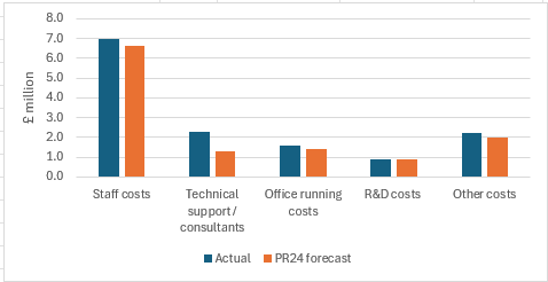
The remainder of controlled track costs are related to LSPH’s internal costs which are shown in Figure 4.1. LSPH internal costs were £13.9m for the year, £1.8m higher than forecast at PR24 and higher than last reporting year by £0.7m. The overspend was driven by higher staff and consultancy costs. Staff costs were £0.3m above the PR24 baseline, while technical consultancy exceeded assumptions by £1.1m due to residual PR24 close-out costs, asset management work (including handbook development), and tax advisory support. Office costs were £0.2m higher than target, reflecting increased spend on software licences; IT equipment; and business continuity. Other costs were also £0.2m above budget, primarily due to additional recruitment and higher audit fees.
Figure 4.1 London St. Pancras Highspeed’s internal costs 1 April 2025 to 31 March 2026, compared to PR24 forecast
Source: London St. Pancras Highspeed AMAS, 1 April 2025 to 31 March 2026
Pass-through costs
Some of LSPH’s costs are passed through directly to train operators, with revenue collected during the year and a wash‑up adjustment applied at year-end to align income with actual spend. These costs are largely outside LSPH’s control and include items such as electricity, business rates and insurance. In the reporting year, pass-through costs were £26.4m, broadly in line with the PR24 assumption of £26.5m. Variances within this reflect higher non‑traction electricity costs, offset by underspends on business rates, insurance, and other energy-related costs.
Looking ahead, there is a risk of increased cost pressure, with business rates expected to rise significantly from April 2026 following the latest revaluation. LSPH and operators are considering next steps in response to these pressures.
Freight costs
Although no freight services currently operate on the HS1 route, LSPH remains obligated to maintain freight-related infrastructure (including sidings at Ripple Lane), resulting in ongoing costs that are no longer directly allocated to freight users. Freight costs were broadly in line with the PR24 forecast.
Upgrades
The European Rail Traffic Management System (ERTMS) is a significant signalling programme that LSPH anticipates delivering in CP5 (the control period from 1 April 2030 to 31 March 2035) as a ‘Specified Upgrade’. The Concession Agreement categorises certain investments as Specified Upgrades or upgrades to the route, which may be funded through government grant, an Additional Investment Recovery Charge (AIRC), or a mix of both. In the year £0.1m was spent on work associated with the ERTMS upgrade and was recovered by an AIRC on current operators.
Efficiency
For PR24, we assessed an efficient level of expenditure for the operation, maintenance and renewal of the route infrastructure. A significant proportion of LSPH’s costs relates to its contractual arrangements with NR(HS). To evidence performance, NR(HS) reports against a “fishbone” framework, which categorises movements into:
- efficiencies;
- headwinds (unplanned cost increases due to external factors such as the pandemic);
- tailwinds (unplanned cost decreases due to external factors);
- scope changes (planned changes to levels of work undertaken); and
- input prices (inflationary effects from increases or decreases in costs above general CPI inflation).
NR(HS)’s efficiency target for CP4 is £35m (at February 2025 prices). This reporting year, NR(HS) has reported net efficiencies of £2.2m against a target of £5.5m indicating a £3.3m shortfall in efficiency delivery. The contributing factors are discussed in the Asset Management chapter of this report and include delays to technology projects; worse than expected asset condition; and the timing of additional efficiencies to meet the stretching targets from our PR24 determination. These pressures were partially offset by £2.2m of underspend on enabling activities, which have been reprofiled into later years of the control period to support future delivery of efficiencies. LSPH and NR(HS) report that they remain committed to delivering these efficiencies in the later years of the control period.
Station charges
We set stations renewals charges, referred to as the Long-Term Charge for each station, for the first time at PR24. These are set per station so do not vary by traffic volume; income therefore matched forecasts for each station: £5.75m for St. Pancras, £1.5m for Ebbsfleet; £1.3m at Stratford International and £0.6m at Ashford International. These charges are paid into an escrow account for each station, the movements of which are illustrated below.
We do not regulate LSPH’s operating and maintenance spend for stations, which is set on an annual basis in a process run by the infrastructure manager with the train operators that use its stations. We understand that LSPH spent around £43.6m on these costs in the year, against a budget of £44.2m.
Escrow accounts
Some of LSPH’s access charges are paid escrow accounts to fund current and future renewals of the route and stations. The funds collected are paid into separate ring-fenced bank accounts (one for route and one for each of the four stations) each quarter. This fulfils a similar function to the Regulatory Asset Base in other regulated utilities by spreading these costs over the long term to ensure that users of the railway pay their fair share.
Route escrow account
The total funding balance held within the route escrow fund at 31 March 2026 was £212.3m, comprising £86.6m held in the route escrow account and £125.7m held in investments. The movement in the escrow balances during the year comprised:
- £29.8m of payments into the escrow account, £0.6m less than the PR24 forecast;
- £19.2m was withdrawn to pay for renewals delivery;
- £5.1m of interest paid in the year. A further £1.7m of interest was accrued but will not be paid until the maturity of the respective deposits. At PR24 interest was estimated at £6.0m for this year.
Of the total escrow balance £125.7m was held in investments to generate additional returns. Funds were diversified across multiple banks to reduce reliance on any one institution and limit exposure to counterparty credit risk.
Stations escrow accounts
Stations renewals charges are paid into escrow accounts to fund current and future renewals at the four stations: London St. Pancras International, Stratford International, Ebbsfleet international and Ashford International.
The total funding balance held across the stations escrow accounts at 31 March 2026 was £94.8m, comprising £20.5m held in stations escrow accounts and £74.3m held in investments. The movement in the escrow balances during the year comprised:
- £9.5m income received through long term charges for each station;
- £7.1m withdrawn to fund renewals delivery; and
- £2.2m of interest paid in the year. A further £1m of interest was accrued but will not be paid until the maturity of the respective deposits. At PR24 interest was estimated at £2.7m for this year.
Of the total stations escrow balance £74.3m was held in investments to generate additional returns.
We highlighted the issue of low returns on escrow balances at PR24. It is encouraging to see LSPH taking steps to improve returns. This includes placing £200m on deposit across multiple banks, securing improved interest rates, and exploring further diversification of investment deposits. As of March 2026, LSPH is close to finalising arrangements with an additional bank, which would allow up to £240m to be held in investments. These actions demonstrate a proactive approach, within the constraints of the Concession Agreement.
Overview of LSPH’s statutory financial statements
The operating company of LSPH made a profit after tax of £115.3m this reporting year (set against £121.7m in the previous year) with earnings before interest, tax, depreciation, and amortisation of £91.4m (£107.3m in the previous year). Net assets increased by £91.0m, primarily reflecting the profit reported during the year. Debt levels also reduced over the period. The ratio of cashflow to debt interest and principal payments for 1 April 2025 - 31 March 2026 was 1.51x (noting this was 1.47x in the previous reporting year). This demonstrates that LSPH comfortably generated sufficient funding to meet its debt costs and make scheduled repayments of principal. The operating business remained above its debt-service cover ratio (referred to as DSCR) covenant lock-up threshold of 1.20 - below this level, the company would not be permitted to make distributions to its shareholders and would instead be retained for debt service until the ratio recovers.