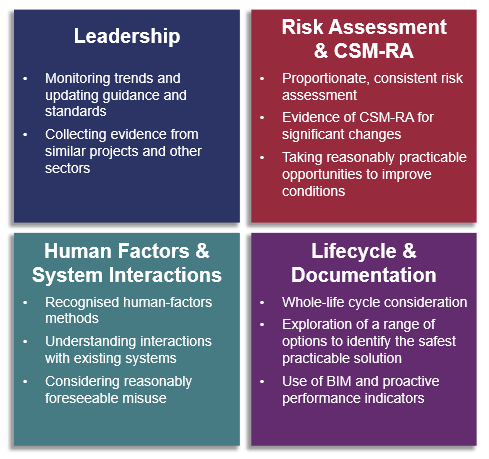

Why compliance matters
Health and safety by design is required by several areas of legislation and must be applied from the earliest stages of planning and design. It is essential for preventing foreseeable risks, improving functionality and reducing the need for costly changes later.
Many of the compliance expectations exist because long-standing challenges continue to restrict good design practice, including restrictive client briefs, insufficient briefing on intended uses, time and budget limitations, and a tendency to repeat existing solutions rather than consider safer alternatives.
Compliance with health and safety by design is increasingly important as the industry faces new forms of risk, including the growing dependence on digital systems and the need to address cyber security at the design stage.
Legal requirements for health and safety by design
Health and safety by design is covered in several areas of health and safety legislation:
- Health and Safety at Work etc. Act 1974 (HSWA)
- Management of Health and Safety at Work Regulations 1999 (MHSW)
- Construction (Design and Management) Regulations 2015 (CDM)
- Railways and Other Guided Transport Systems Regulations 2006 (ROGS)
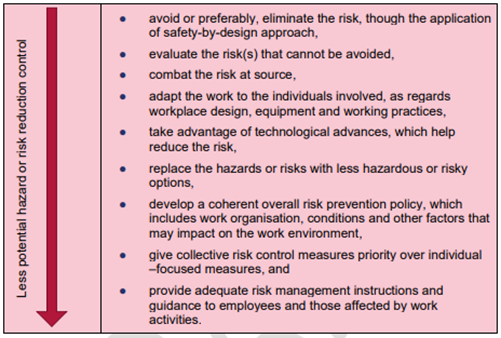
MHSW requires suitable and sufficient risk assessment and application of the hierarchy of risk control, including the preference for elimination of risk, combat at source and intrinsic safety.
Hierarchy of risk control – based on MHSW
CDM requires risks to be eliminated or controlled from the concept stage onward, including during feasibility studies, and requires designers to consider risks to those constructing, operating and maintaining structures. Note that ORR has an agency agreement with the Health and Safety Executive (HSE) on the enforcement of health and safety by design in respect of railways and other guided transport systems, giving ORR an enforcement role from the earliest stages of a project.
ROGS requires use of CSM-RA for significant changes, and requires cooperation between dutyholders on shared risks and interfaces. This covers both basic design compatibility, such as between train and platforms, as well as operational issues, for example ensuring stations are designed with ventilation to ensure operators staff are not exposed to Diesel Engine Exhaust Emissions (DEEE).
More information on ‘The Law’ is provided in the Appendix.
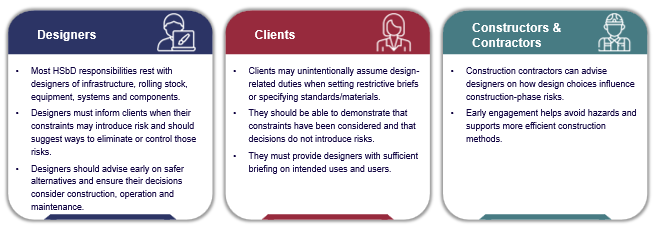
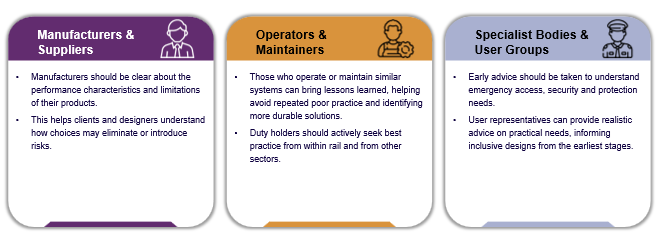
ORR’s expectations of dutyholders
ORR has established the following priorities grouped by dutyholder role:
ORR oversight, supervision and enforcement
Under RM3, ORR examines health and safety by design issues under OC5, PI1 and RCS3. Inspectors will continue to challenge dutyholders to show that change is managed proactively using good practice and relevant standards.
ORR’s Principles for health and safety on the railway set out minimum design and operational principles.
ORR allocates resources to influence major schemes where no existing dutyholder is in place, such as HS2.
Dutyholders must have design assurance procedures that ensure standards are met, deviations are controlled, and delivered assets match approved designs.
In permissioning functions, ORR will seek evidence that health and safety by design has been applied.
What ORR expects to see as good practice
Dutyholders should demonstrate: