

Applying health and safety by design throughout the design process
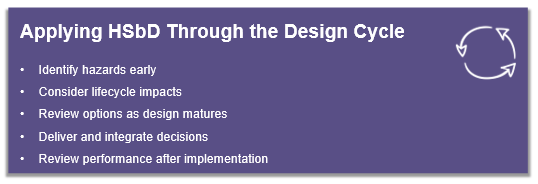
Health and safety by design should begin at the earliest stages of a project and continue as design choices are made. Designers should regularly evaluate the impact of their decisions across the lifecycle of the works, including construction, operation, maintenance and de-commissioning.
Early decision-making is critical. Safety considerations should be integrated during the initial exploration of options and then examined in progressively greater detail as the design develops, with the aim of identifying and eliminating hazards wherever possible.
Continuous improvement in health and safety by design requires that design decisions are delivered by the project, integrated into equipment, systems and operations, and reviewed after implementation to confirm they are functioning as intended.
Improving safety, cost and efficiency outcomes
Applying health and safety by design principles leads to more effective, efficient and sustainable safety outcomes over the life of the project. Early-stage decisions often overlook the potential for long-term safety and cost benefits.
Designing out hazards early removes the ongoing cost of managing those hazards and reduces the need for operational controls throughout the asset’s life.
Infrastructure, equipment and systems that are simpler to use and maintain are less costly to operate, because of reduced maintenance requirements and lower staffing needs.
Injuries and ill-health create lost time, delays and additional costs, including civil claims or criminal investigations. Better planning of construction and manufacturing work reduces exposure to these risks.
Strengthening assurance and design processes
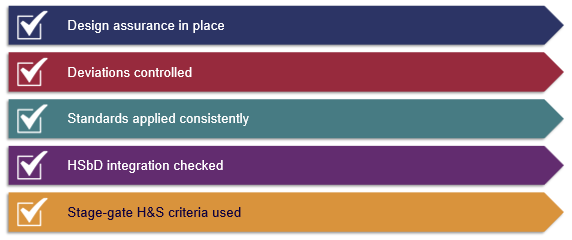
Dutyholders should ensure that design standards and procedures that address health and safety by design are consistently applied, with arrangements in place to challenge deviations and verify that delivered assets match approved designs.
Design assurance should check that industry and company standards are complied with, that deviations are authorised through robust challenge processes, and that changes are fully documented.
Stage-gate processes should include health and safety criteria so risks and assumptions are properly assessed before progressing a design. This reflects the RIBA Plan of Work approach to change control.
Enhancing risk assessment, human factors and option selection
Dutyholders should monitor safety trends and use learning from incidents and other dutyholders to update guidance and standards.
Proposed designs should take a holistic view of the railway as a system, considering interactions with existing assets and, where relevant, with systems beyond the railway.
Dutyholders should use consistent, proportionate risk assessment, and where relevant apply the Common Safety Method for Risk Assessment (CSM-RA).
Reasonably practicable opportunities to improve conditions should be taken, such as improving platform conditions beyond basic resurfacing.
Recognised human-factors methods should be used to address risks linked to equipment, tasks, systems and the working environment, including consideration of foreseeable misuse.
Dutyholders should show they have explored a range of reasonably practicable options, identifying the safest overall solution for the whole lifecycle.
Organisations with large programmes of work should use proactive performance indicators to measure how well their design processes function.
BIM and digital modelling should be used to document health and safety by design issues throughout the design and life of assets and ensure this information is used to support risk management.
Preparing for future change: digital, software and cyber security
Dutyholders must address cyber security issues in the specification, design and purchasing of equipment and systems, using guidance from the Department for Transport and National Cyber Security Centre.
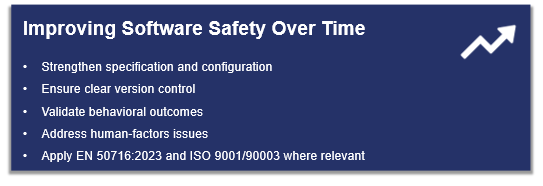
Software risks often arise from poor configuration, planning, version control and maintenance. Continuous improvement requires clear functional specifications for normal, abnormal and emergency conditions.
Design should take account of human-system interfaces, ensuring usability and comprehension, especially where systems support emergency situations and degraded working.
Modification and change of software must follow a structured, planned process, including verification and validation before release and documented traceability.
Standards such as EN 50716:2023 and ISO 9001 / 90003 should be used for software safety and quality assurance.
Recommended resources and industry learning
Dutyholders should draw on relevant resources, including:
- ORR Principles for Health and Safety on the Railway (design and operational principles)
- Safety Verification guidance (non-mainline)
- RSSB resources (Taking Safe Decisions, health-by-design materials, human-factors guidance)
- HSE and CITB CDM resources
- CPNI and NCSC guidance on security and system design
Dutyholders should participate in forums and learning networks such as the HS2 Learning Legacy, Crossrail Learning Legacy and inclusive design/user engagement groups.