

Executive summary
In this report, we focus on the financial and efficiency performance of Network Rail in the second year of Control Period 7 (CP7). Network Rail’s funding and requirements for this five-year control period were set out in our 2023 periodic review (PR23). In this we determined what Network Rail should deliver in respect of operating, maintaining, and renewing its network, and the funding necessary to do this for the five-year period from 1 April 2024 to 31 March 2029.
Network Rail delivered £614 million of efficiency improvements in the second year of CP7, covering April 2025 to March 2026.
At the same time, inflationary pressures, maintenance of ageing assets and train performance issues placed additional pressure on Network Rail’s financial performance in the last year. The company financially underperformed by £490 million in 2025-26 against its CP7 delivery plan, meaning, that, net of income, Network Rail spent £490 million more than originally planned. This indicates that wider cost pressures outweighed the efficiency improvements delivered during the year. This compares with an underperformance of £243 million in 2024-25.
Network Rail spent £10.2 billion on operations, support, maintenance and renewals in the year, which falls within the scope of our PR23 review. A further £4.8 billion was spent on enhancements and financing costs (that sit outside the PR23 settlement) taking total expenditure to £15.0 billion.
Key findings
Key finding 1: Network Rail exceeded its efficiency targets in Year 2 and is planning to exceed its efficiency targets during the remainder of CP7. This will help mitigate forecast inflationary pressures and other delivery challenges which are impacting future renewals delivery
Delivering efficiencies is a core requirement of Network Rail’s CP7 funding settlement, requiring material cost reductions over the control period to remain within its funding envelope. As set out in our PR23 determination, this equates to £3.9 billion of efficiencies in cash terms, which are embedded within Network Rail’s CP7 delivery plan and underpin its funding. These efficiencies must be achieved to ensure the available budget withstands the forecast of inflation underpinning the funding settlement.
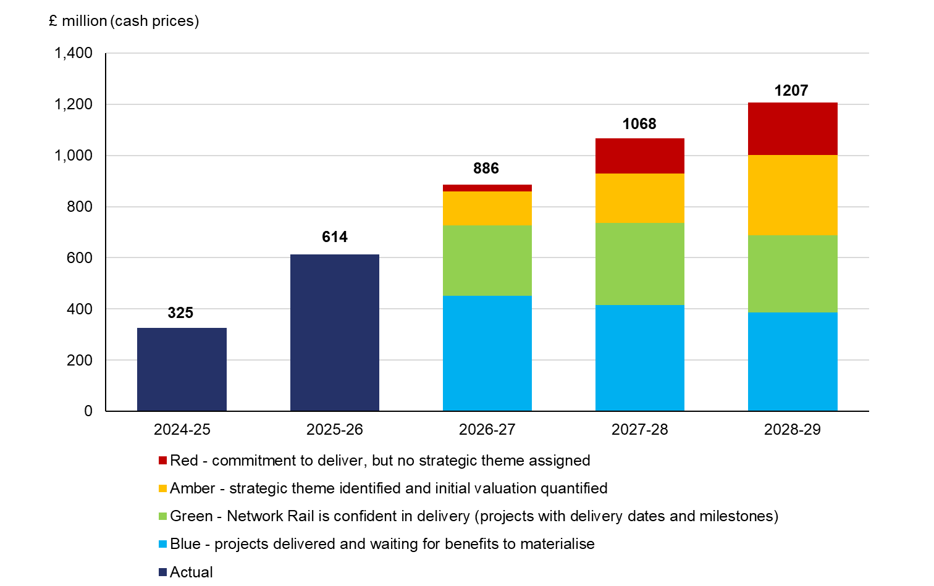
In Year 2 of CP7, Network Rail delivered £614 million of efficiency improvements, 4% ahead of our PR23 target of £589 million. This builds on the efficiencies achieved in Year 1 and represents a combined total of 23% of its five-year efficiency plan for CP7. Further details on these savings are set out in Chapter 2.
However, inflation has persisted above the forecasts underpinning the PR23 financial settlement and continued to put pressure on Network Rail’s funding. To help counter these pressures Network Rail has re-forecast its CP7 efficiency target up from £3.9 billion to £4.1 billion. We welcome this as continued delivery of efficiencies will be important to mitigate ongoing inflationary pressures and support delivery of its renewals programme.
Figure 1: Network Rail’s actual and latest CP7 forecast efficiency improvements, April 2024 to March 2029
Source: ORR analysis of Network Rail’s data
All five of Network Rail’s regions exceeded their Year 2 efficiency targets. These efficiencies are further explored in Chapter 5.
Key finding 2: Higher inflation and input prices added £651 million to costs over the year, impairing financial performance and increasing pressure on asset renewals
Network Rail financially underperformed by £490 million in the year compared to its original CP7 delivery plan. This means it spent £490 million more (net of income) on operating, maintaining, renewing, enhancing and financing the railway than it was funded to deliver (approximately 3.3% of its annual expenditure).
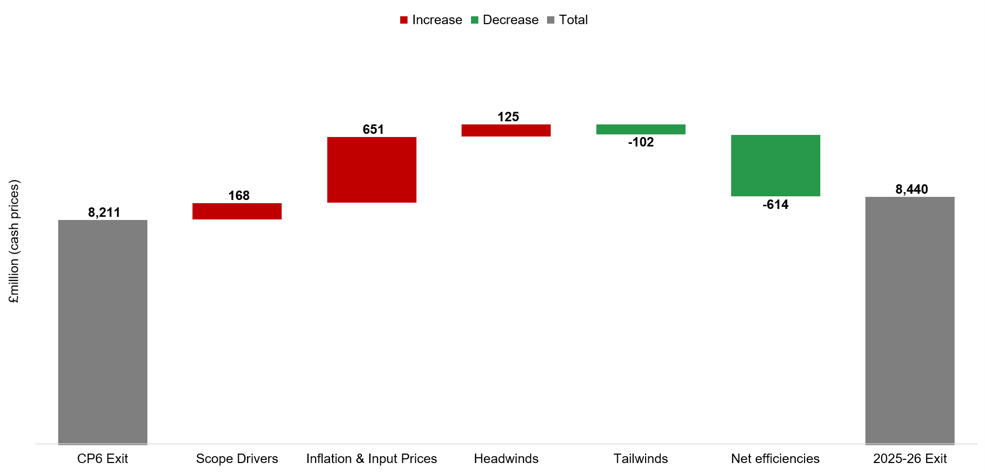
The main driver of this underperformance has been higher-than-expected inflation. This has significantly impacted the cost of delivering maintenance and renewals activities. Compared to the start of CP7, general price inflation (measured by CPI) added £492 million of cost pressure in the year before taking account of any increases in income resulting from higher inflation, with a further £159 million of additional cost from higher input prices above CPI inflation.
While Network Rail has improved how it delivers work (i.e. efficiencies), reducing the cost of individual activities, these cost savings (or higher output) were already embedded in its delivery plan (which is set on a post-efficient basis). As a result, these efficiencies have not been sufficient to offset rising costs, particularly from high inflation.
Increased volume and complexity of renewals and maintenance activities added £168 million of costs in the year compared with the start of CP7. Network Rail also incurred £125 million of headwinds (‘exogenous costs’), most notably from the increase to Employer National Insurance contributions (NICs).
Figure 2: Network Rail’s Year 2 cost drivers, compared to CP6 exit
Source: ORR analysis of Network Rail’s data
Financial under-performance has varied across regions (but within a fairly narrow range of 1% to 6% of overall expenditure), reflecting differences in cost pressures, efficiency performance and delivery challenges. These variances were driven by higher maintenance and renewals costs, differing levels of efficiency delivery, as well as higher-than-planned Schedule 8 compensation payments associated with poor train performance. These variances are covered in Chapter 2.
Over CP7, general inflation and input prices are forecast to increase Network Rail’s costs by approximately £2.3 billion (as at the end of March 2026) compared to the forecast used in PR23. This comprises £2.0 billion from general inflation and a further £0.3 billion from input price inflation. To manage this cost pressure, Network Rail has revised its CP7 plans to reduce renewals delivery in England & Wales. While this will help to manage short-term financial pressures, the reduced renewals increase the risks to reliability and long-term sustainability of the rail infrastructure.
Key finding 3: Staff costs have increased above CPI inflation with a continued shift to more senior grades
Total permanent staff costs increased by 5% over the last year to £3.2 billion due to a 2% increase in headcount (to 41,794 FTE) and a 1% above inflation increase to average remuneration. A significant proportion of the increase in staff costs relates to higher employer National Insurance contributions (NICs), which are outside Network Rail's control and are treated as an external cost pressure.
Senior management staff costs increased by 9% to £142 million, reflecting a 5% increase in headcount (to 697 FTE) and a 3% above inflation increase in average remuneration.
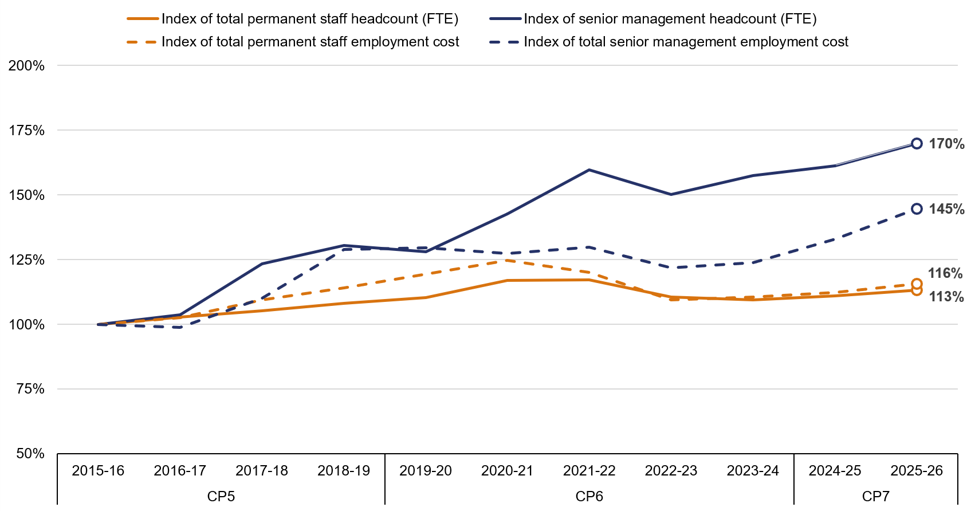
Figure 3 shows the ten-year trend in total headcount and staff employment costs (including bonus, pensions and allowances) for both the overall workforce and senior management. Senior management headcount and employment costs have exceeded those for all staff over the last decade.
Figure 3: Change in total permanent staff and senior management headcount (FTE) and total employment costs (real prices), April 2015 to March 2026
Source: ORR analysis of Network Rail’s data
Our analysis shows that including employee benefits, average employment costs have increased by 2% above inflation over the past ten years. Over the same ten-year period, Office for National Statistics (ONS) data shows that average UK earnings have increased by 3% above inflation. Overall, this suggests that Network Rail’s employment costs trend is broadly consistent with earnings in the wider economy.
Key finding 4: Network Rail Scotland made good progress in its efficiency delivery but also faced financial pressures
Network Rail Scotland continued to make strong progress in its efficiency delivery in Year 2, achieving £79 million of savings, 26% above its PR23 target of £62 million. This performance was supported by a relatively stable delivery plan at the start of CP7, enabling effective workbank planning and more favourable commercial outcomes with the supply chain than assumed in its delivery plan. The region has been able to bring forward efficiencies to flatten its trajectory in later years, in line with independent reporter recommendations, providing greater confidence in the deliverability of its overall CP7 efficiency target.
Whilst delivering strongly to exceed efficiency targets, other cost pressures resulted in Scotland financially underperforming by £37 million compared with its CP7 delivery plan, meaning that it spent £37 million more (net of income) than planned to operate, maintain, renew and enhance the Scottish railway (approximately 2.5% of its annual expenditure). The underperformance was driven by higher than assumed inflation and input prices, and increased employer National Insurance contributions (NICs). Renewals performance remained broadly in line with the delivery plan, with cost pressures being managed well.
Key finding 5 - Forward look: Rising pressures over CP7 present delivery challenges, while rail reform may offer new efficiency opportunities
Looking ahead, Network Rail faces a more challenging financial environment over the remainder of CP7, including:
- higher-than-forecast inflation and other cost pressures, including increased pay awards and employer National Insurance contributions;
- a significantly reduced CP7 risk fund; and
- a steeper efficiency delivery challenge over the final three years of the control period.
Continued higher-than-forecast inflation and the cost impact of pay awards and employer National Insurance contributions (NICs) above those assumed in Network Rail's plan are increasing the scale of the financial challenge. This is compounded by a funding stretch following the 2025 Spending Review, which reduced Network Rail’s funding by around £165 million.
This comes alongside increasingly limited flexibility within Network Rail's remaining CP7 risk fund, which stands at £443 million at the end of Year 2, 27% of the original £1.6 billion fund set aside at the start of CP7, despite around 60% of the control period remaining.
Network Rail’s efficiency trajectory also steepens significantly over the final three years of CP7. Given these pressures, this is likely to require continued trade-offs in how funding is prioritised. If inflation remains above forecast, or other cost pressures emerge, there is a risk that renewals volumes could be reduced to help manage affordability, which would have implications for asset condition and longer-term performance.
Network Rail will need to demonstrate sustained progress on efficiency alongside clear prioritisation choices to remain within its funding envelope. These choices will need to be made proactively to support a stable renewals workbank and avoid further disruption to delivery plans. How effectively it manages these trade-offs, particularly between short-term affordability and longer-term sustainability will be critical not only to maintaining a stable financial position through the remainder of CP7, but also to supporting long-term growth objectives by maintaining the condition, capability and reliability of the railway.
The latter part of CP7 is also when Great British Railways (GBR) will take responsibility for infrastructure management from Network Rail. This provides an opportunity to improve how the railway is planned and operated, with greater integration between track and train. This could help the railway respond to future affordability pressures and improve value for taxpayers and passengers.
Ensuring these efficiencies are realised over the course of CP7, supporting a more affordable and sustainable railway, also forms part of ORR’s growth goals recently set by government. While responsibility for delivering efficiencies in rail infrastructure will transition from Network Rail to GBR as rail reform progresses, the importance of delivering the CP7 efficiency commitments, and ORR’s monitoring of progress against them, will remain unchanged.