

3.1 Network Rail faces financial pressure from higher than expected inflation and input price costs, together with the challenge of delivering its planned renewals and efficiency improvements within the funding available for CP7. This chapter examines how these pressures have affected Network Rail's finances in the first two years of CP7 and the options available to manage emerging funding pressures.
Inflation and input prices
3.2 Network Rail continued to face significant cost pressures from inflation and rising input prices during Year 2. Although the company exceeded its annual efficiency target, it financially underperformed against its original delivery plan as increased costs outweighed the benefits of efficiency delivery. Compared to the start of CP7, inflationary pressures added around £651 million of costs (gross of income effects) during the year, including £492 million from general inflation (CPI) and £159 million from input prices increasing faster than CPI inflation.
3.3 In the first two years of the control period, higher general inflation and input prices have cumulatively added £978 million of cost pressure. Combined with other cost pressures, this has contributed to Network Rail having to revise its plans. As a result, it is now forecasting lower renewals delivery in England & Wales over CP7, placing additional pressure on asset reliability and sustainability in CP7 and beyond.
3.4 While Network Rail Scotland has also faced inflationary and input price cost pressures (included in the above figures), these have been managed well through a stable delivery plan at the start of CP7, which supported efficient workbank planning and delivery. Network Rail Scotland also received a higher proportion of income from infrastructure cost charges than England & Wales’s regions, this income is adjusted for actual inflation. As a result, Network Rail Scotland has not needed to reduce its planned renewals delivery. Further detail on Scotland's performance is provided in Chapter 4.
3.5 Compared with the inflation assumptions underpinning the PR23 Final Determination, current forecasts indicate that general inflation alone is forecast to increase Network Rail's CP7 costs by around £2.0 billion over the five-year control period, with a further £0.3 billion arising from higher input prices. Under the Bank of England’s latest central scenario, general inflation is expected to remain above 2% until late 2027. This increases the risk of further cost pressures during CP7 and places greater pressure on decisions about which renewals can be delivered.
Funding gap
3.6 Higher-than-forecast inflation and input prices increased Network Rail's expected CP7 costs relative to the assumptions underpinning the PR23 Final Determination. As a result, Network Rail's England & Wales CP7 delivery plan included a funding gap between available funding and planned expenditure, which stood at around £500 million by the end of Year 1.
3.7 Throughout Years 1 and 2, Network Rail made significant efforts to reduce the funding gap while seeking to minimise the impact on core renewals and maintenance activities. However, continued inflationary pressures made this increasingly challenging. Network Rail ultimately closed the funding gap during Year 2, primarily through reductions in planned renewals.
3.8 In contrast, Network Rail Scotland did not have a funding gap in its CP7 delivery plan which increased the stability of its plan, resulting in a stronger capacity to withstand additional inflationary pressures.
Risk funding and input prices
3.9 To help manage inflation and other uncertainties during CP7, our PR23 determination allowed for £1.6 billion (cash prices) of funds to manage financial risks including higher than forecast inflation. This comprised of £1.4 billion for England & Wales and £0.2 billion for Scotland. Since the start of CP7, substantial drawdowns have been required to fund Schedule 8 payments associated with poor train performance, increased inflation and input price pressures affecting Years 2 and 3 and higher employer National Insurance Contributions (NIC).
3.10 As shown in Figure 3.1, the pace at which the fund has been utilised highlights the scale of these pressures. The fund reduced from £1.6 billion at the start of CP7 to £779 million by the end of Year 1, before falling further to £443 million by the end of Year 2. As a result, 73% of the fund has been committed in the first two years of CP7, with the majority of this funding planned to be utilised in Years 3 to 5. This leaves 27% available to manage future financial risk over the remaining three years of the control period.
Figure 3.1: Network Rail risk fund, April 2024 to March 2026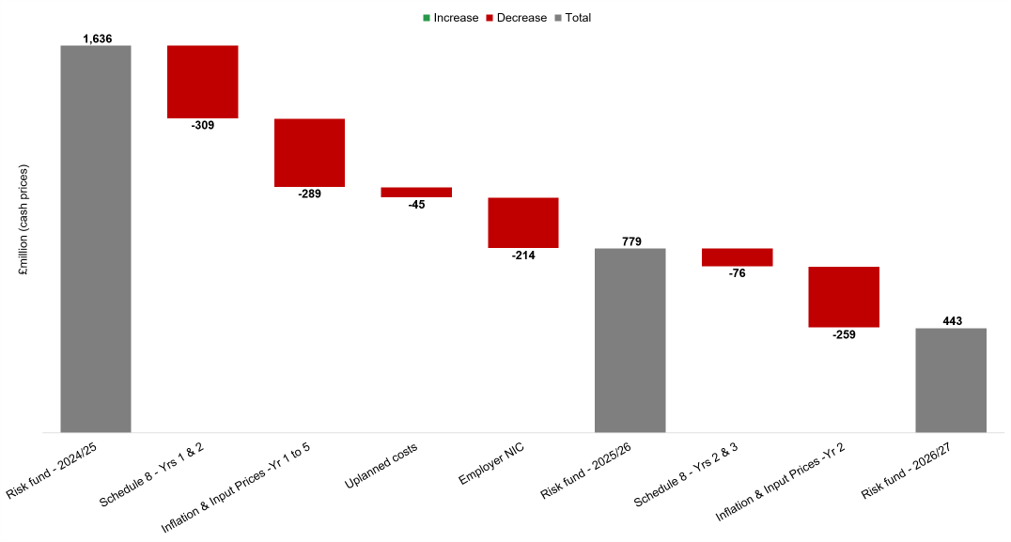
Source: ORR analysis of Network Rail’s data
3.11 Further pressure is expected following the 2025 Spending Review, which has already reduced Network Rail's funding by around £165 million from April 2026. With approximately 60% of CP7 remaining, the combination of a reduced risk fund and lower available funding leaves less flexibility to absorb future cost pressures, increasing the importance of delivering planned efficiencies and raises the risk of difficult prioritisation decisions should further cost pressures emerge.
Research and development expenditure
3.12 Our PR23 determination included £165 million (cash prices) of funding for research and development (R&D) activities during CP7. Due to financial pressures, Network Rail has subsequently reduced its planned R&D spend to £134 million (cash prices).
3.13 Network Rail spent £15 million on R&D activities in 2025-26, compared with its revised plan of £29 million. In CP7 to date, it has spent £47 million, which is lower than its revised plan. The lower spend is due to delays and slippage across a number of projects, resulting in expenditure being deferred into later years.
3.14 Compared with CP6, when Network Rail spent £238 million on R&D activities, the level of funding and expenditure in CP7 is significantly lower. Coupled with expenditure below the revised plan, raises concerns that the pace of innovation may slow, reducing the pipeline of opportunities to deliver future efficiencies and performance improvements.
3.15 Several projects have begun to deliver benefits as they are adopted across the network, with around £6 million of efficiencies reported in regional plans during 2025-26. However, forecast savings of £54 million over CP7 remain below the £72 million target set for the programme.
3.16 While Network Rail's reporting has increasingly focused on benefits expected to be realised during CP7, it is also important that the programme continues to develop innovations capable of delivering material benefits beyond the current control period.
3.17 Third-party funding continued to support Network Rail's R&D programme during 2025-26. Network Rail secured £9 million of additional external funding in the year and aims to secure a further £57 million over the remainder of CP7.
Industry Performance Improvement Fund
3.18 Our PR23 determination included funding for an Industry Performance Improvement Fund (IPIF) in England and Wales and the Targeted Performance Fund (TPF) in Scotland to support industry-led initiatives aimed at improving network performance and delivering benefits for passengers and freight users.
- Industry Performance Improvement Fund (IPIF, England & Wales). Our PR23 determination provided £41 million (cash prices) for the IPIF. During 2025-26, £7 million was spent on projects through the fund, following £5 million spend in 2024-25, to support innovation and performance improvement initiatives across the network. To date, 21 projects have been delivered, along with 20 further projects in delivery, of which 13 have received full Technical Authority approval. Projects supported by the fund include the rollout of PRIMA, which supports more proportionate speed restrictions during adverse weather conditions, and Beyond Visual Line of Sight (BVLOS) drone trials, which explore more efficient approaches to infrastructure monitoring and inspection.
- Targeted Performance Fund (TPF, Scotland). Our PR23 determination provided £53 million (cash prices) for the TPF. During 2025-26, to date, 28 projects with a total approved value of £40 million have been supported by the fund. The largest scheme, North Clyde Integration, which brings Network Rail and Scotrail Operations teams together within Yoker Signalling Centre, with new signalling control, traffic management, and track access technology solutions, valued at over £10 million, was delivered during 2025-26, with benefits expected to be realised in the coming year.
Budget flexibility
3.19 Network Rail is subject to the Government's resource and capital departmental expenditure limits, which restrict its ability to reprofile funding between years and limit flexibility to switch spending between resource and capital budgets.
3.20 No budget rollover was available for England and Wales as of 31 March 2026. It is anticipated that budget rollover will also not be available in 2026-27.
3.21 Responsibility for overseeing grant payment flexibility in Scotland sits with Transport Scotland and is subject to the Scottish Government's budgetary framework. As a result of these flexibilities, £20 million of funding was reprofiled from Year 2 to Year 4 of CP7.
3.22 Further details on the budget flexibility rules for CP7 are explained in our PR23 financial framework document.
Regulatory asset base, net debt and gearing
3.23 Network Rail’s regulatory asset base (RAB) remained broadly unchanged from the previous year at £92.7 billion. Renewals expenditure during the year was offset by amortisation, while property sales totalled £23 million.
3.24 Network Rail no longer issues debt to fund its capital expenditure. However, it continues to hold legacy debt (£61.1 billion), including financial instruments issued to investors before the company’s reclassification to the public sector. It incurred £3.0 billion of financing costs in the year, including £1.4 billion of financing costs on index-linked debt. These costs are funded separately by the Department for Transport (DfT). Network Rail’s gearing (net debt relative to RAB) is at 66%.