

Financial performance
4.1 Between April 2025 and March 2026, Network Rail Scotland spent £1.5 billion on operating, maintaining, renewing, enhancing and financing the rail infrastructure. It reported £37 million of financial underperformance against its Year 2 CP7 delivery plan. This means, net of income, Network Rail Scotland spent £37 million more than originally planned.
4.2 Table 4.1 shows that the underperformance was largely driven by maintenance and network operations.
Table 4.1: Network Rail Scotland’s financial performance April 2025 to March 2026
| £ million, cash prices | Actual | Original CP7 delivery plan for Year 2 | Variance | FPM out / (under) performance | % of FPM contribution |
|---|---|---|---|---|---|
| Grant income | 649 | 689 | (40) | 0 | 0% |
| Franchised track access charges | 527 | 523 | 4 | 1 | (3%) |
| Other income | 58 | 62 | (4) | (1) | 3% |
| Total income | 1,234 | 1,274 | (40) | 0 | 0% |
| Network operations | 97 | 80 | (17) | (17) | 46% |
| Support costs | 113 | 121 | 8 | 2 | (5%) |
| Traction electricity, industry costs & rates | 127 | 127 | 0 | 0 | 0% |
| Maintenance | 261 | 238 | (23) | (18) | 49% |
| Schedule 4 | 22 | 14 | (8) | (6) | 16% |
| Schedule 8 | 1 | 1 | 0 | 0 | 0% |
| Total operating expenditure | 621 | 581 | (40) | (39) | 105% |
| Renewals | 426 | 449 | 23 | 2 | (5%) |
| Enhancements | 153 | 159 | 6 | 0 | 0% |
| Total capital expenditure | 579 | 608 | 29 | 2 | (5%) |
| Other expenditure | 0 | 31 | 31 | 0 | 0% |
| Financing costs | 300 | 293 | (7) |
| 0% |
| Total expenditure | 1,500 | 1,513 | 13 | (37) | 100% |
| Financial performance measure (FPM) |
|
|
| (37) | 100% |
Source: ORR analysis of Network Rail’s data. Numbers may not sum due to rounding. Note that total income does not equal total expenditure, this is because of the timing of recognition of income and expenditure (particularly in relation to indexed-linked financing costs) as explained in Network Rail’s regulatory financial statements.
Operating Expenditure
Network operations costs
4.3 Network Rail Scotland spent £97 million on network operations in Year 2 of CP7. It financially underperformed by £17 million due to additional expenditure on performance improvement initiatives to improve passenger experience, combined with increased signalling resources and additional headcount to improve operational resilience on the network. Additionally, pay awards for frontline staff were higher than expected, exceeding CPI.
Support costs
4.4 Support activities such as human resources, finance and other corporate services cost Network Rail Scotland £113 million in Year 2. The Scotland region financially outperformed on support costs by £2 million due to small savings across several areas, including utilities which was driven by market prices.
Traction electricity, industry costs and rates
4.5 Network Rail Scotland spent £127 million in Year 2 on traction electricity, industry costs and rates. This was in line with plan and offset by operator income for traction electricity. Wider geopolitical events and the associated increase in energy prices did not impact the 2025-26 financial position as rates had already been agreed with the supplier in advance.
Maintenance
4.6 Network Rail Scotland spent £261 million on maintenance activities. It financially underperformed by £18 million. This was driven by increased reactive maintenance activity on buildings to help manage asset condition; additional temporary resources and training to address organisational gaps and increased civils inspections to support safety requirements. Cost pressures were exacerbated by above-inflation increases in materials, contractor rates, and pay awards.
Schedule 4 & 8
4.7 The Schedule 4 regime compensates operators for planned reductions to network availability. It incentivises Network Rail to plan engineering work early and to reduce disruption. Schedule 4 costs in Scotland were £22 million in Year 2 with £6 million financial underperformance recorded. Costs were higher than the delivery plan due to additional engineering work delivered to manage weather risk and following the fire at Glasgow station to ensure passenger safety.
4.8 The Schedule 8 performance regime compensates train operators or Network Rail for the impact of unplanned service disruption. Schedule 8 performance was largely in line with plan, in contrast to England & Wales where there was a material underperformance in Schedule 8 costs. Despite being in line with plan on schedule 8 costs, Scotland missed its passenger train performance target and must maintain its focus on improving performance for the future. Further details on Network Rail Scotland’s train performance can be found in our Network Rail Scotland Annual Assessment 2026.
Capital expenditure
Renewals
4.9 In Year 2 of CP7, Network Rail Scotland spent £426 million on renewals which was 5% (£23 million) below its delivery plan. This was mainly due to the reprofiling of renewals activity, particularly signalling work, to later years in the control period. Financial performance for the work that was actually delivered was broadly neutral with £2 million outperformance recorded.
4.10 Just like other regions, Network Rail Scotland faced inflationary pressures. However, the region did not have to cut renewals as it had a more prudent plan and undertook a range of other measures to offset inflation. Bulk delivery, project coordination, use of blockades and minimum viable product interventions reduced delivery costs. Further details on Network Rail Scotland’s renewals can be found in our Network Rail Scotland Annual Assessment 2026.
Enhancements
4.11 Network Rail Scotland spent £153 million on enhancement projects funded by Transport Scotland, delivering new infrastructure capabilities. An additional £26 million was spent on schemes funded by third parties including local councils. These costs were broadly in line with the delivery plan, with no financial outperformance or underperformance recorded.
4.12 Key enhancement projects undertaken in the year included the Fife Decarbonisation programme (£64 million), the Feeder Stations programme (£46 million) and the East Kilbride and Barrhead Rail Enhancement scheme (£19 million).
Other expenditure
Centrally managed expenditure
4.13 Costs incurred by central teams are re-charged to regions in proportion to their use of services and in accordance with the ORR’s CP7 regulatory accounting guidelines. Around £418 million (10%) of national functions costs were recharged to Scotland in Year 1 of CP7, of which £300 million related to financing costs.
4.14 Centrally managed costs allocated to Scotland were 2% lower than the delivery plan, contributing £17 million of financial outperformance. These reductions were related to savings across a number of central functions. For example, support costs are lower than the delivery plan due to reduced costs associated with the restructuring of High Output resource.
Table 4.2: Allocation of centrally managed expenditure to Scotland, April 2025 to March 2026
| £ million (cash prices) | Actual | Original CP7 delivery plan for Year 2 | Variance | FPM out / (under) performance |
|---|---|---|---|---|
| Network operations | 3 | 4 | 1 | 1 |
| Maintenance | 11 | 14 | 3 | 3 |
| Support costs | 68 | 78 | 10 | 4 |
| Traction electricity, industry costs and rates | 8 | 8 | 0 | 0 |
| Schedule 4 | 1 | 2 | 1 | 1 |
| Schedule 8 | 0 | 0 | 0 | 0 |
| Operating expenditure | 91 | 106 | 15 | 9 |
| Renewals | 27 | 28 | 1 | 8 |
| Enhancements | 0 | 0 | 0 | 0 |
| Capital expenditure | 27 | 28 | 1 | 8 |
| Financing costs | 300 | 293 | (7) | 0 |
| Total centrally-managed expenditure | 418 | 427 | 9 | 17 |
Source: ORR analysis of Network Rail’s data. Numbers may not sum due to rounding.
Risk Funding and input prices
4.15 At the start of CP7, Network Rail Scotland set aside £234 million (cash prices) of ring-fenced risk funding for unplanned costs.
4.16 65% of the funding has now been allocated out to manage cost pressures such as higher-than-expected staff costs, national insurance payments, inflation and input prices, property costs and storm remediation costs.
4.17 Network Rail Scotland enters Year 3 with £82 million of unallocated risk funding remaining to tackle unexpected costs such as higher-than-expected inflation or costs of the Glasgow fire. While Network Rail Scotland’s stable delivery plan positioned them well for continued delivery, the remaining risk fund will need to be carefully managed for the remainder of CP7.
Targeted Performance Fund
4.18 Our PR23 determination included £53 million (cash prices) of funding for a Targeted Performance Fund (TPF) in Scotland to support industry-led initiatives aimed at improving network performance and delivering benefits for passengers and freight users.
4.19 Network Rail Scotland has maintained momentum on allocating the Targeted Performance Fund to performance-improving schemes. At the end of Year 2, 28 projects have been approved with a value of around £40 million. The largest approved scheme – North Clyde integration, which brings Network Rail and Scotrail Operations teams together within Yoker Signalling Centre, with new signalling control, traffic management, and track access technology solutions, valued at over £10 million, recently opened. These improvements should deliver improved reliability and resilience of one of Scotland’s busiest railway routes.
Efficiencies
4.20 Network Rail Scotland reported £79 million of efficiency improvements in Year 2 of CP7, exceeding its original CP7 delivery plan target by £16 million (26%).
4.21 Delivery of efficiencies benefited from improved contract negotiations with suppliers and more efficient use of access – underpinned by the relative stability of the delivery plan.
4.22 While over 71% (£276 million) of the £389 million CP7 efficiency target remains to be delivered, current progress indicates a positive trajectory towards the delivery plan target.
4.23 Leading indicators show that Network Rail Scotland is well prepared for delivery in Year 3. Efficiency plans are 85% developed, renewals remits issued and accepted by the supply chain are at 95%, above the national average of 70%, and 127% of required access has been secured to deliver the planned work.
4.24 While Network Rail Scotland has made good progress at improving its efficiency in CP7, as discussed earlier in the chapter it has underperformed financially. This is largely due to the structural differences between the two measures, as explained in Annex B.
Efficiencies, headwinds, tailwinds, scope changes and input prices
4.25 Efficiencies are only one type of cost driver. Figure 4.1 demonstrates all the other drivers impacting Network Rail Scotland, which explains why Year 2 costs have increased compared to the CP6 exit position despite successful delivery of efficiencies.
Figure 4.1: Network Rail Scotland’s Year 2 cost drivers, compared to CP6 exit 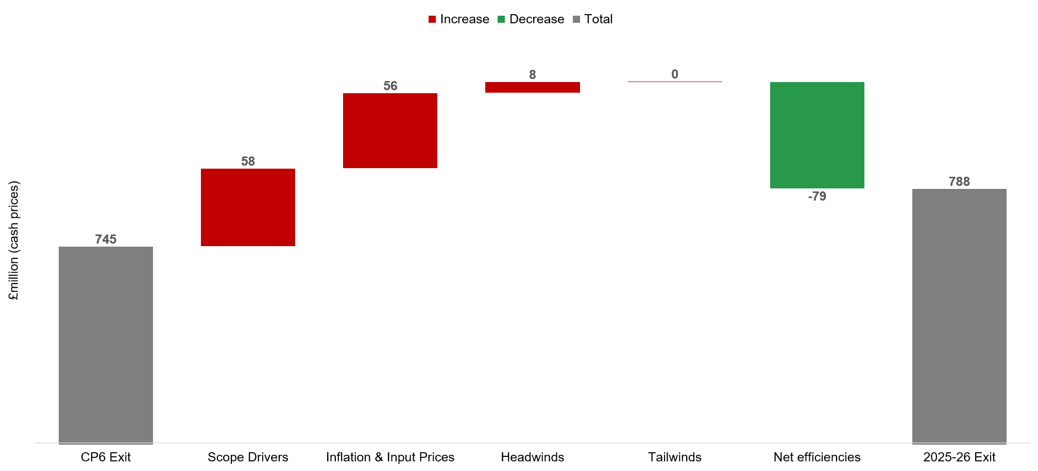
Source: ORR analysis of Network Rail’s data
4.26 Scope drivers refer to changes to complexity or scale of work being delivered, resulting in higher costs. Cost increases have been driven by additional activity in structures, earthworks, performance improvement, buildings, drainage, asset improvement and in examinations of civil infrastructure.
4.27 Inflation and input prices were higher than assumed in Network Rail Scotland's CP7 delivery plan. General inflation (CPI) increased costs by £44 million, with a further £12 million arising from higher rail-specific input prices, including materials, labour and supply chain costs.
4.28 Headwinds encompass other cost drivers which increase the cost of delivery beyond Network Rail’s control. Headwinds have included higher national insurance payments, higher pay awards and the Union Street fire in Glasgow.
4.29 Tailwinds refer to cost drivers which decrease the cost of delivery, which are beyond Network Rail’s immediate control. No tailwinds were recorded for the last year.
Income
4.30 Network Rail Scotland received £1.2 billion of income in 2025-26. This excludes enhancement grants, which are funded separately by Transport Scotland and financing costs related to indexed linked debt.
Franchised track access charges
4.31 Franchised track access income comes from fees paid by train operating companies (excluding open access and freight operators) to use Network Rail Scotland’s rail infrastructure. Track access charges income was broadly in line with plan, at £527 million, which was 1%, above the delivery plan.
Grant funding
4.32 Network Rail Scotland received £439 million in network grant funding in 2025-26, £26 million less than planned in the CP7 delivery plan. Most of the 2025-26 difference in grant payments reflects the reprofiling of £20 million of funding from Year 2 to Year 4 of CP7. The flexibility of grant payments in Scotland is under the oversight of Transport Scotland and Scottish Government’s CP7 budget process. Total CP7 funding remains £2,299 million, in line with the plan.
4.33 Separate arrangements with the DfT cover Network Rail Scotland’s share of financing costs, British Transport Police, and corporation tax. Funding for these totalled £210 million, £14 million below plan, reflecting lower-than-expected costs and therefore reduced grant requirement.
4.34 Grants are considered outside Network Rail’s control and do not impact financial performance assessments.
Other income
4.35 Other income includes freight and stations income, property rental and sales income, depots income and freight traction electricity income. Network Rail Scotland received £58 million of other income, broadly in line with target.