

Improving legislation and processes for train driving licences
The Train Driving Licences and Certificates Regulations 2010 (TDLCR) implemented an EU-wide system of train driver licensing and certification based on common standards. We have issued over 29,000 licences to train drivers in Great Britain.
Following a 2023 post-implementation review that demonstrated a case for change, we worked closely with the DfT throughout 2025 to 2026 to develop options to improve the regime. This focused on reducing costs by streamlining requirements and processes and considering legislative changes to reflect technological and medical advances. These changes are expected to significantly reduce industry burdens, with a DfT consultation planned for 2026 to 2027.
DfT also prioritised lowering the minimum age for train drivers from 20 to 18, announced in May 2025. ORR and DfT reviewed industry implementation plans and were satisfied they met the criteria set by the Minister for Rail. Legislation was laid in February 2026 and came into force on 30 June 2026. The TDL Portal has been updated accordingly.
We enhanced the TDL Portal, streamlining employer information requirements to reduce administrative burden within legislative constraints. We delivered rising volumes of licences and improved forecasting with operators to support future demand, with volumes expected to peak in 2028 as 10-year licences come up for renewal. We also updated all related guidance and processes.
Other policy developments and improvements
We completed a post-implementation review of ROGS on behalf of DfT, providing a draft report well ahead of the August 2026 deadline.
ROGS set the rail safety framework across mainline railways, metros, tramways, light rail, and heritage railways, requiring operators to maintain safety management systems and hold certification from ORR.
We gathered stakeholder input through eleven engagement sessions and used this evidence to develop draft findings and recommendations, including improvements to guidance and ways to reduce administrative burden.
We worked with the Health and Safety Executive (HSE) and the Department for Business and Trade (DBT) on the Employment Rights Bill, supporting guidance on suitable work for children in heritage railways. This was welcomed by the Heritage Railway Association and led to a statutory duty for ORR and HSE to produce guidance by December 2026. Work began in 2025 to 2026, with publication expected in the Summer of 2026.
We also worked with RSSB to assess the effectiveness of the railway standards framework. In January 2026, we approved updates to the Railway Standards Code, including establishment of an Industry Leadership Group to provide strategic direction and escalation. We continued to support interoperability authorisation and the application of standards.
Working with other regulators, safety authorities, and industry bodies to share best practice and aid continuous improvement
Our international engagement
Our updated international engagement strategy reflects the post EU Exit environment, aligns with wider government priorities, and focuses on maximising benefits for ORR, government, and the British rail industry.
Although we received fewer engagement requests than in previous years, we hosted two inward visits - from Dubai’s Road and Transport Authority and Saudi Arabia’s Transport General Authority (TGA) - supporting valuable knowledge exchange on railway health and safety. Under our Agency Agreement with Northern Ireland’s Department for Infrastructure, we also provided operational support through inspection activity.
We continued to participate in key forums, including RESCOR in Dublin in October 2025, and attended European Union Agency for Railways (ERA) National Safety Authority Network meetings as an observer, alongside several ERA subgroups. These forums support experience sharing and help us monitor European developments relevant to the Channel Tunnel and domestic railways.
We also maintained an active role in the International Liaison Group of Government Railway Inspectorates (ILGGRI), providing the secretariat and supporting knowledge sharing on health and safety and operational risk across participating authorities.
Case Study 5: Engagement with the Transport General Authority of Saudi Arabia
The Transport General Authority of Saudi Arabia is an important stakeholder for the UK Government. As part of our support, we engaged extensively with TGA during 2025 to 2026. This included two ORR colleagues attending the Saudi International Rail event in Riyadh in October 2025 as part of a wider UK delegation. We spoke on a panel, and colleagues took part in a site visit and broader UK led engagement with TGA.
To further support the UK–Saudi relationship, we hosted four TGA delegates in London in April 2026. The visit included high level discussions on health and safety regulation and key operational risks. Delegates visited St. Pancras International, travelled on London Overground, Underground, and mainline networks with ORR’s Operations team, and observed our regulatory liaison with stakeholders. The visit provided valuable mutual insight and strengthened information exchange on regulatory approaches and key safety issues.
Our external health and safety committee
Since April 2025, we held four meetings of the Railway Industry Health and Safety Advisory Committee (RIHSAC), with ORR Board non executive director Ian Dobbs becoming Chair in February 2026. The committee brings together employers, employees, trade unions, passengers, and government to advise and constructively challenge ORR’s Board on health and safety matters.
Topics discussed included rail sector transformation, passenger welfare during stranded train incidents, risks from trains passing the end of authority (including SPADs), ORR’s risk profiling outcomes, mental and occupational health, and annual safety reports from ORR, RSSB, and RAIB.
Our engagement and collaboration with other regulators
We maintained close working with the Health and Safety Executive (HSE) as co regulators, covering shared policy and operational priorities. This included reviewing inter agency agreements on road vehicle incursions and safety by design, and joint work towards potential ratification of an International Labour Organisation convention on occupational health and safety.
Following HSE’s post implementation review of RIDDOR, we worked together to ensure alignment in guidance to duty holders and continue to support consultation on future legislative changes.
We also collaborated with HSE and the Office for Nuclear Regulation to maintain clarity on the duty to reduce risks ‘so far as is reasonably practicable’ and ensure consistent regulatory approaches and communications.
We remained active in the UK Health and Safety Regulators’ Network (UKHSRN), with our Chief Inspector Richard Hines becoming Chair in 2026.
Case Study 6: Building our future capability
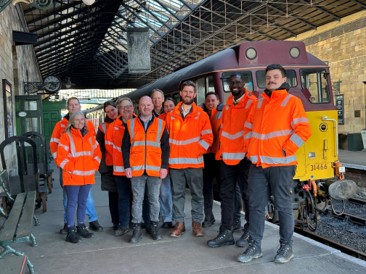
In October 2025 we recruited a further ten trainee Inspectors to ensure we build capability and resilience in ORR’s ability to continue to regulate the railways. The trainees come from a mix of previous rail industry and regulatory experience. They will work towards gaining the National Examination Board in Occupational Safety and Health (NEBOSH) diploma in Railway Regulatory Health and Safety qualification, learning all the necessary regulatory legal and railway technical skills they need through a blend of classroom and practical “on the job” training. The trainees are supported by our Learning and Development Team, who deliver the formal classroom learning, and our Operational Training Team, drawn from our Inspectors, who teach them the details of how to be an inspector.
Below shows our new cohort 2026 Inspectors in training visiting the North Yorkshire Moors Railway, accompanied by members of the Operational Training Team, for their initial railway induction on 3 to 6 March 2026.
Preparations are already underway to recruit and train around 10 Inspectors and Inspector Assistants in the next 12 months.
Delivering a range of statutory work
We grant a range of health and safety permissions and approvals, often to statutory deadlines, supporting an effective railway safety framework and train driver licensing regime.
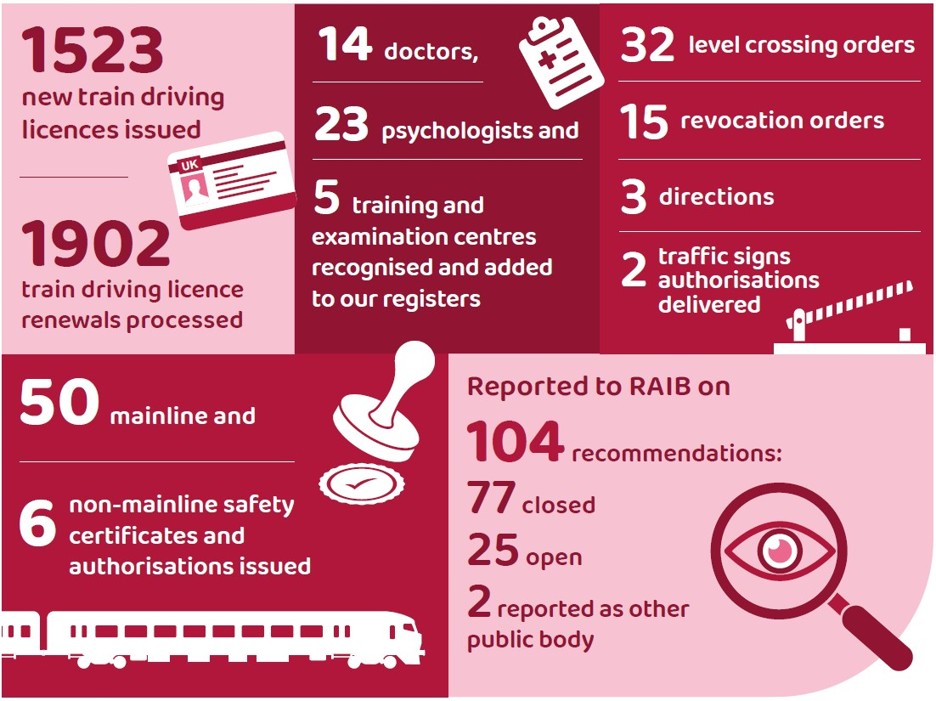
While we aimed to meet all service standards, train driving licence renewals experienced some delays due to high demand, although new licence applications consistently met targets. A summary of our work in 2025 to 2026 is provided below:
Source: ORR