

Rail reform context and the safe transition to GBR
The transition to public ownership of train operators is underway following the Passenger Railway Services (Public Ownership) Act 2024, with further transfers planned through 2026 and 2027. This is taking place alongside the development of GBR, bringing together track and train into a more integrated system. We continue to assess Safety Certificates and Authorisations and oversee Network Rail’s Safety Authorisation to ensure that safety management systems remain effective throughout this transition.
This period of change presents risks to the continuity and effectiveness of safety management arrangements across both infrastructure and operations, particularly where responsibilities, interfaces and governance structures are evolving. It is essential that duty holders maintain clear accountability and effective control of risk throughout.
We have been actively engaged in rail reform since the Williams Rail Review, working closely with the GBR Transition Team, Department for Transport, Network Rail, operators, RSSB, and trade unions to understand and manage these risks. This has included workshops with senior industry and workforce representatives to gather insight on key safety issues.
We have published our Guiding Principles for Great British Railways’ Health and Safety Management System, setting out the outcomes we expect under future arrangements. These principles support clear accountability, effective interfaces, and robust safety governance, without prescribing structures.
We will continue to provide proportionate and transparent regulatory oversight throughout the transition to ensure that safety risks are effectively managed, and that GBR is established with a stable and resilient safety management system from day one.
Network Rail
As the infrastructure manager, Network Rail plays a central role in delivering system-wide safety outcomes. The following section summarises our assessment of its current performance and key risk areas.
Network Rail’s management maturity (RM3)
We completed nearly 400 RM3 assessments across Network Rail through our frontline inspector activities, covering central functions and regions. These show variability in the consistency and effectiveness of safety management system application.
Most areas were assessed as standardised. However, Workload Planning, Asset Management, Change Management and Safe Systems of Work each included some ad hoc ratings. This indicates that arrangements are not always applied consistently and there is a greater risk of non-compliance.
Risk performance
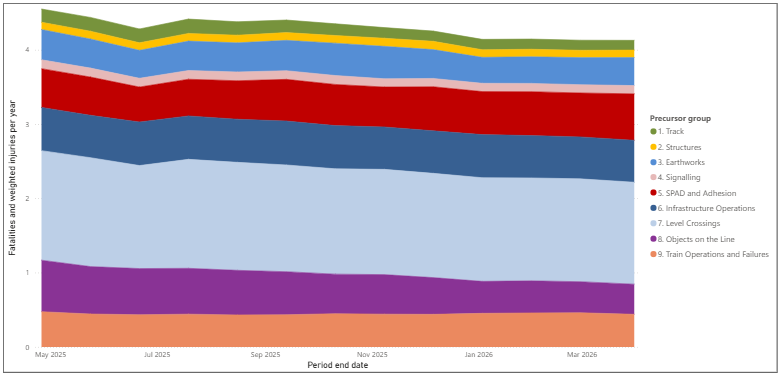
In 2025 to 2026, 29 high-potential train accident incidents were reported (2024 to 2025 revised to 28), of which twelve involved level crossings.
Risk from objects on the line has reduced, particularly vehicle incursions. Signal passed at danger (SPAD) and adhesion risk has slightly increased, though adhesion’s contribution has fallen. Train operations risk has risen due to overspeeding.
There were twenty high-potential workforce safety events (down from 30 last year), mostly involving trackworkers on open lines. Slips, trips, and falls remain the main contributor to workforce injuries. One case of Pontiac fever followed Legionella exposure. Workforce precursor risk rose slightly from 0.067 to 0.069.
Figure 1: PIM trend April 2025 to March 2026
Source: RSSB
CP7 health and safety delivery plan
Network Rail’s CP7 delivery plan remains the key reference point for assessing progress against its health and safety commitments.
During the year, financial pressures have affected the delivery of renewals and other planned work. Where activities are deferred or reduced, Network Rail must demonstrate that risks have been properly assessed and that suitable mitigations are in place.
We will continue to challenge and seek assurance that safety risk is being effectively managed in these decisions.
Structures and operational property
Network Rail is responsible for over 30,000 structures and 2,500 stations, making effective inspection and assessment arrangements essential to safety.
Our inspections previously identified compliance gaps affecting around 4,500 structures and operational property assets. Following regulatory intervention, Network Rail confirmed that risk assessments were in place for these assets.
During 2025 to 2026, we required completion of structural capacity assessments where these were missing. This work is now largely complete, with plans in place to address the small number of remaining assets.
Overall, Network Rail has made good progress in addressing previously identified gaps, with more than 1,100 assessments completed and increased assurance that structural risks are being managed.
Trackworker safety
The fatality at Radlett in March 2026 highlights the importance of correct protection arrangements. In this case, work was carried out on an open line rather than the protected line.
There has been a step change in moving away from red zone working to safer green zone arrangements. However, incidents continue where planned protections are not correctly applied or followed.
In 2025 to 2026, there were 12 high-potential incidents. While this is a reduction overall, some incidents were more severe in nature, including cases where workers were on open lines with protection in place at entirely different locations.
Network Rail has established Safety Task Force 2 to improve how safe access is planned and delivered. We will continue close engagement to ensure sustained improvement, alongside our investigation into the Radlett incident.
Level crossings
Fatalities at level crossings have increased significantly, from 1 in 2023 to 2024 to 5 in 2024 to 2025, and 11 in 2025 to 2026. This reinforces the need for sustained and consistent risk control.
Network Rail is progressing upgrades such as miniature stop lights, additional barriers, and exploring new technologies to reduce reliance on at-grade crossings.
Our inspection campaign on passive crossings found that risk management processes are in place and generally effective. Narrative Risk Assessments were present, and controls broadly aligned with the hierarchy of control.
However, there is variation in the quality, supporting evidence and review of these assessments, as well as in the timely delivery of improvements. Overall, risk is managed at a broadly standardised level, but greater consistency and stronger assurance are needed across regions.
Investigation of collision and derailment at Shap, Cumbria
In November 2025, a passenger train derailed near Shap after striking material from a landslip caused by blocked drainage and heavy rainfall. Injuries were fortunately, minor.
Although monitoring equipment had been installed at this high-risk location, it did not prevent the incident.
Our investigation is ongoing and is considering infrastructure management, maintenance arrangements, and the effectiveness of monitoring systems and alarm responses.
Occupational Health Matters
We served an Improvement Notice following reports of worsening hand-arm vibration (HAVs) exposure at London Bridge Delivery Unit. We have engaged with Network Rail to reinforce the need for risk assessments to be based on task-related exposure rather than individual tools alone.
Since the closure of the Improvement Notice relating to welding fume exposure, we have raised concerns regarding employee awareness and understanding of the newly implemented requirements and associated equipment.
We continue to engage with Network Rail to ensure lessons from earlier enforcement are identified and applied across the wider organisation.
Case Study 1: Track maintenance and assurance
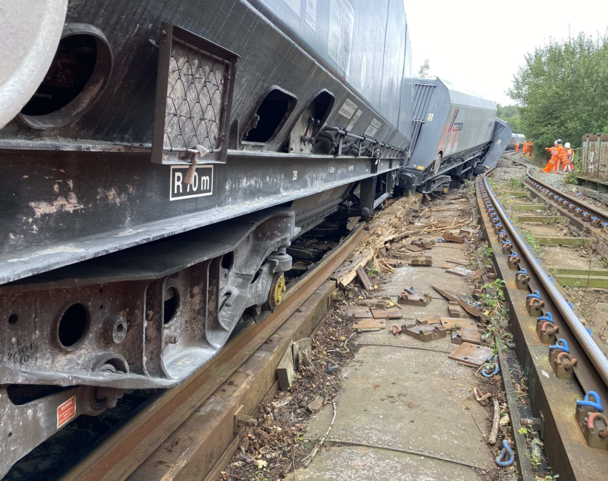
The freight train derailment at Audenshaw in September 2024 highlighted the significant safety risks that arise when maintenance and assurance systems fail to operate effectively.
In 2025, our investigation found that Network Rail had not planned or delivered maintenance effectively, and that assurance arrangements were not providing sufficient challenge or escalation. These failings were linked to wider systemic weaknesses, including gaps in engineering capability, weak local oversight, poor defect management, and ineffective coordination between teams. An Improvement Notice was served in April 2025.
By April 2026, we accepted that Network Rail had achieved compliance, supported by a national review of inspection regimes, targeted interventions in delivery units, and actions to strengthen engineering capability, safety culture, and assurance within its Safety Management System.
While this represents clear progress, the case demonstrates that such failures are often systemic rather than isolated. We will continue targeted oversight to ensure improvements are sustained, with a continued focus on strengthening maintenance discipline, assurance effectiveness, and early identification of risk across the network.
Case Study 2: Occupational Health – Welding Fume
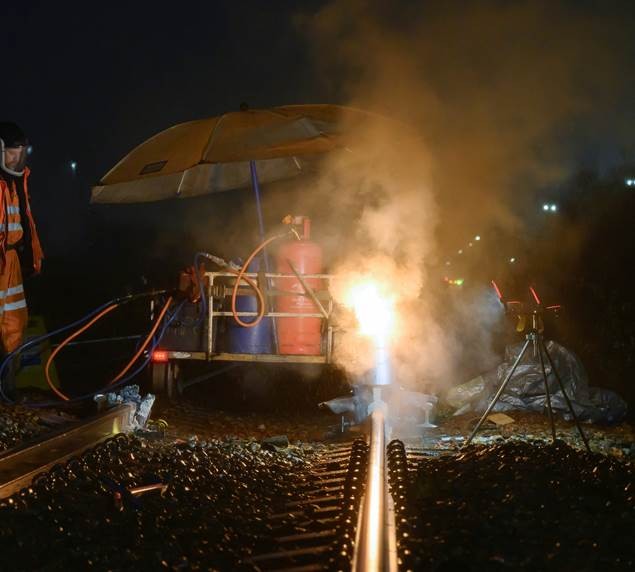
Network Rail carries out many thousands of welding activities each year, creating a significant risk of exposure to welding fume. This exposure is linked to serious and often irreversible health effects, including lung cancer, occupational asthma, respiratory irritation, and metal fume fever. These risks require robust assessment and effective control at source.
Through various interventions and engagement, we identified that Network Rail had not carried out suitable and sufficient risk assessments, nor identified or implemented adequate controls. An Improvement Notice was served in February 2024.
Following resolution of an appeal, Network Rail responded positively, and by February 2026, we accepted that Network Rail had achieved compliance, supported by strengthened risk assessments and the introduction of improved reasonably practicable control measures.
While this represents clear progress, sustaining and embedding these improvements remains essential. We will continue targeted inspections and engagement to ensure welding fume risks are effectively managed and workers’ health is protected over the longer term.
Mainline train operators and freight
Overspeeding
Overspeeding remains a significant system risk and a precursor to derailment or collision. Previous incidents, including at Spital Junction, demonstrate how close trains have come to potentially catastrophic outcomes.
Our inspections found that early progress in addressing this risk was slow, with limited information sharing, inconsistent approaches, and over reliance on administrative controls rather than more robust or technological solutions.
Following a further incident on the East Coast Mainline, in December 2025 the Chief Inspector convened an urgent cross industry meeting with Network Rail and train operators to accelerate progress in addressing the underlying issues and implementing Rail Accident Investigation Branch (RAIB) recommendations. This meeting provided a clear point of focus for industry leadership and set expectations across three key areas: improving information sharing to better target risk, strengthening cross industry coordination and accountability, and making better use of data to understand and manage overspeeding risk.
This intervention has had early impact. There has been good progress in developing joint risk assessments for high risk junctions and a stronger focus on collaboration across infrastructure managers and operators. Industry groups, including the Rail Delivery Group (RDG) and RSSB, are also progressing work to establish more coordinated leadership arrangements.
However, further incidents, including at Cambridge Junction, show that risks remain and that the robustness and consistency of risk assessments still need to improve. Overall, arrangements remain uneven and are not yet consistently proactive across the system.
Welfare for Railway Workers
There has been strong initial commitment to improving welfare facilities, including 26 organisations signing the Welfare Charter. However, progress has been uneven and industry momentum has slowed.
Key barriers remain, particularly around coordination, shared access to facilities, and consistent delivery across different parts of the network. A refocussed programme is now underway with RSSB to strengthen leadership, improve collaboration, and establish clearer expectations and milestones.
We will continue to assess welfare provision through inspections and engagement, while encouraging wider adoption of the Charter. Sustained focus is needed to translate commitment into practical improvements and ensure workers have consistent access to appropriate facilities.
Fatigue
Our fatigue programme is improving understanding of fatigue as a safety risk and setting clearer expectations through updated guidance and ongoing engagement with industry.
Inspection evidence shows that, while progress is being made, fatigue management arrangements are not yet consistently embedded or operating as part of a mature, system wide approach. Controls are often reactive, with limited use of data to proactively identify and manage risk.
Further work is needed to integrate fatigue management more fully into safety management systems and support earlier intervention. We will continue its programme of inspections and targeted engagement to drive more consistent and effective control of fatigue risk.
Stranded Passengers
The industry has continued to develop its approach to managing stranded train incidents, supported by guidance from RDG and practical resources from RSSB. These focus on improving preparedness, strengthening response capability, and prioritising passenger welfare.
There is growing emphasis on coordinated, multi agency working and a whole system approach, recognising that effective management depends on clear roles, communication, and collaboration across organisational boundaries.
We welcome this progress, particularly the focus on shared learning and continuous improvement. We will continue to monitor how effectively these arrangements are applied in practice, including during operational incidents.
Violence and harassment to Railway Workers
Violence and harassment towards railway staff is increasing and remains a significant concern. Wider trends in poor passenger behaviour, alongside serious incidents, highlight the risks to staff and the public.
The industry has responded with guidance and practical measures, including improved reporting and the use of body worn cameras, helping to build a more consistent approach to managing these risks.
However, this must be treated as a core health and safety issue, not solely a security matter. Duty holders need systematic arrangements covering risk assessment, prevention, training, and post incident support.
We will continue to engage with industry to clarify expectations, promote good practice and support more effective, coordinated action to reduce risks to frontline staff.
Collaboration with Industry Groups
We continue to engage with key industry forums to drive health and safety improvements across passenger and freight operators. Notable examples include:
Freight Safe Steering Group and National Freight Safety Group
- Progressing the Wagon Condition Programme to improve wagon safety through better maintenance and train preparation; on track for completion in July 2026.
- Developing the Freight Precursor Indicator Model, providing improved data on derailment risks specific to freight, including wagon condition and operational factors.
- Coordinating action to improve welfare facilities for freight drivers, with all freight operators signed up to the Welfare Charter.
Passenger Operators Safety Forum
- Supporting development of industry guidance on station inspection.
- Coordinating operator feedback on controls to prevent trains entering service with defective sanding systems, following issues highlighted by the 2024 Talerddig incident.
These forums play an important role in improving coordination, sharing good practice, and supporting consistent risk management. They demonstrate the significant benefits of good collaboration between different parts of the system to address important issues.