

2.1 A significant change that ROGS brought about was taking away the responsibility that the safety regulator had for approving new or altered infrastructure or vehicles under The Railways and Other Transport Systems (Approval of Works, Plant and Equipment) Regulations 1994 (S.I. 1994/157). The purpose of safety verification is to provide a flexible process to make sure projects that could significantly increase risk are safe. This is achieved by appointing an 'independent competent person' - this person can come from inside or outside the organisation.
Who is the Duty Holder?
2.2 Safety verification applies to non-mainline transport operators (that is, transport undertakings and infrastructure managers). They are responsible for deciding if safety verification is needed and making sure it is carried out properly. Mainline transport operators are responsible for applying the CSM for risk evaluation and assessment when they make significant changes. If a non-mainline transport operator also operates on the mainline, they can choose to voluntarily apply the CSM for risk evaluation and assessment as opposed to safety verification. Many projects that introduce new vehicles or infrastructure to the mainline railway must also take account of the UK verification process under the Railways (Interoperability) Regulations 2011.
What Duty Holders must do
Deciding if safety verification is needed
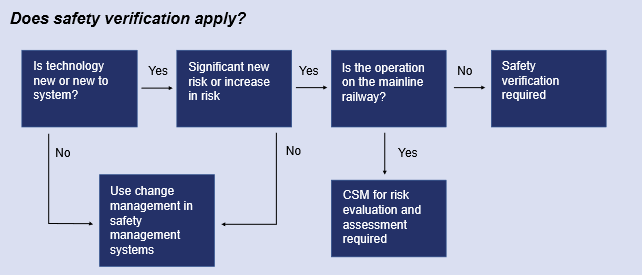
2.3 Safety verification is needed if:
- the operation is non-mainline;
- the risk arising from the project is new, or is new to the transport system (the 'difference test'); and
- there will be a new significant safety risk or a significant increase in risk (the 'risk test').
2.4 If a project passes all three of these tests, safety verification is needed, and you must:
- prepare a written safety verification scheme that meets the requirements set out in ROGS (see below)
- appoint an independent competent person to do the verification assessment; and
- make sure the independent competent person carries out the assessment.
2.5 The principles behind safely introducing new or altered vehicles or infrastructure are the same, whether you use safety verification or a change management process from a safety management system. Safety verification is designed to provide an independent assessment that a project has gone through all the steps needed to reduce risks. The main difference is that the safety verification process needs an independent competent person to carry out the assessment and the change management process may not.
What non-mainline duty holders must do
Appointing an independent competent person
2.6 Under ROGS, the independent competent person must be appointed early enough in the project for them to be involved in:
- considering the design of the project;
- identifying or setting standards and conditions for the verification process; and
- setting out the inspection and assessment plan.
2.7 There are three important things to consider when appointing an independent competent person:
- They must have the skills and knowledge needed to carry out the safety verification.
- They must not have been responsible, in a way that might cause them to be biased in their assessment, for any of the things they will have to assess.
- They must not be part of the management chain that is responsible for introducing the project.
Who can be an ‘independent competent person’?
2.8 Under ROGS, an independent competent person can be a person or an organisation.
Features of the safety verification process
Management arrangements
2.9 Part of your safety management system is a description of how you will manage the introduction of new or altered vehicles and infrastructure (see chapter 1). A summary of the safety verification arrangements would also be included in any application for a new or amended safety certificate or authorisation.
Making decisions
2.10 You should have a process in place for deciding whether or not a project should go through a safety verification process. In particular, you should take a consistent approach to ’risk’ and ’difference’ tests.
Appointing the independent competent person
2.11 You must have a process in place for appointing an independent competent person (see above) at an early stage of the project.
Preparing a written safety verification scheme
2.12 The independent competent person should be involved in preparing the written scheme. This involves developing an agreed plan that will allow the independent competent person to assess and monitor:
- the methods the project uses;
- whether the project is being designed and put in place safely; and
- whether tests are being carried out safely, and in line with agreed standards and conditions.
Providing information for the independent competent person
2.13 The independent competent person needs to have access to all relevant information and documents to be able to carry out a satisfactory assessment.
The independent competent person’s assessment
The independent competent person’s recommendations
2.14 You must have arrangements in place for making sure that the findings of the assessment – including any action the independent competent person has recommended you take – are communicated to the appropriate managers. You must also keep a record of any action you carry out as a result.
Monitoring, reviewing and revising the scheme
2.15 You can apply the general management arrangements and decision-making processes across a range of projects, and you should set these out in the safety management system. You should also review them regularly to make sure they are still effective. You should record the specific information, assessments, recommendations and action taken for each project that goes through the safety verification process.