

3.1 Under ROGS, nobody is allowed to operate vehicles or manage infrastructure unless we have awarded them the necessary safety certification (for transport undertakings) or authorisation (infrastructure managers).
Does everyone need a certificate or authorisation?
3.2 All mainline operators need a certificate or authorisation. Some 'lower-risk' non- mainline operators do not need one. However, these operators must still have a safety management system (see chapter 1) in place.
The specific types of transport systems that do not need a certificate or authorisation are as follows:
- A transport system that does not run at speeds above 25mph (40km/h).
- Tramways, no matter what speed they run at.
The safety certification and authorisation process
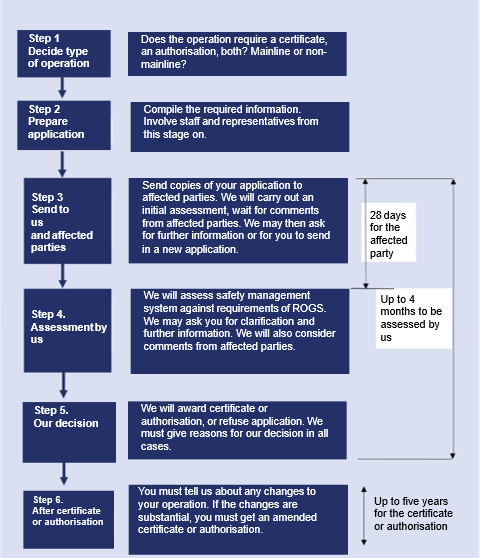
Step 1: Decide type of operation
Do I need a certificate or authorisation?
Certificate
3.3 All transport undertakings (except on some 'lower-risk' systems - see paragraph 3.2) need relevant safety certification to operate on a transport system. This includes both the mainline and non-mainline railway. It does not include operating only on systems within depots, sidings or engineering possessions.
Authorisation
3.4 All organisations which develop and maintain infrastructure (the track, signalling systems, bridges, crossings and so on) or operate and manage stations need a safety authorisation. This applies to both the mainline and non-mainline railway.
Both
3.5 A train operating company that also manages its own infrastructure will need both a certificate and an authorisation from us. As 'the infrastructure' includes stations, transport undertakings that manage stations (nearly all the major train operating companies) will also need both.
Do I need a mainline or non-mainline certificate or authorisation?
3.6 Chapter 1 includes an explanation of what a mainline railway is and what it is not. There is little practical difference between the two in the certification and authorisation process. The size and nature of the transport system you are operating or managing is much more important.
Mainline certificates
3.7 If you are a mainline transport undertaking, you must apply for certificates in two parts.
- Part A sets out your general safety management arrangements.
- Part B relates to one transport system. It includes details of how you make sure the specific transport system you want a certificate for is operated safely.
Recognition of safety certificates
3.8 Following EU Exit, in order to operate on the GB mainline railway infrastructure, all duty holders must hold Part A and Part B safety certificates that have been issued by the ORR. This applies to both GB and EU based duty holders.
3.9 Part A and Part B safety certificates issued by the ORR are no longer valid in the EU. Transport operators operating services in the EU must hold the necessary EU safety documentation issued by the relevant safety authority in order to operate services in the EU.
3.10 More information is available here: Rail transport: domestic and cross-border operations
Non-mainline certificate
3.11 Non-mainline certificates come in one part. The requirements are broadly similar to a mainline application. The safety management system, the size and nature of the transport system being operated or managed is the main factor in deciding how detailed and complicated the application needs to be.
Operating on both mainline and non-mainline railways
3.12 Some trains are operated on both mainline and non-mainline infrastructure. As a lot of the information needed is the same, you can apply for one certificate in one application to run on both (the application needs to be clear about which parts of it apply to the mainline railway and which parts apply to the non-mainline railway).
3.13 Mainline transport undertakings that also run on non-mainline infrastructure should apply for a mainline certificate. The mainline certificate will cover operation on both types of infrastructure.
3.14 Non-mainline transport undertakings that also operate on the mainline infrastructure should apply for a non-mainline certificate. Such non-mainline operators must also show that their safety management systems are adequate for operation on the mainline railway.
3.15 Where a holder of an existing mainline or non-mainline certificate proposes to operate a tram-train service on the mainline railway and they have not previously done so, this is likely to constitute a material change to their safety certificate, and they must show that their safety management systems are adequate for tram-train operation on the mainline railway. Tram-trains will need a non-mainline certificate when they operate on the mainline railway.
3.16 Mainline and non-mainline authorisations are specific to the relevant infrastructure. The main difference in applying for a mainline or non-mainline authorisation is the size and nature of the transport system being managed. Also, infrastructure managers who in practice only manage stations (in other words, most train operating companies) would be expected to produce less information as part of their authorisation than those who also maintain track, signals, and so on.
Step 2: Prepare application
The information we need from you
Your details
3.17 Basic information, for example:
- your contact details:
- the type of application you are making;
- the number of staff your company employs; and
- any existing certificates or authorisations you hold.
- The type and nature of the transport being operated. If you are a transport undertaking, this refers to:
- your activities;
- the franchises you hold;
- the infrastructure and routes you operate over;
- the purpose of the transport you operate (commuter travel, freight, and so on); and
- the number of trains and passengers.
Or
3.18 The particular details of the infrastructure. For infrastructure managers, this should refer to:
- the length of track;
- the type of signalling and control systems; and
- safety-related features or structures such as stations, crossings, tunnels and major junctions.
3.19 For ‘station-only’ infrastructure managers, the ‘particular details’ could be as simple as quoting the number of stations and the number of people employed at them.
- ‘Interfaces’ with other operators. For example, where a train operating company uses stations that are owned and managed by another operator.
Summary of the safety management system
3.20 You need to provide evidence that your safety management system is designed to meet the requirements of ROGS as described in chapter 1. The summary should:
- include a copy of the safety policy statement and a description of how it is shared with staff at all levels;
- refer to any recognised safety management models you use;
- refer to other documents which describe the safety management system and its supporting procedures;
- show the structure of the safety management system, in particular highlighting how roles and responsibilities are given to staff;
- describe how the safety management system fits in with other activities and priorities;
- explain how individuals who manage safety are held responsible;
- set out the conditions for involving staff and their representatives at all levels in the safety management system;
- describe how you monitor safety performance and how you put right any faults; and
- explain how you put in place new safety developments and lessons you have learned from accidents or incidents.
Details of safety measures
3.21 The basic parts of a safety management system are also described in chapter 1. You should include in the application a brief description of how your organisation does each of these things, and an explanation of where detailed policies or process documents can be found.
Involving staff and their representatives
3.22 ROGS places a duty on operators to consult employees’ health and safety representatives when preparing their application for a safety certificate and / or safety authorisation. This means that you must carry out your consultation before you send us your application and do so as early as possible, to enable comments received to be taken into account.
Step 3: Send to us and affected parties
3.23 We will appoint an assessment manager and a lead assessor for each application. After we receive your application, the lead assessor will confirm they have received it and give you their contact details and those of the assessment manager. See the ‘More information’ box at the end of this chapter for details of where to send your application.
Initial screen
3.24 The lead assessor will check your application to make sure that you have included the basic information we need (see paragraph 3.17 above) to carry out an assessment. If you have not, you may need to provide any missing information before we can begin the main assessment. If there are any serious gaps in the information you have provided, we may return your application for you to correct.
Affected parties
3.25 You must send a copy of your application to all the people who will be affected by it (the ‘affected parties’) or tell them where it can be accessed on a website. The ‘affected parties’ must include the following:
- For all applications, any recognised trade unions (for example RMT, ASLEF, TSSA, Unite) plus any staff safety representatives in your organisation. However, this should not be the first time they see the application as they should already have been involved in preparing it;
- For all applications, the appropriate rail user groups (normally, this would be Transport Focus or London TravelWatch, or both). Generally, if your services do not operate within the London area there is no requirement to consult London TravelWatch.
- For a certificate application, anyone who manages the infrastructure that you will be operating over.
- For an authorisation application, anyone who manages infrastructure that ‘interfaces’ with yours and those operators who operate over your infrastructure.
3.26 The applicant should send their application to affected parties either on the same day that their application is submitted to ORR or the following day to avoid delays in the assessment. It is good practice to copy in ORR to the email sent to affected parties as a way of notification.
3.27 Affected parties have 28 days to make any comments or provide us with further information about the application. The affected party should provide a response to ORR within 28 days even if there is a ‘nil return’.
3.28 If you send us any further information during the application, you must send copies of this to the affected parties.
3.29 In the event of an application from the Operator of Last Resort, DfT can apply for an exemption under Regulation 30(2) requesting that the Operator of Last Resort be exempt from consulting affected parties. That application should be made either in advance of, or at the same time as, an application for a safety certificate and/or safety authorisation is submitted for assessment. The exemption only applies to applications for new or amended certificates and/or authorisations. For any renewal application, the Operator of Last Resort must consult any affected parties as per the process described above in 3.25.
We also consider it good practice for you to share your final application documents with the affected parties.
Step 4: Assessment by us
Our assessment and decision
3.30 The main assessment is where we examine the quality of the detailed content set out in your application. We have four months to carry out the assessment and advise you of the outcome. The 28-day period for affected parties to make their comments will run concurrently with the four-month period.
3.31 For those applicants who are yet to operate a train and are not taking over a franchised operation, the assessment will include a review of the selection of Safety Management System (SMS) procedures that are referred to in the application and, in some instances, an on-site inspection to verify that the content of the submission is able to be delivered practically. These activities help identify vulnerable areas where further inspection activity may be required post issue of the safety certificate and / or safety authorisation, once the operations commence.
Step 5: Our decision
3.32 Following the assessment, we will either:
- prepare and issue you with a certificate or authorisation; or
- write to you explaining why we have refused your application.
3.33 We must give reasons for our decision, no matter whether we accept or refuse your application.
3.34 For those applicants not taking over a franchised operation, we ask that upon receipt of your certificate or authorisation you confirm to us the date you intend to start operations. If this is unknown at the time of receiving your certificate or authorisation, you should notify the lead assessor of your application once the date is confirmed.
Amending a certificate
3.35 If you hold a certificate or authorisation, it will be valid for up to five years. During this time, you must tell us if there are any changes to the transport system you run (and keep a record of any resulting changes to your safety management system). You must tell us if the name of the transport operator changes.
3.36 If you make a ‘substantial change’ (see below), you will need to apply for an amended safety certificate or authorisation. In addition to a ‘substantial change’, other changes (organisational, operational or technical), may require you to amend your SMS and obtain an amended safety certificate or authorisation before they can take effect. You should discuss any proposed changes with ORR at the earliest opportunity.
3.37 To apply to make an amendment, you will need to:
- describe the proposed change; and
- provide details of any changes to the evidence you sent us when you originally made your application. These should be highlighted in different colour text within the submission document.
3.38 You will also need to consult safety representatives and send a copy of the amended information to the affected parties. How long the amendment process takes and how detailed it needs to be will depend on how complicated the change is.
3.39 If changes to the law mean you will have to make a substantial change to the transport system you operate or manage, we may ask you to apply to amend your certificates or authorisations (this is known as a ‘direction to apply for an amendment’).
Further certificates and authorisations
3.40 You can contact us to discuss the renewal of your certificate or authorisation up to eight months before expiry of your existing certificate or authorisation. Your application document needs to highlight any changes or proposed changes since the previous submission. Aside from this, the application process is the same and we will issue you with a new certificate or authorisation if your application is successful. You cannot by law continue to operate if your certificate or authorisation expires.
Revoking a safety certificate or authorisation
3.41 We will only revoke (cancel) your certificate or authorisation if:
- you are not meeting the conditions of the certificate or authorisation; and
- there is a significant safety risk as a result.
3.42 If you are a transport undertaking, we will also revoke your certificate if you do not operate a vehicle under the certificate within a year of it being issued.
3.43 We must give you notice that we are considering revoking your certificate or authorisation. We must also give you at least 28 days to make any comments. If we revoke your certificate or authorisation, you must stop running the transport it was issued for.
Appeals
3.44 You can appeal to the Secretary of State if you are not happy because we:
- refused your application (including an application to amend or extend your certificate or authorisation);
- (failed to make a decision on your application within four months;
- revoked your certificate or authorisation; or
- asked you to apply to amend your certificate or authorisation.
3.45 Affected parties, passenger groups and trade unions have no right to appeal against a decision we have made under ROGS.
3.46 You can ask us for details of the appeals process at rogs@orr.gov.uk.
Step 6: After the award of a safety certificate or safety authorisation
3.47 After issuing a safety certificate or a safety authorisation, we will have arrangements in place to check:
- whether the results outlined in the application for a safety certificate or a safety authorisation are being achieved during operation; and
- that all the necessary requirements are complied with on a continuous basis.
3.48 Following the issue of a safety certificate / safety authorisation, ORR’s arrangements for overseeing safety performance are as follows:
- We set out a strategy and plan(s) for supervising mainline transport operators;
- We have clear techniques for how to conduct our supervisory activities;
- We have clear links between the assessment for mainline safety certificates/authorisations and supervision activity;
- We operate a competence management system for those conducting supervision activities;
- We utilise decision-making criteria when evaluating transport operators’ activities;
- Where necessary (such as cross-border railway operation activity) we cooperate and coordinate our supervisory activity with other national safety authorities.
3.49 ‘Supervision’ means the arrangements put in place by the ORR to oversee safety performance after it has granted a safety certificate or safety authorisation.
ROGS Exemptions and the application of The Railway Safety Regulations 1999
3.50 Where a heritage railway applies for an exemption under Regulation 30(1) to carry out operations at speeds above 25mph (40km/h) on a short-term basis, it must also consider the requirements of the Railway Safety Regulations 1999 (S.I. 1999/2244) (RSR 1999).
3.51 If a heritage railway normally carries fare paying passengers but intends to temporarily introduce a separate operation at higher speed under possession conditions, it is considered to be a separate operation not carrying fare paying passengers, and RSR 1999 does not apply.
3.52 However, this separate operation will need to comply with the requirements of ROGS and the railway must be in possession of a non-mainline safety certificate and safety authorisation or an exemption before any higher speed operation can commence. We advise you to discuss any proposals with your lead inspector as early as possible.
3.53 The following example illustrates the principles of how RSR 1999 and ROGS interact: