

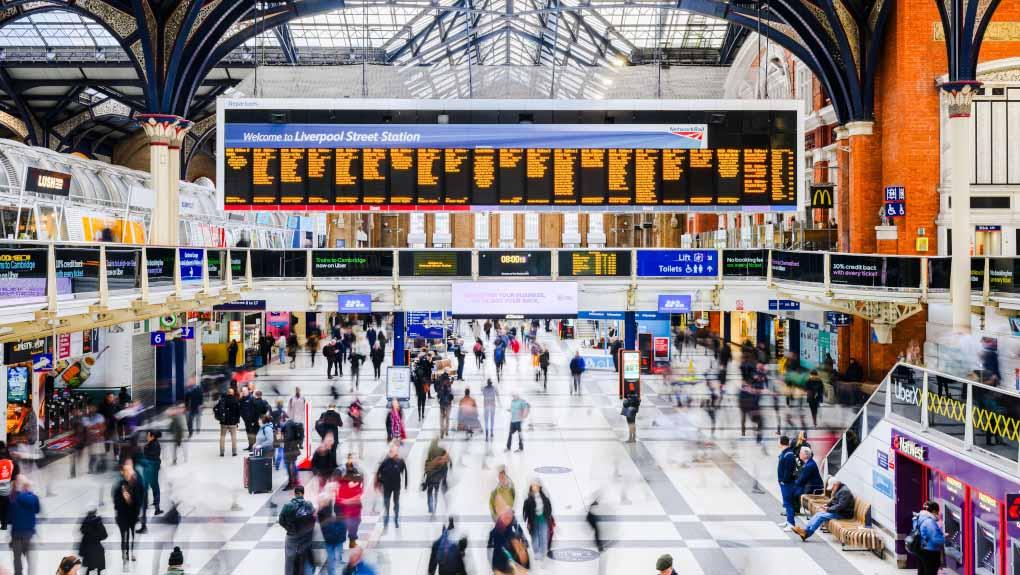
The results, from ORR’s latest annual estimates of station usage statistics (April 2024 to March 2025) published today, reflect the continuing impact of the Elizabeth line, which has reshaped travel patterns across London since the central section opened in May 2022. Its services continue to drive high usage at London Liverpool Street, Paddington, Tottenham Court Road, Farringdon and Stratford.
Six of the top 10 most popular flows – journeys between stations – were between stations served by the Elizabeth line, with 8.7m journeys between London Liverpool Street and Tottenham Court Road.
Access the estimates of station usage statistics here.
The top 10 most used stations in Great Britain
| Rank | Station | Entries and Exits | Rank last year |
|---|---|---|---|
| 1 | London Liverpool Street | 98.0m | 1 |
| 2 | London Waterloo | 70.4m | 4 |
| 3 | London Paddington | 69.9m | 2 |
| 4 | Tottenham Court Road | 68.1m | 3 |
| 5 | London Bridge | 54.7m | 7 |
| 6 | London Victoria | 53.8m | 6 |
| 7 | Stratford (London) | 51.5m | 5 |
| 8 | Farringdon | 50.2m | 8 |
| 9 | Bond Street | 42.8m | 9 |
| 10 | London Euston | 40.2m | 10 |
Birmingham New Street remains the busiest station outside of London with 36.6 million entries and exits. Manchester Piccadilly remains in second place (27.4m), with Leeds (27.3m) leapfrogging Glasgow Central into third place.
In Scotland, Glasgow Central (25.3m) and Edinburgh Waverley (22.8m) continue to be the country’s busiest stations, maintaining their long-term national rankings.
Cardiff Central is the busiest station in Wales with 12.5 million entries and exits, with Newport (South Wales) second with 2.8m.
The top 10 most used stations in Great Britain outside London
| Rank | Station | Entries and Exits | Rank last year |
|---|---|---|---|
| 1 | Birmingham New Street | 36.6m | 1 |
| 2 | Manchester Piccadilly | 27.4m | 2 |
| 3 | Leeds | 27.3m | 4 |
| 4 | Glasgow Central | 25.3m | 3 |
| 5 | Edinburgh Waverley | 22.8m | 5 |
| 6 | Gatwick Airport | 21.2m | 6 |
| 7 | Brighton | 15.3m | 7 |
| 8 | Glasgow Queen Street | 15.0m | 8 |
| 9 | Liverpool Central | 14.8m | 10 |
| 10 | Liverpool Lime Street | 14.4m | 11 |
Elton and Orston in Nottinghamshire was Great Britain’s least used station, with just 68 recorded entries and exits. It was also the least used station in the year April 2021 to March 2022. Shippea Hill in Cambridgeshire (76) and Ince and Elton in Cheshire (98) also feature among the quietest stations.
Denton in Greater Manchester - last year’s least used station - is now fourth, after the number of entries and exits nearly doubled compared with last year.
The top 5 least used stations in Great Britain
| Rank | Station | Entries and Exits | Rank last year |
|---|---|---|---|
| 1 | Elton and Orston, Nottinghamshire | 68 | 9 |
| 2 | Shippea Hill, Cambridgeshire | 76 | 2 |
| 3 | Ince and Elton, Cheshire | 98 | 3 |
| 4 | Denton, Greater Manchester | 100 | 1 |
| 5 | Reddish South, Greater Manchester | 102 | 5 |
Feras Alshaker, director of planning and performance at the Office of Rail and Road, said:
Notes to editors
- Estimates of station usage April 2024 to March 2025 (statistical release, data tables, quality and methodology reports, FAQs and interactive dashboard)
- Estimates of station usage are primarily derived from LENNON, the rail industry’s ticketing and revenue system, together with some local ticketing data. A number of adjustments are made to the source data to make the estimates as accurate as possible.
- As a result of methodology improvements – e.g inclusion of ticket sales previously not available, better allocation of journeys to specific stations, means that estimates are not always comparable over time
- The Office of Rail and Road is the primary producer of official statistics for rail.